
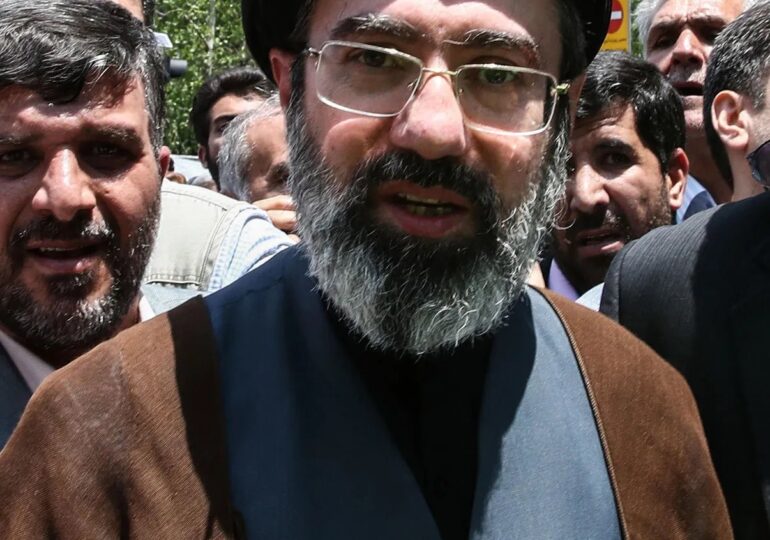
Mojtaba Khamenei, the Supreme Leader of the Islamic Republic of Iran, continues to remain elusive. He disappeared after his father and predecessor as Supreme Leader, Grand Ayatollah Ali Khamenei, was assassinated in an American-Israeli attack in February.
Neither Mojtaba’s inauguration as Supreme Leader nor even his father’s state funeral were enough to bring him out of the shadows, even for a moment, writes Newsweek.
If all reports are to be believed, it paints a picture of a disfigured but only slightly wounded Khamenei Jr. in Iran and at the same time in Moscow. Powerless, yet running the country from behind the scenes. Dead and alive at the same time. A true paradox worthy of Schrödinger's cat.
Regardless of the situation, his absence continues to complicate Tehran's efforts to govern and negotiate a truce with the White House... or does it actually complicate them? Perhaps the Islamic Republic does not need a Supreme Leader. At least not a physically present one.
To better understand the significance of Khamenei's disappearance for Iran's war and negotiations with the United States, for the internal balance of power, and for Iranian society as a whole, Newsweek conducted interviews with three experts.
In some respects, their responses were almost as diverse as the speculations about where Khamenei might be. Descriptions of Mojtaba ranged from "an almost mythical leader" to "a boiled potato."
Nevertheless, each offered fascinating perspectives on what is actually happening on the streets of Tehran and in the corridors of power—and on the question of whether Mojtaba will ever return.
The past few months have been quite chaotic, between bombings, threats to close the Strait of Hormuz, and the dangerous proximity to a global energy crisis.
From Leader to Legend?
For most states, the disappearance of the head of state, with no idea of when he might return, would be inconceivable. Imagine if Donald Trump (who just this week warned again of a "massive attack" against Iran) were to disappear for months and no one heard from him except through a few written statements.
Setting aside this hypothesis, the idea is as follows: for many Iranians, Mojtaba's absence may not be a problem. On the contrary, given that around 90% of the population is Shiite Muslim, it could give him an almost supernatural aura.
"Shiite Islam maintains that the Twelfth Imam—the messianic figure whose return is awaited at the end of times—has been absent from the seen world for over 1,200 years. This messianic figure does not need to be physically present among the faithful; guidance can be sought through spiritual, metaphysical, and doctrinal means," said Peiman Salehi, an Iranian political analyst based in Tehran.
The assassination of Ali Khamenei makes him remembered by Iranians in "mythical terms."
Mojtaba, who communicates occasionally to the public, could become a spiritual symbol around which Iranians rally: not a leader involved in day-to-day decisions, but rather a nationalist and ideological symbolic figure, communicating almost like sacred texts.
Khosro Isfahani, Research Director at the National Union for Democracy in Iran and a specialized investigator at the Atlantic Council, agrees—but with a very important caveat. He believes that the military and intelligence leaders dictating Tehran's policy are deliberately trying to cultivate Khamenei's image as an "absent Imam" to strengthen their own control and power.
"Mojtaba is a young cleric devoid of authority, with the charisma of a boiled potato. He is a weak orator and incapable of controlling the Islamic Republic and managing all internal tensions as his father did. No one takes him seriously.
His absence is a blessing for the regime... it turns him into a blank canvas. It allows the regime's security forces and the intelligence services of the Islamic Revolutionary Guard Corps (IRGC) to project onto him whatever image they desire," he said.
Isfahani, who has spent over a decade researching the Islamic Republic from within Iran through open-source analysis, emphasized that Mojtaba spoke and wrote so rarely before his father's death that there is not enough linguistic corpus to verify if the statements attributed to him were indeed written by him.
"The true holders of power in Iran—the ones who control the weapons and the megaphone of the Islamic Republic's mass media—believe that the symbol of a Supreme Leader serves the regime's long-term interests. Fourteen centuries of belief in an absent Imam have prepared the Iranian people for this moment, and the regime will capitalize on it."
In the most pessimistic scenario, the Islamic regime, which Isfahani describes as "monolithic," could exploit this religious and spiritual symbolism to mobilize the most radical elements to commit acts of terrorism.
Filling the Power Vacuum
It is possible for Mojtaba to endure as a mythical leader, even if not as a physically present one. However, one thing can be said with certainty: Khamenei Jr. is not his father.
Since the death of the first Supreme Leader of the Islamic Republic, Ruhollah Khomeini, in 1989, the various branches and factions of Iran's political and security establishment have constantly fought for influence, power, and favors. However, ultimately, the final decision always belonged to one man—and only one.
Ali Khamenei spent about six decades shaping the structure of the Islamic Republic from within the system. He knew everything about everyone: what people valued, what they desired, what they believed in, and perhaps most importantly, what compromising secrets they hid. This unparalleled level of knowledge and influence guaranteed him supreme authority.
Mojtaba does not benefit from any of this. Even if he remains physically and mentally healthy and continues to act behind the scenes, the death of his senior Khamenei triggered a power struggle in Tehran that Mojtaba is actually incapable of controlling.
"Iran is no longer governed top-down—there is a competition between the leadership of the Islamic Revolutionary Guard Corps (IRGC), the Supreme National Security Council, Parliament, the Presidency, the diplomatic apparatus, and the clerical establishment," said Andreas Krieg, Middle East expert and Associate Professor at the King's College London School of Security Studies.
"The most obvious winner is the IRGC. They control the instruments through which any political authority becomes real: military operations, intelligence services, and internal repression apparatus... (IRGC Commander-in-Chief) Ahmad Vahidi and the extended leadership of the security apparatus occupy the space that a functional Supreme Leader would normally control, increasingly managing the political system rather than safeguarding it."
Iranian Parliament Speaker Mohammad Bagher Ghalibaf also seems to have capitalized on Mojtaba's absence. He has taken on the role of the primary negotiator with the United States and serves as a bridge between the IRGC and Parliament. However, Krieg warns that Ghalibaf remains dependent on the Revolutionary Guards to implement any agreement that may be reached.
Increasingly Aggressive Negotiations
Iran has suffered significant losses from US military attacks, but continues to withstand missile and drone strikes, using its control over the Strait of Hormuz and its ability to pressure Washington's Arab allies in the Gulf to secure a more advantageous deal.
What began primarily as a negotiation to abandon the nuclear program in exchange for lifting sanctions has turned into a complex set of Tehran's claims, including the demand to exercise new authority over the Strait of Hormuz—a position far from what the White House considers acceptable.
This is partly due to Iranians understanding better the disproportionate influence that control over a vital maritime route provides, as well as the effectiveness of their asymmetric warfare strategy.
"The West, and especially President Trump, seems to believe that Iran's interest in controlling the strait is limited to collecting fees and generating revenue. In Iran, this is at most a secondary concern," said Salehi.
"The political and social pressure for Iran to control the Strait is driven by what Iranians have directly observed during the war: how quickly Western governments changed their tone after the strait was closed. Control over it must be maintained as a tool of pressure on the West."
According to experts, this is also another consequence of Mojtaba's absence. Tehran's hesitant yet escalating attitude in negotiations with the Trump administration reflects the internal power struggle.
"Ghalibaf and Foreign Minister Araghchi want Washington and regional mediators to consider them indispensable interlocutors. The IRGC wants foreign governments to understand that no agreement can survive without its consent. The ultra-radicals want to show that they can impose political costs on anyone willing to compromise. As a result, negotiations have become yet another battleground for internal power consolidation," explained Krieg.
What Does the Population Want?
After the assassination of Ali Khamenei, Trump believed that the disappearance of a symbolic leader could trigger regime change and called on Iranians to rise up against the authorities. However, this revolution did not materialize.
If Mojtaba had succeeded his father in peacetime, in a carefully orchestrated transition, it is possible that the population would have rejected such a dynastic succession in favor of an inexperienced and unqualified cleric. However, the circumstances under which Mojtaba became Supreme Leader had a unifying effect, says Salehi.
"Iranians took to the streets in support of the regime for almost 150 consecutive nights—many of them the same women and young tattooed individuals who, in 2022, protested against the Islamic Republic," Salehi said.
"Iran is a society that unites in the face of foreign aggression, regardless of internal grievances. When economic difficulties increase, people can protest, criticize their government, and even consider political change. But when a foreign power attacks Iran, the entire logic changes."
Under these circumstances, he says, the population is willing to accept the absence of Khamenei, to continue to support the Supreme Leader, and society will "function efficiently" as long as statements are periodically published in his name.
Isfahani agrees that Mojtaba's prolonged absence will be tolerated, not due to popular support, but because the new holders of power in the regime desire it.
"In the West, we believe that every position in the state must have a purpose and be held by popular and legitimate individuals. High-ranking officials of the Islamic Republic have repeatedly stated that popularity has no connection to how they govern," says Isfahani.
"There may have been a small group of people who, after the death of senior Khamenei, wondered if a Supreme Leader was still needed. However, those in power believe that this role serves the long-term interests of the regime as a symbol and, therefore, will not change anytime soon."
However, Krieg is more reserved. The legend of the wounded leader may work for a while. But even legends need public appearances, speeches, and visible acts of leadership.
Seriously speaking... Will he ever return?
"I don't believe Mojtaba has left Iran. He lost his wife, sister, and father in this conflict. If exile were a viable option for him, his father would have chosen it first and saved his family from death," says Salehi.
"I see no compelling reason to believe the Israeli and Saudi claims that he was clandestinely taken out of the country. The main reason for his absence is not his health condition, but security: the uncertainty about the resurgence of war and the very real and well-documented threat of an assassination attempt against him, reiterated just two weeks ago by the Israeli press, which cited an Israeli official stating that Mojtaba is on a hit list."
Krieg agrees that Mojtaba is most likely in an extremely tightly controlled security environment and gives little credence to rumors that he has died. However, he finds plausible the information that Khamenei has suffered severe injuries, significantly reducing his ability to move, communicate, and lead.
"He may be able to approve certain decisions on a case-by-case basis, but without being able to sustain the workload, mobility, or public exposure required by the position of Supreme Leader."
It is plausible that he has been transferred abroad for specialized medical treatment or for protection, but this information has not been verified and comes from parties interested in portraying Tehran as being devoid of leadership."
Regardless of the extent of Mojtaba's capabilities or injuries, it is almost certain that his security depends on the IRGC chiefs and members of Iran's Ministry of Intelligence. All three experts agree that this small group likely controls the flow of information reaching Khamenei, limits the number of people who can communicate with him, and shapes the statements issued in his name to serve their own interests.
This puts him in a no-win situation. Greater freedom and public exposure increase the risk of assassination, but isolation destroys his ability to exert the influence he inherited.
If Mojtaba fails, whether due to injuries or lack of competence, to break free from this dependency, he will have very little or no real power to set the future direction of Iran. His leadership will be devoid of substance, even if a large part of the population continues to support it.
And this may be exactly what the current shadow rulers of the Islamic Republic want.