
NATO is ready to respond to any Russian aggression against an allied state and to inflict much greater losses on Moscow than any advantage it could gain. At the same time, the alliance is rapidly changing the way it prepares for war, drawing inspiration from the lessons learned by Ukraine.
Western intelligence services are increasingly warning about the risk of Russian provocations against the eastern flank of NATO, and the United States is considering reducing its military presence in Europe.
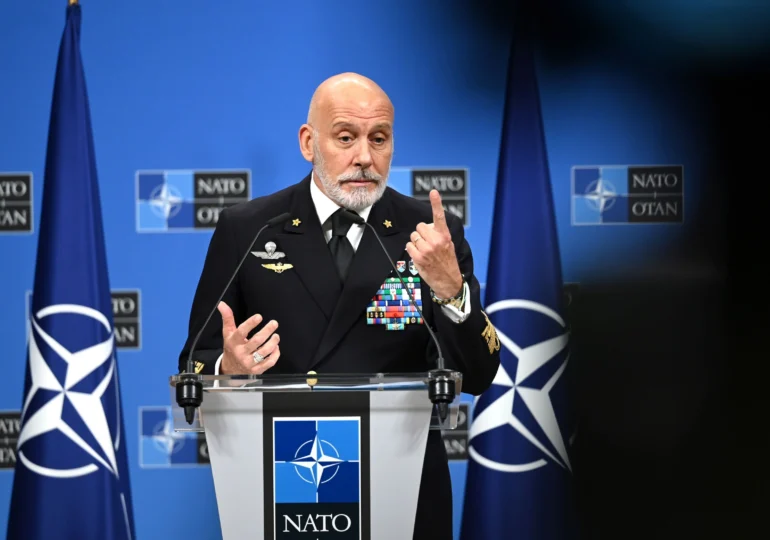
In an interview with the publication Kiev Independent, the President of the NATO Military Committee, Italian Admiral Giuseppe Cavo Dragone, states that the alliance is prepared to deter any Russian attempt to test collective defense and explains how the war in Ukraine is profoundly changing Western military doctrine.
"Russia would lose much more than it would gain"
Asked how realistic the scenario of a Russian attack on Poland or the Baltic states is, Cavo Dragone replied that NATO treats Russia as a threat precisely because such a step cannot be ruled out.
"Today, Russia would lose much more than it could gain by targeting Poland or the Baltic states. We are prepared," the military official declared.
He emphasized that the alliance's objective is to make any hostile action so costly that Moscow would be deterred from attempting it.
NATO learns from the war fought by Ukraine
The NATO military chief says that the war in Ukraine has become an essential source of lessons for the alliance.
The experience gained by the Ukrainian army in using drones, electronic warfare, and quickly adapting to new technologies is being analyzed by the Joint Analysis, Training, and Education Center (JATEC) in Poland.
According to Cavo Dragone, NATO is already modifying its procurement plans to combine sophisticated weapons with cheap, mass-produced systems that Ukraine has shown to be extremely effective on the battlefield.
Ukraine starts to gain ground, says NATO official
Asked about the evolution of the war, Giuseppe Cavo Dragone states that he shares the assessment that Ukraine is going through a more favorable period.
"Ukraine is gaining something, not losing," he says, noting that Russia's increasingly aggressive reactions could be fueled by frustration.
Regarding how the war could end, the official believes it is too early to talk about the recovery of all occupied territories or a capitulation by Russia. In his view, NATO's priority remains to achieve a ceasefire and begin negotiations for a lasting peace.
Europe needs to be prepared for a greater role
The interview also addresses the possibility of reducing the American military presence in Europe. Cavo Dragone says that the United States needs to allocate its resources across multiple regions of the world, but he argues that NATO is preparing a coordinated transition so that European allies gradually assume some responsibilities.
"We are proceeding so that European allies can cover any gaps left by the United States. It will be a coordinated process that we will manage together," the NATO official asserts.
He identifies strategic airlift, long-range precision strikes, electronic warfare, and intelligence, surveillance, and reconnaissance (ISR) capabilities as the most critical vulnerabilities, areas where the US currently plays an essential role.
Ukrainian industry, an advantage for NATO
The military official believes that allied states should continue arms deliveries to Ukraine and also directly invest in its defense industry.
He notes that Ukrainian manufacturers can introduce new equipment on the front lines much more quickly because they are tested and validated directly in real combat conditions, while in NATO countries, certification procedures can take between one and three years.
In his opinion, Ukraine is no longer just a recipient of Western support but has already become a security provider for the entire alliance.
G.P.