
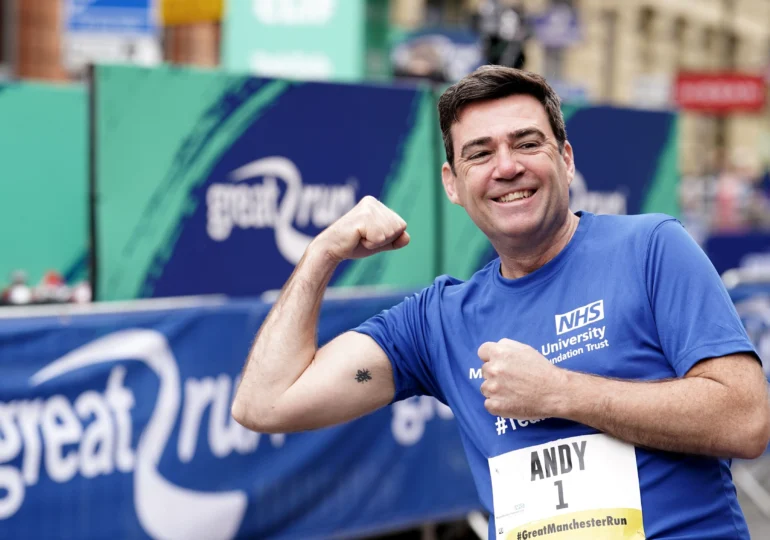
Andy Burnham’s political success depends on his ability to steer the United Kingdom away from the wave of nationalist populism that brought Donald Trump to the forefront of global politics.
However, this has not stopped the future Prime Minister of the United Kingdom from studying the rise of the American president and – intentionally or not – adopting some of his methods for the political confrontations with the right that await him, writes Politico.
"Trump is very unpopular in the UK," said Luke Tryl, executive director of More in Common UK, a think tank and polling institute. "But even people who can't stand him say: at least he does what he says he will do." The fact that he is perceived as being constantly active is something Burnham "can learn" from anti-system populists like Trump, Tryl added.
Burnham, the new leader of the center-left Labour Party, assumes the role of Prime Minister of the United Kingdom on Monday. He has been propelled to leadership by his colleagues, who fear that the party could be crushed in the next general election after months of mistakes and scandals under the leadership of the incumbent Prime Minister, Keir Starmer.
- The Prime Minister of the United Kingdom has announced his resignation. Keir Starmer presented the timeline for what comes next
- Who is Andy Burnham, the politician preparing to take Keir Starmer's place
The extreme right populist party Reform UK - founded five years ago and led by Trump's ally Nigel Farage - has achieved spectacular results in recent elections across the country, shattering traditional Labour strongholds and leading in national polls for over a year.
Labour MPs hope that Burnham can be the outsider with a fresh image to rebuild the party's deteriorated relationship with increasingly cynical voters they have lost. For years, he has been clear about what is at stake for the party: if Labour fails, British politics risks following the example of the United States and electing its most right-wing government in history.
"Whether we like it or not, Donald Trump and Nigel Farage have managed to connect with people who feel neglected by politicians," wrote Burnham and his co-author, Steve Rotheram, in their 2024 book, Head North. To meet the needs of millions of working-class voters, they argued, the Labour Party must "fight against the radical right on the very ground it claims to master."
It all starts by harnessing the rejected outsider's anger. There are signs that both Trump and Burnham are motivated by personal resentments towards the political elites who once looked down on them and the desire to overturn the old hierarchy of snobs.
Many commentators have noted that Trump's experience, facing the disdain of America's wealthy and influential elites when he was a real estate developer, fueled his political mission. The essential point is that Trump's ability to convey the sense of being rejected by the establishment resonated with voters who feel abandoned by the same elites.
Burnham has been, so to speak, even more direct than Trump about his own frustrations. In Head North, Burnham, then Mayor of Greater Manchester, and Rotheram, Mayor of Liverpool, described how they were treated as "second-class citizens" during their time as MPs by the elitist politicians in London: "We want you to know how we felt when we heard those mocking voices in the corridors of power."
In that passage of the book, Burnham and Rotheram were addressing their grandchildren. However, many voters from the northern regions they come from already know what it is like to be ignored by the center.
Burnham never misses an opportunity to present himself as an outsider from the former industrial working-class areas of northern England, and this positioning can work, analysts say. With his regional accent, he appears "authentic" and does not give the impression of being part of the London establishment for many voters who supported the Labour Party two years ago but have since abandoned it, says political consultant Deborah Mattinson, former party strategy director before the 2024 elections.
Mattinson is currently working on new polls and focus groups for the Progressive Policy Institute, a think tank based in Washington. "Essentially, people are very angry and very impatient," she says. "These essential working-class voters are even more eager to see changes and are very skeptical that politicians are capable of delivering them."
To talk to everyone, all the time
Farage dominates the coverage of British politics in the press, while Trump's frenetic activity on social media often sets the global news agenda.
Burnham does not have the same influence, but he uses direct channels to communicate with the public. He frequently posts selfie-style videos in a relaxed and colloquial manner, building an informal image meant to show voters that he is one of them.
"Trump and Farage are constantly communicating with people," says Tryl of More in Common. "They simply talk directly. I think it's very important to be present on multiple channels — X, TikTok, Instagram, and all other platforms — to reach people."
If Burnham manages to establish this connection with voters, what does he want to convey to them?
For now, the details of his political program are unclear. However, his project for the UK, as presented in Head North, focuses on a radical transfer of power from London to communities and regions across the country. Burnham believes that replicating the model by which he led Manchester for nine years as mayor can transform the United Kingdom and restore hope to forgotten communities.
Both Mattinson and Tryl have found evidence that the decentralization agenda can be attractive to voters who feel their regions have been neglected by London.
But both are convinced that Burnham must not lose sight of the public's main concern: the cost of living reduction. For many families, daily expenses have reached unsustainable levels, with inflation accelerating in the years following the pandemic, while wages have not kept pace.
In the United States, Trump paid a political price for the impact of the conflict with Iran on the cost of living. Burnham would do well to take note of this lesson: the cost of living is by far the most important issue for British voters, according to numerous polls and focus groups, fueling the frustration that often turns into anger among those who voted for Starmer in 2024 hoping he would improve their lives.
"There is a real desire for quick actions in the first six months of his term, especially regarding the cost of living," says Tryl. Decentralization may be well received by voters, but Burnham "must tie it to the concrete issues of daily life," adds Mattinson.
The very narrow window of Burnham
Voters are increasingly willing to embrace radical solutions. A focus group conducted last month by Politico in Makerfield, Burnham's new parliamentary constituency, and organized by Public First, showed that voters are skeptical about any politician's ability to improve their lives.
More in Common regularly asks respondents whether British institutions should be preserved and improved or, conversely, allowed to collapse. "Currently, we still have a majority in the camp of those who say 'let's keep and improve them' — 60%," Tryl said last week in Westminster. "But 40% are in the 'let them all burn' camp, and that is a quite worrisome statistic."
Although Trump himself is not popular, many focus group participants appreciate that he seems to get results and do what he says he will do, regardless of the opposition he faces. "People really want a strong leader," adds Mattinson.
Burnham has "an extremely narrow window" to convince former Labour Party supporters to give him another chance, says Mattinson. "He will need to come to the forefront with strength and give the impression of a truly different new government."
Burnham has stated that he wants a more consensual style of politics, collaborating with rival parties, both left and right, to find solutions, rather than just pursuing short-term political gains. However, the biggest risk for him seems to be that the very impatient voters may not be willing to wait for a change in political culture before seeing concrete results.
Perhaps Burnham has already learned from Trump that he needs to make an immediate impact once he takes power, as the American president did at the beginning of his second term this year.
"I am ready," Burnham declared on Friday when he officially took over the leadership of the Labour Party. "I have a plan."