
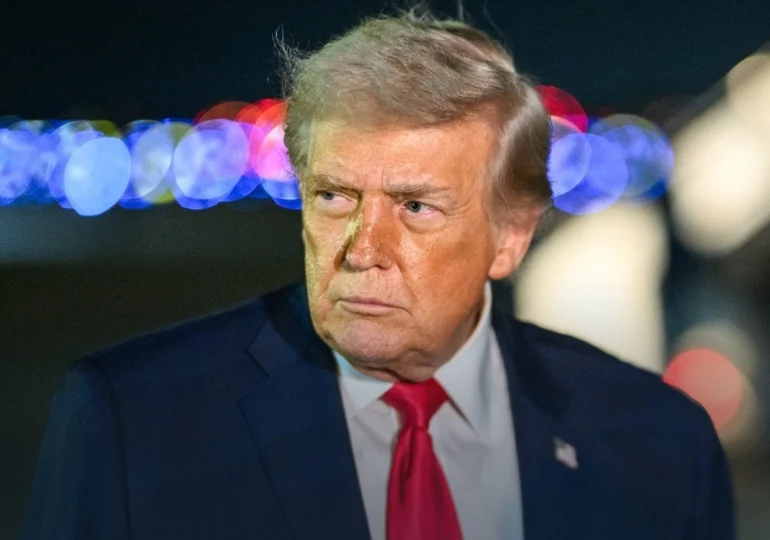
The increase in the number of American soldiers killed and the escalation of the war with Iran bring back to the forefront a long-unanswered question: what is President Donald Trump’s ultimate goal and how does he intend to achieve it?
From the very first strikes, this war has been insufficiently explained by the Trump administration. The return to what looks like a large-scale air war, after the ninth consecutive night of American bombardments, is no exception, writes CNN in an extensive analysis.
The President seems to have resumed the bombings because the personal, political, and economic costs of Iran's most significant success so far - control over the Strait of Hormuz - are impossible for him to accept. However, he has not explained to Americans why he believes this strategy could now be more successful than in the past.
Meanwhile, the significant intensification of American bombings and the extension of Iranian reprisals - the attack in which two American soldiers were killed and one is missing last week took place in Jordan - risk throwing the entire region back into a large-scale conflict.
Jordan, a U.S. ally located east of Israel and west of Iraq, is further away from Iran than American bases in the Gulf states. However, the fact that Tehran managed to hit American troops on Jordanian soil demonstrates that it retains lethal military capabilities, despite weeks of American attacks. On Sunday, Iran accused the U.S. of attacking a nuclear power plant under construction and warned that it would respond accordingly. Israel stated that it is prepared to immediately resume military operations if attacked.
The war with Iran is not yet the kind of "endless war" in the Middle East that the President has repeatedly promised to avoid. But it is far from being a conflict with a predictable end.
How Can Trump Cancel Iran's Greatest Success?
Without an unforeseen change in the political structure of the regime in Tehran, it is not clear how this new series of attacks could significantly reduce its options. The administration has not specified whether the purpose of the new strikes is solely the destruction of Iranian capabilities in the Strait of Hormuz area, which allow Tehran to attack commercial ships, or whether they are laying the groundwork for broader operations, possibly including ground troops.
Another unknown is whether the President is now more willing to target civilian targets as an additional means of pressure on Iran's already affected economy and power structure.
Only time will tell if Trump has the patience to endure the global economic shocks that may follow, before the blockade re-imposed on ships and ports exerts decisive pressure on Iran. Last month, he told Americans that he had reached a preliminary agreement to end the war precisely because he did not want to trigger a new Great Depression. The statement was interpreted as an attempt to limit the political costs for the Republican Party ahead of the November legislative elections.
These questions are all the more relevant as the conflict intensifies nearly five months after Trump claimed to have won it in just a few days, and this new phase seems to aim at rectifying the failures of the initial campaign. Currently, American forces are practically trying to deprive Iran of the ability to use the Strait of Hormuz to hold the global economy hostage.
Before the war, the strait was open to commercial navigation. If Trump fails to restore this situation, he will go down in history as the author of a strategic disaster. However, his options are limited, especially as certain components of the current Iranian regime seem determined to continue the military confrontation.
The President could have explained his new strategy in a speech to the nation last week. Instead, he only made an indirect reference to the war, dedicating most of the intervention to claims that the American electoral system is corrupt, although declassified documents subsequently released by the White House did not support his accusations.
This omission only served to increase strategic uncertainty.
More American Victims
The losses suffered by the U.S. in the war with Iran do not compare to those in the conflicts in Afghanistan and Iraq. However, each soldier fallen in battle destroys a family, and each victim increases the political leaders' responsibility to demonstrate that the mission justifies the sacrifice.
On Friday, two American soldiers were killed in an Iranian attack on an American base in Jordan, and a third is missing. On Saturday, an American soldier died in northern Iraq during the controlled detonation of unexploded ordnance from a downed Iranian drone. The total number of American soldiers killed has thus reached 17. It is presumed that the number of civilian casualties in Iran is higher, but the international press cannot independently verify this information.
Trump reacted to the deaths of the first two soldiers in an interview with the New York Post. He described the losses as "a tragedy" and said he would contact the families of the fallen. In an interview with NewsNation, he stated, "We are deeply saddened when such things happen."
The most clear explanation given on Sunday by the administration regarding its actions came from U.S. Secretary of Energy, Chris Wright. In the ABC News program "This Week," he stated that the President's objective is "weakening Iran's ability to terrorize the world, hold global trade hostage, as it currently does, and preventing Iran from obtaining nuclear weapons. This objective has not changed."
Wright disputed claims that oil traffic through the Strait of Hormuz had been nearly completely blocked. However, public data from the maritime monitoring agency MarineTraffic shows that the number of ships transiting the strait dropped to just eight on July 16, down from 15 the day before. Before the outbreak of the war, approximately 116 ships crossed this essential maritime route daily.
Republican Congressman Michael McCaul from Texas stated on "Fox News Sunday" that the U.S. military is "winning the war against Iran." He added, "We paused to negotiate a ceasefire and an agreement."
McCaul was referring to the memorandum of understanding that Trump claimed met all U.S. objectives but partially collapsed as Iran wanted to demonstrate control over the Strait of Hormuz. According to McCaul, the "fundamental objective at this moment" is the destruction of Iranian launch pads and drones.
In the CNN program "State of the Union," Democratic Senator John Fetterman, who has distanced himself from part of his own party by supporting the war and Israel, stated that Trump should continue the operations. "I think it is fully justified to continue the confrontation with Iran," he told Jake Tapper.
Is There a Way Out?
The current debate in Washington about the war, like Trump's public statements, seems to only highlight a vicious circle. Attacking Iranian positions around the Strait of Hormuz and civilian targets, such as bridges used for military purposes, may temporarily reduce the threat posed by Tehran. However, in an era of drones, where only a few missiles are enough to deter ships from transiting the strait, the question arises whether the U.S. military will ever be able to reduce the risks to an acceptable level.
Criticizing Trump for the war may be an effective political argument for Democrats ahead of the legislative elections. However, it does not offer a solution to end the conflict. If political pressure will lead Trump to withdraw, the global economy will remain practically hostage to an authoritarian regime in Tehran. Moreover, there is no indication that Iran would accept through diplomatic negotiations concessions considered sufficient by the United States and the international community.
The current strategy of escalating bombings may work for a while. However, without repeated returns to military actions, Trump or the future President of the United States may face difficulties in guaranteeing the definitive elimination of the Iranian threat. And in the absence of transparency that could be provided by a verifiable nuclear agreement through international mechanisms, the possibility cannot be excluded, even theoretically, that the Islamic Republic may accelerate the development of a nuclear weapon.
Perhaps this apparent lack of solutions explains Trump's new strategy: escalating the conflict without a clear final objective.
Retired American Admiral James Stavridis told Jake Tapper that all of Trump's options are unfavorable. Iran "doesn't have a very good hand of cards, but they're playing surprisingly well... in a way that echoes the North Vietnamese in the Vietnam War or the Taliban in Afghanistan," Stavridis said. "They are trying to convince us that this conflict is not worth the costs and that, ultimately, we will give up."
He continued: "I don't think they will succeed with this strategy, but it is clear that this is their plan. And so far, they have at least managed to stay in the game and continue the confrontation."