

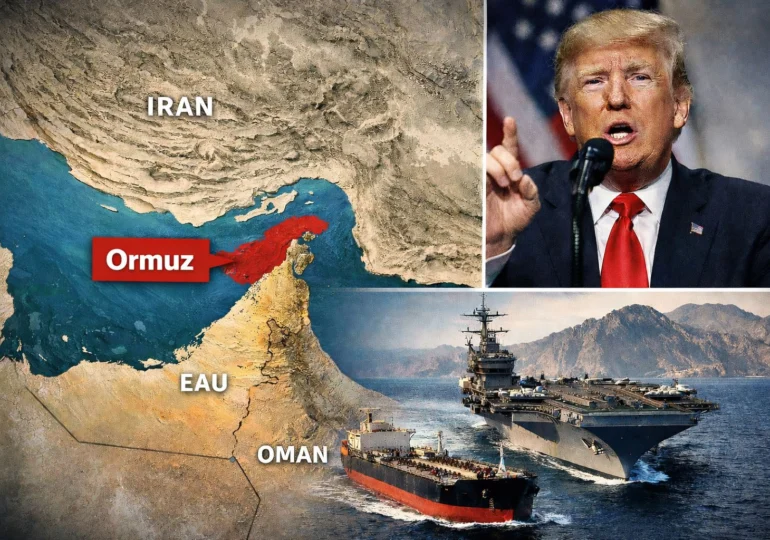
Amid escalating tensions with Iran, the Donald Trump administration seems to be caught in a deadlock: military strikes have not brought Tehran back to the negotiation table, and diplomatic efforts have failed. In this context, an idea is beginning to take shape that could offer a way out of the crisis caused by the blockade of the Strait of Hormuz, one of the most important maritime routes for global oil transportation.
According to CNN, discussions are being held in diplomatic and academic circles about the possibility of establishing an international mechanism through which the Persian Gulf littoral states, including Iran, would jointly manage the traffic through the strait and share the revenues generated by maritime services, without Tehran gaining exclusive control over it.
Although the idea is far from becoming a reality, it reflects the lack of viable alternatives for Washington and the increasing pressure exerted by the economic consequences of the war.
Neither war nor diplomacy have worked
The United States has launched new strikes on Iranian targets in recent days, after Donald Trump warned that Iran would receive "a new blow." However, Tehran has not returned to negotiations.
At the same time, the diplomatic attempt previously supported by the American administration collapsed with the failure of the negotiated memorandum of understanding between the parties.
Thus, the White House faces a difficult choice: either risk military escalation, including a possible ground war that would endanger hundreds of American soldiers, or accept, at least implicitly, that Iran exercises control over the Strait of Hormuz.
"We are in a very difficult situation," says Lyle Goldstein, Asia director at the American think tank Defense Priorities, as quoted by CNN.
Consequences extend far beyond the Middle East
The impact of the conflict goes well beyond the directly involved states.
If the Strait of Hormuz remains closed to most civilian traffic, global oil reserves will continue to decline, and prices of oil, diesel, and fertilizers will rise. Europe even faces a potential shortage of liquefied natural gas during the winter.
At the same time, Gulf states are losing their attractiveness as destinations for investments, tourism, and expatriates, while European governments are affected by new price hikes.
Even Trump is not immune to the political costs. A CNN/SSRS poll published on Wednesday shows that less than 30% of Americans approve of his Iran policy and handling of fuel prices, a level that could seriously impact the Republican Party in the midterm elections.
Discussed compromise: joint administration of the Strait of Hormuz
In the absence of a clear military solution, several experts propose a compromise.
The idea analyzed by the Bourse and Bazaar Foundation, an analysis center in London, involves creating an international institution through which the Persian Gulf littoral states would jointly manage the traffic through the Strait of Hormuz and collect fees for maritime services provided to commercial vessels.
The model would be inspired by the administration of the Strait of Malacca, between Singapore, Indonesia, and Malaysia.
The proposal does not involve the introduction of a transit fee per se, as international law guarantees freedom of navigation through international straits. Instead, fees could be charged for maritime services, a formula that Oman also promotes in discussions with Iran.
The study authors estimate that such a system could generate approximately $26 million annually, even before a potential increase in fees.
Iran could accept if it also gains a political advantage
Esfandyar Batmanghelidj, one of the study's authors, believes that for Tehran, the political and economic benefits would be more important than the actual revenues. According to him, an agreement with the United States could pave the way for lifting sanctions and resuming Iranian oil exports.
At the same time, Iran could argue that the war did not end in defeat, as the status of the Strait of Hormuz has changed, and its regional influence has been maintained.
Europe could become indispensable
CNN points out that such a compromise would require the involvement of external actors, and Europe could play a significant role.
The problem is that relations between Washington and European allies have deteriorated significantly during Trump's second term. European leaders have criticized American military intervention, and the White House has accused them of not participating in operations.
Moreover, any diplomatic initiative is complicated by the lack of a clear strategy from the American administration. "It's one thing to ask Europe to support an agreed-upon strategy and another thing is the current situation, where it's not even clear what the United States' strategy is," says Ian Lesser from the German Marshall Fund.
According to the cited source, Iran does not reject proposals conveyed through Oman, but it is not willing to relinquish control of the strait as long as the United States continues military escalation.
CNN's analysis indicates that in the absence of convincing military or diplomatic options, Washington and Tehran could ultimately be pushed towards a compromise that neither party truly desires, but both may consider preferable to continuing the war.