
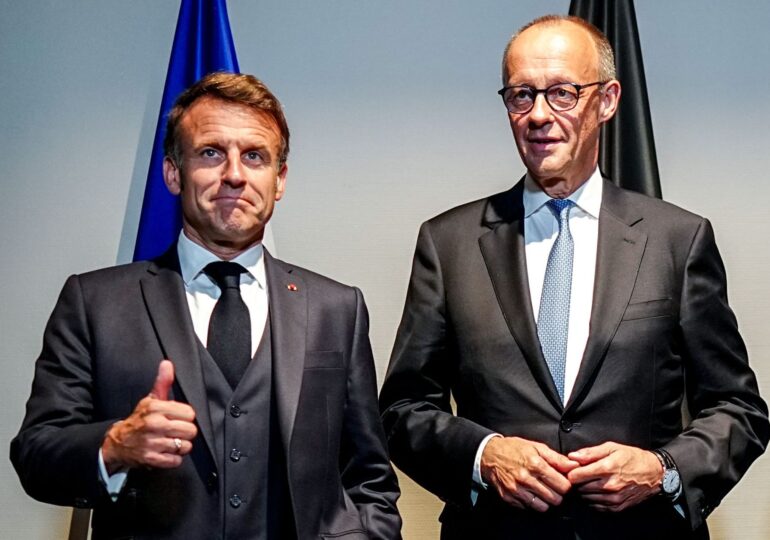
Following joint ministerial meetings held in Germany last week, the leaders of the two largest economies in the European Union, German Chancellor Friedrich Merz and French President Emmanuel Macron, have urged their governments to conclude a comprehensive agreement aimed at strengthening Europe’s industry and reviving the bloc’s automotive sector — key priorities for both countries.
The pact would combine France’s efforts to reserve more public procurement contracts and subsidies for the European industry with Germany’s initiatives to rescue its struggling automakers, whose crisis has become acute after Volkswagen recently warned it could cut up to 100,000 jobs globally, as reported by Politico.
The agreement would involve Berlin supporting stricter "Made in Europe" provisions, as requested by Paris under the EU's Industrial Strategy Act. These would limit which trading partners can obtain "trusted partner" status equivalent to the Union's in key public procurement and subsidy programs.
In return, France would agree to relax the EU's planned gradual phase-out by 2035 of new cars with internal combustion engines, as requested by Berlin.
"We have been entrusted with the task of building a comprehensive agreement on these issues," said French Industry Minister Sébastien Martin to Politico. "It would be ideal to have an agreement in the fall. I am confident that we could also convince other countries, such as Italy. All states are waiting for a Franco-German agreement."
Two high-ranking German officials, who requested anonymity as they were not authorized to speak publicly, confirmed that the pact is under negotiation.
Officials on both sides of the Rhine emphasized that the exact terms of the agreement are still to be negotiated, with discussions at an early stage. It is likely that both parties will need to make further concessions to reach a final agreement.
Negotiations will continue throughout the summer, with the aim of reaching an agreement ahead of a meeting of EU Industry Ministers on September 24 and a summit of EU leaders on October 15–16, according to Martin.
The discussions will coincide with difficult negotiations between the EU and China on how to rebalance the bloc's bilateral trade deficit, estimated at 1 billion euros per day.
Meanwhile, European governments and parliamentarians are grappling with the text of the industrial act, which European Commission President Ursula von der Leyen aims to adopt by the end of the year.
Read the full analysis France and Germany negotiate a major agreement on the automotive industry and "Made in Europe" rules on Curs de Guvernare