
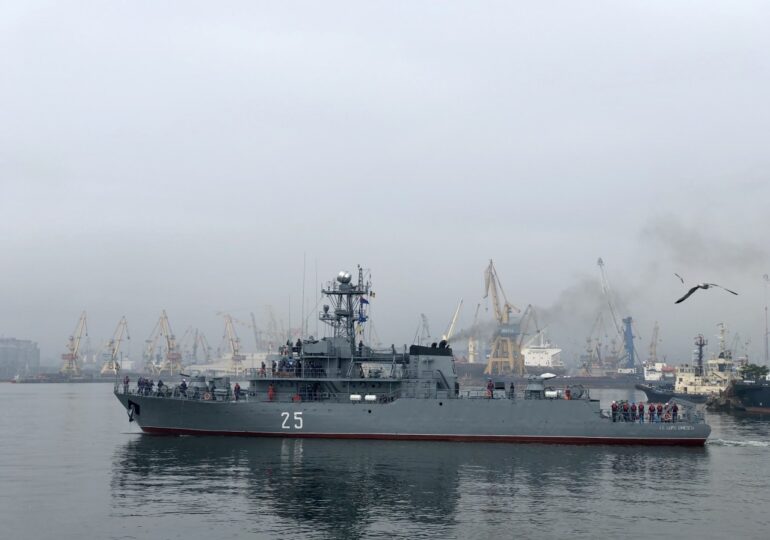
Bulgaria, Romania, and Turkey are trying to lower the temperature of the conflict in the Black Sea, where about 250 commercial ships have been attacked since the beginning of the Russian invasion of Ukraine, most of them this year.
A ship located 25 kilometers from Sulina requested assistance this morning, after a fire broke out on board. Several sailors are missing, and the incident was reported after 4 F-18 and F-16 fighter jets were deployed last night, immediately after radars reported a group of drones between Serpents Island and Sulina.
It is the second such event in 12 hours. The maritime risk firm Ambrey has counted at least 45 commercial ships attacked in 12 months in areas that were previously not considered high risk, compared to none in the previous period.
In August, the aerial warfare reduced the grain exports of both Ukraine and Russia by two-thirds, and Moscow rejected the naval armistice offered by Kiev.
At the end of September, the Turkish Chamber of Maritime Commerce counted 226 civilian ships attacked since the beginning of the war, with over 70% in 2026. 30 ships owned by Turks have been hit since June, according to data from Ankara.
Attacks in the Exclusive Economic Zones of the Black Sea
Drones from the Russo-Ukrainian war increasingly threaten the coastlines of Romania and Bulgaria, while Turkey considers attacks on commercial vessels "unacceptable."
The National Security Advisory Council in Sofia has classified the attacks as a "serious violation of international law" and has requested urgent consultations with Bucharest and Ankara since last week.
Bulgaria and Romania have already jointly requested support from the European Maritime Safety Agency. Bulgarian President Iliana Iotova stated that together with the Romanians and Turks, they have prepared a joint document to put the Black Sea on the agenda of the EU leaders' meeting, which begins today, with the aim of a moratorium on the use of drones against commercial ships and civilian infrastructure.
In Bulgaria's exclusive economic zone, 4 ships have been hit in 8 days.
On October 6, the first attack on a ship under the Togo flag occurred, which sank, followed by an attack on a vessel under the Palau flag, which caught fire. Both had Turkish owners and were hit by aerial and naval drones. Between October 12 and 13, another vessel, owned by a Ukrainian company, was hit 20 kilometers from Byala and another 25 kilometers from Krapets.
In Romania, at the beginning of June, a Ukrainian drone that got out of control exploded near the port of Constanta, and on August 11, two Gerbera drones were destroyed near the Neptun Deep platform.
Then, on August 20, a Russian naval drone loaded with explosives was detected about 100 kilometers from Constanta and destroyed by an F-16. On October 5, a ship owned by a Turkish owner loaded in Ismail with corn sank about 10 kilometers from the Pescarus platform and about 25 kilometers from the shore.
On October 14, near Sulina, in Romanian territorial waters, an empty ship under the Comoros flag caught fire, while several drones entered Romanian airspace.
In Romania, Russia's Stake Seems Greater Than in Bulgaria
What is understood from the attacks on ships passing near the coasts of the Black Sea in the vicinity of Romania and Bulgaria?
1) Bulgaria has 4 ships hit, 2 sunk, 21 dead and missing sailors;
2) in Bulgaria, only commercial ships were hit, while in Romania, the list includes energy infrastructure, so the stake in Romania has strategic implications;
3) the attacks are approaching the shore in both states, and if drones constantly enter territorial waters, the last secure corridor could disappear;
4) there is a Danubian pattern of attacks, as the ships hit in October had connections to Danube ports: the target seems to be the Danube-coast corridor, hence, Romania and Bulgaria are hit as a single area;
5) unlike Romania, which seems to be on standby regarding the attacks in the Black Sea, Bulgaria has moved, institutionally, faster and further: it has convened the Security Council, called the Russian ambassador to order, and sent letters to NATO and the EU;
6) the Prime Minister of Sofia, Rumen Radev, does not want to accuse either Ukraine or Russia of the attacks in Bulgaria's exclusive economic zone, stating that together with Turkey and Romania, they will seek US support to examine the wrecks to determine the origin of the drones that hit civilian vessels. Romanian officials, when unsure if the attack came from Russia, prefer to remain silent and say nothing;
7) the insurance of civilian ships passing through the Black Sea has increased several times, according to brokers cited in the international press
Why NATO States in the Black Sea Do Not Agree
In January 2016, Romania proposed the formation of a NATO fleet in the Black Sea together with Bulgaria and Turkey. The idea had the support of Turkey, the United States, and NATO headquarters, but the Bulgarian Prime Minister rejected it, citing a Russian warning and stating that he did not want a war in the Black Sea.
After ten years, the configuration reversed: in 2016, Ankara, in a temporary crisis with Moscow, supported NATO's presence in the Black Sea, while Sofia boycotted it. From 2022, Turkey closes the sea to non-coastal fleets and becomes oscillating towards Moscow again, and Bulgaria leads the trilateral diplomatic offensive. President Nicusor Dan merely responds to Sofia's initiative.
The positions of the 3 NATO states in the Pontic area vary according to each one's relationship with Russia. Therefore, a common doctrine in the Black Sea might be necessary.
The problem is that there is an asymmetric relationship between the three: an Atlantic Council report from 2024 highlighted that Turkey was the only coastal NATO member to modernize its fleet at the pace of Russia, and the MCM Black Sea, the operational group formed by Romania, Bulgaria, and Turkey for mine warfare and maritime security, confirmed its status as the main maritime security provider.
Romania's naval forces are 6 times smaller than Turkey's, and Bulgaria's forces are even more deficient.
The Asymmetric Relationship of Romania and Bulgaria with Turkey, the Stronger Party
In an asymmetric relationship, the weaker party always has more to lose and pays disproportionate attention to the relationship, while the stronger party looks at things superficially, somewhat inattentive, caught up in more important matters on the stage.
The difference in attention produces distorted mutual perceptions: the weak one sees in the non-involvement of the strong one contempt or hidden calculation, while the strong one sees in the insistence of the weak one exaggeration. The relationship remains stable if the strong one acknowledges the autonomy of the weak one, and the weak one shows deference. This is how the relationship with Ankara is seen from Sofia or Bucharest. And vice versa.
At the Montreux Conference in 1936, where Turkey officially took over the keys to the Straits, Nicolae Titulescu framed the situation in geopolitically relevant terms still valid today: the Straits are the "heart of Turkey," but also the "lungs of Romania," meaning the country's only outlet to the global ocean.
For Bulgaria, it is the coastline on which energy and tourism depend. For Turkey, the Black Sea is a theater among others (Middle East, Caucasus, Eastern Mediterranean) and is included in the relationship with Russia, which Erdogan called "Our Black Sea" in September 2023 in Sochi.
This explains Ankara's equidistant language regarding the urgency in Sofia and Bucharest. The risk is that the Black Sea could become a Russo-Turkish lake.