

The past of the Securitate continues to stir controversy in Romania, almost 37 years after the fall of communism. Former members of Ceaușescu’s regime structures remained in state institutions even after the Revolution, and the influence of intelligence services on political and economic life continues to raise questions.
In an analysis published on Monday, Le Monde examines this legacy, starting from revelations about the past of General Lucian Pahonțu, who has been leading the Protection and Guard Service (SPP) since 2005.
The French publication points out that the investigation by Recorder on August 26, which documented Pahonțu's presence in the repressive structures of the communist regime, has reignited mistrust in state institutions during a period marked by political crisis.
Le Monde also mentions the reaction of President Nicușor Dan, who rejected the conclusion that Pahonțu participated in the repression of protesters, despite the documents presented by journalists.
A "systemic failure" after the fall of communism
Historian Stejărel Olaru explains to Le Monde that Romania did not undergo a clear break from the old communist structures, unlike other Eastern European countries. "The transition justice in Romania was a systemic failure," says the historian, attributing this situation especially to the absence of a lustration law, through which former representatives of the communist regime would have been removed from certain public positions.
This continuity of personnel has, in his opinion, favored the connections between intelligence services, justice, and politics.
Olaru estimates that around 80% of the individuals recruited by the SRI in the '90s came from the former Securitate. The proportion has decreased since then, but the historian emphasizes that the past of some individuals in important positions continues to come to light.
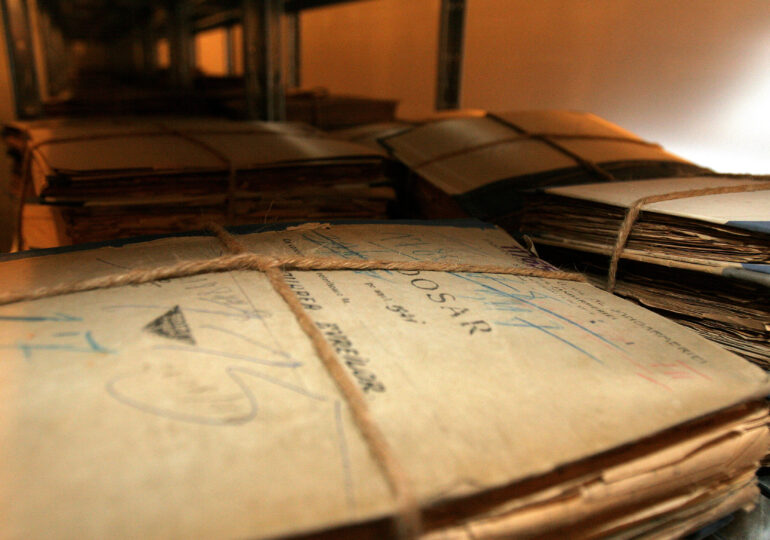
He also mentions the difficulties faced by researchers in accessing archives. Some documents were destroyed after the Revolution, others were hidden or used for political purposes.
According to the data presented in Le Monde's analysis, the Securitate had around 30,000 members in 1989, but relied on a much larger network. At least 650,000 people collaborated with the political police between 1948 and 1989.
How much power do the secret services actually have
Le Monde also addresses accusations that the intelligence services control Romania, forming a so-called "parallel state." Historian Mădălin Hodor, vice-president of the National Council for the Study of the Securitate Archives (CNSAS), believes that the reality is more nuanced. He acknowledges the influence of the services in politics and the economy but rejects the idea that they are all-powerful.
In his view, the issue also lies with the responsibility of politicians who have the obligation to control the activities of the intelligence services. "Without an owner, the dog may think it is free to do as it pleases," explains the historian, using a metaphor in the discussion with Le Monde.
Hodor recalls that the SRI has been without a director for over three years, since the resignation of Eduard Hellvig in July 2023.
Nicușor Dan has repeatedly promised to make a proposal for the leadership of the service but has postponed the appointment. The President explained that he did not want to overlap negotiations for forming a government with political discussions regarding the leadership of the SRI.
The Pahonțu case and Nicușor Dan's reaction
General Lucian Pahonțu was an officer in the Securitate Troops and was part of the unit in the University - Intercontinental area during the December 1989 Revolution, according to documents presented by Recorder.
The unit he belonged to also took part in the intervention against protesters in University Square in June 1990. However, Pahonțu's personal role in suppressing the protests has not been established.
After the investigation's publication, Nicușor Dan defended the head of the SPP, stating that he is not in the position of someone who suppressed protesters. "Mr. Pahonțu is not in this situation," declared the president, who also mentioned the verifications made at the general's appointment 21 years ago.
Meanwhile, the Romanian Gendarmerie confirmed that it holds documents about Pahonțu's activities during the Revolution and the Mineriad, but refused to make them public, citing that they are classified as "service secrets." The institution claims that the documents show that the general fulfilled his duties in a legal manner.