
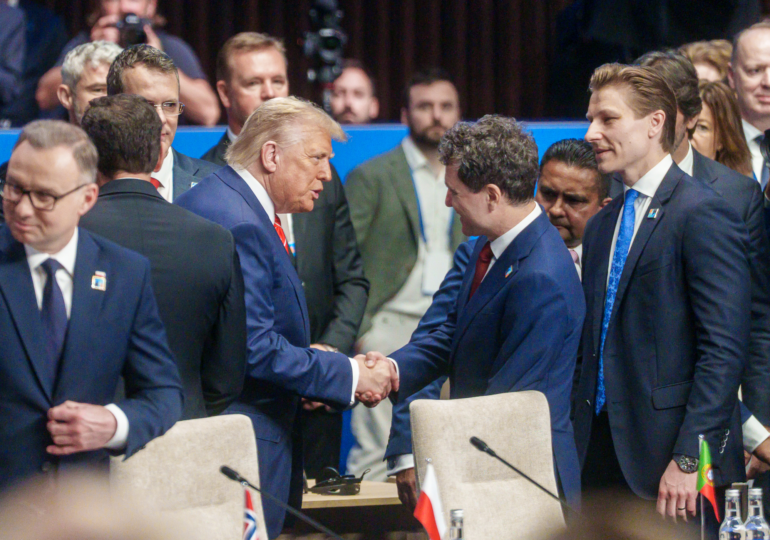
What does the Trump-Putin agreement on gasoline mean for Romania? And why is Bucharest silent?
In Romania, there are no official positions regarding the idea of American President Donald Trump to partially lift the embargo on Russian gasoline. However, European Union leaders and even important congressmen from Washington have criticized the USA-Russia agreement, both morally and economically, as it gives a boost to the Moscow war machinery.
At the end of last week, after a one and a half hour conversation with Putin, Trump announced that Russia will immediately deliver over 300,000 tons of gasoline to the American and global market, another 500,000 tons in November, and one million tons right after that.
On the same day, the U.S. Treasury issued License 135 authorizing the import of Russian-origin gasoline until April 7, 2027. The license text does not specify the quantities to be imported and does not lift other sanctions against Russia.
Romania between the US and the EU
"I don't see why Romania should publicly reject a certain position of Washington. What would we prove with such a gesture?" wonders the presidential adviser for European affairs, Valentin Naumescu, a professor of international relations at Babeș-Bolyai University in Cluj.
In other words, Bucharest does not need to position itself between the EU and the US. Professor Naumescu puts theory into practice because:
(i) in conditions of serious uncertainties regarding the intentions of major powers, small states do not choose between "balance" and "alignment," but often combine elements that are contradictory;
(ii) small, peripheral countries try to maximize their economic gains, have indirect security ties, and avoid confrontations;
(iii) the calculation is mathematical: the cost of making the wrong choice is higher than the cost of ambiguity. When the presidential adviser Nicușor Dan says, "we should not criticize the US to please the EU and vice versa," it is understood that Romania wants to maintain its balance between Brussels and Washington because in this equation, principles do not matter, but the interest in benefiting from both sides. However, this philosophy has its limits: it works as long as the two centers of power do not force you to choose.
In Brussels, the adoption of Package 22 of sanctions against Russia, which involves blocking energy re-export hubs and financial platforms facilitating clandestine money flows, does not pose problems for Romania: Bucharest votes with the EU and remains silent about the US.
Where does Romania source its oil and gas from?
Romania does not officially purchase Russian oil.
However, what comes through the pipeline bringing fuel from Kazakhstan to Novorosiisk and then further by sea to the Midia Năvodari Refinery contains about 10-15% Russian oil, according to estimates by the Moscow Times.
Kazakhstan is the third supplier to the EU (after the USA and Norway), and the pipeline passes through Russia. The pipeline also contains Russian molecules in a proportion of over ten percent. Then, Hungary and Slovakia purchase directly from the Russians through the old pipeline from the communist era called Friendship (Druzhba).
Even the Russian gas reaching Romania is not purchased directly as "Russian gas" because it is acquired through intermediaries. Imported gas enters Romania through three points:
1) from Hungary, through the Szeged-Arad interconnector, with gas coming to Hungary directly from Russia;
2) from Bulgaria, through Kardam-Negru Vodă;
3) from Bulgaria, through Giurgiu-Ruse.
The Bulgarian routes are supplied from TurkStream, meaning Russian gas from the pipeline passing through Turkey. In fact, Bulgaria acts as a hub for gases coming from Russia and the Caspian Sea. Some of the gas entering Romania from TurkStream goes further to Hungary and may even reach Ukraine.
In Europe, Russian gas accounts for 12-15% of the continent's needs. Pipeline imports from Russia increased by 7% this year, and liquefied gas (LNG) imports by 11%, according to the EU Agency for the Cooperation of Energy Regulators (Report "Russia gas import contracts and diversification-2026").
In absolute figures, in 2025, Russia was the EU's second-largest source of LNG with 18 billion cubic meters, plus 18 billion cubic meters through pipelines. In total, over 36 billion cubic meters in 2025, compared to 155 billion cubic meters in 2021. A significant decrease that shows the EU is no longer dependent on Russia, although Moscow remains very important in the European market.
Last week, the US and Russia discussed a possible entry into the project to rebuild the pipelines under the Baltic Sea between Russia and Germany. Berlin opposes any such intention, especially since the gas pipelines are subject to EU and US sanctions. (The explosions in September 2022 damaged both variants of Nord Stream 1 and one of Nord Stream 2, but the B line of Nord Stream 2 remained intact).
Europe is slow to detach from Russian gas, but according to the agreements in Brussels, from 2027, the continent should no longer take a drop of Russian gas. Belgium, France, Spain buy Russian LNG without moral scruples, while gas from TurkStream reaches everywhere in southern Europe, from the Balkans to Italy.
An agreement with limited benefits for the US
The gasoline agreement between Trump and Putin probably has a limited lifespan and could be suspended no later than after the US midterm elections on November 3.
Forbes experts have explained that the deal President Trump is making with Russia will not bring significant benefits: the 300,000 tons of gasoline Trump wants immediately amount to 2.22 million barrels, less than the daily consumption in the US transportation sector (2.94 million barrels).
Every day, the total consumption of gasoline in the United States is around 4 million barrels. Therefore, the 4.8 million tons of Russian gasoline promised by Putin, which is 35.5 million barrels, would not even last Americans for ten days.
The drop in gasoline prices until the midterm elections may not occur (gasoline in the US rose from $3.76/gallon in February when the conflict with Iran began to $6.52 by the end of September). On the other hand, Poland has mocked the entire deal, demonstrating with data that Russia no longer has the necessary capacities to supply the quantities Trump talked about.
The discussion revolves around the money Russia could quickly earn during this period and allocate to the war in Ukraine. Why is Washington helping Moscow? And what can the EU do to protect itself from all American idiosyncrasies, as long as it is dependent on the military defense of the United States?
Unlike Poland and even the Czech Republic, which criticized Trump's agreement with Putin, Romania prefers to remain silent: considering itself a small, powerless, and edge country, it relies on the US for any security needs and at the same time does not want to upset Europe.
Principles have no place in this equation of fear; they subscribe to the historical tradition of balancing and waiting until the last moment with one foot in two boats.