
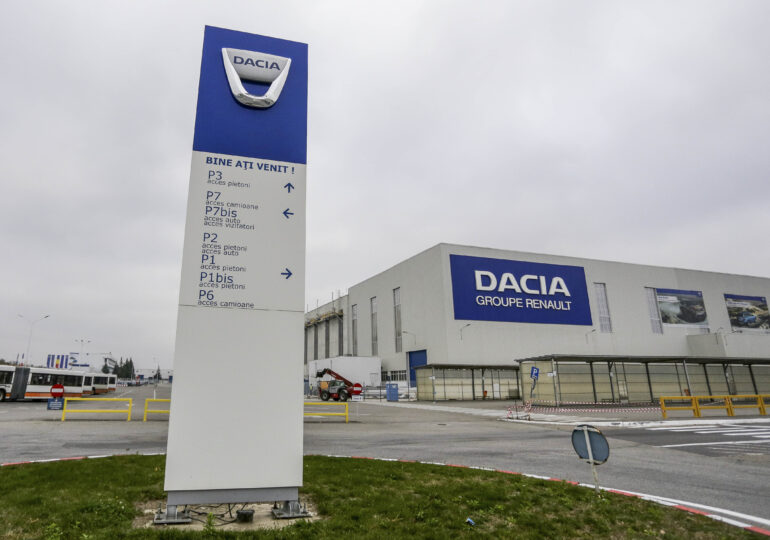
The Dacia plant in Mioveni must quickly reduce production costs by at least 20%, says the general director of the French group, François Provost.
He warns that operations in Romania are no longer competitive and calls on the plant’s management and unions to reach a long-term labor agreement. At the same time, he requests support measures from the Romanian authorities for the auto industry, especially in the context of high electricity prices.
In an interview with Profit.ro, François Provost explained the necessary changes for the Mioveni factory to continue receiving new models and strengthen its position within the group.
Cost Reduction, a Condition for the Future of the Plant
The first change François Provost expects from the team in Mioveni is to reach a long-term agreement between the factory's management and the unions, allowing for a rapid reduction in production costs.
The target set by Renault's CEO is a minimum 20% reduction in the cost of producing a car, but he believes that a decrease of 30% should be aimed for. The objective is not only for the plant but also for the suppliers in the entire industrial ecosystem of the group in Romania.
Provost specified that he is not asking for salary cuts but for solutions that provide more flexibility and allow for a more moderate evolution of annual wage increases.
According to him, Renault already has such agreements in other European countries, but not in Romania. Therefore, he considers negotiating such a mechanism in Mioveni a priority.
"We want Mioveni to survive. We want Mioveni to have a bright future," transmitted the French group's chief, explaining that the long-term stability of the plant depends on its ability to reduce costs and compete effectively with other production centers.
Competitiveness Pressure Affects Suppliers and Research and Development
Renault's plan is not limited to the Dacia factory production lines. François Provost stated that Romanian suppliers must also become more efficient, and research and development teams must demonstrate that they can work at a level comparable to that in China or India.
In the case of engineering departments, the official requested more proactivity and the ability to develop solutions at a competitive pace. Nevertheless, he expressed confidence in the skills of specialists in Romania, based on what he observed during his recent visit to the country.
To support the achievability of the objectives, Provost cited examples from other markets where Renault has implemented similar measures. He mentioned the experience of factories in Spain and France, stating that in France, the group expects a 25% increase in electric car production this year.
Renault Requests Government Support Measures for the Auto Industry
In addition to the changes he requests within the company, François Provost believes that the Romanian authorities should contribute to improving the conditions for the functioning of the auto industry.
He pointed out the high cost of electricity in Romania, which he stated is the highest in Europe, and suggested identifying mechanisms through which the state can support the industry.
The request comes after, during the recent visit to Romania, the Renault Group's chief spoke about the need for robust industrial policies to support local production. Now, he detailed both the company's responsibilities and the role he expects from the authorities.
Provost announced his intention to return to Romania in the coming months and expressed his desire to meet with company representatives, suppliers, and dealers, as well as with the president and the future government (when there is one), if they agree to the meetings.