
The level of trust that Romanians have in doctors, teachers, the press, vaccines, or even in products from stores can offer clues about their political preferences.
The Poll/Int Barometer, coordinated by Cristian Andrei, a specialist in political marketing and electoral research at the Political Rating Agency, suggests that the political instability of recent years has its roots in a deeper problem: the erosion of trust in society.
The profile of trust varies significantly depending on political preference.
PNL and USR voters generally have more trust in doctors, teachers, vaccines recommended by specialists, mass media, the economic environment, and are less inclined to believe that products sold in Romania are inferior to those in the West.
On the other end are AUR voters and undecided individuals, who consistently record the lowest levels of trust. In the case of the PSD electorate, this trend only appears for some of the analyzed indicators.
"This 'trust scale' largely represents the social and political divide in today's Romania. If we want to estimate a Romanian's voting intention, we can orient ourselves quite well based on their level of trust at the social and political level," says Cristian Andrei.
Romania remains a country dominated by distrust
The study's author points out that the issue is not limited to distrust in political leaders but affects the entire society.
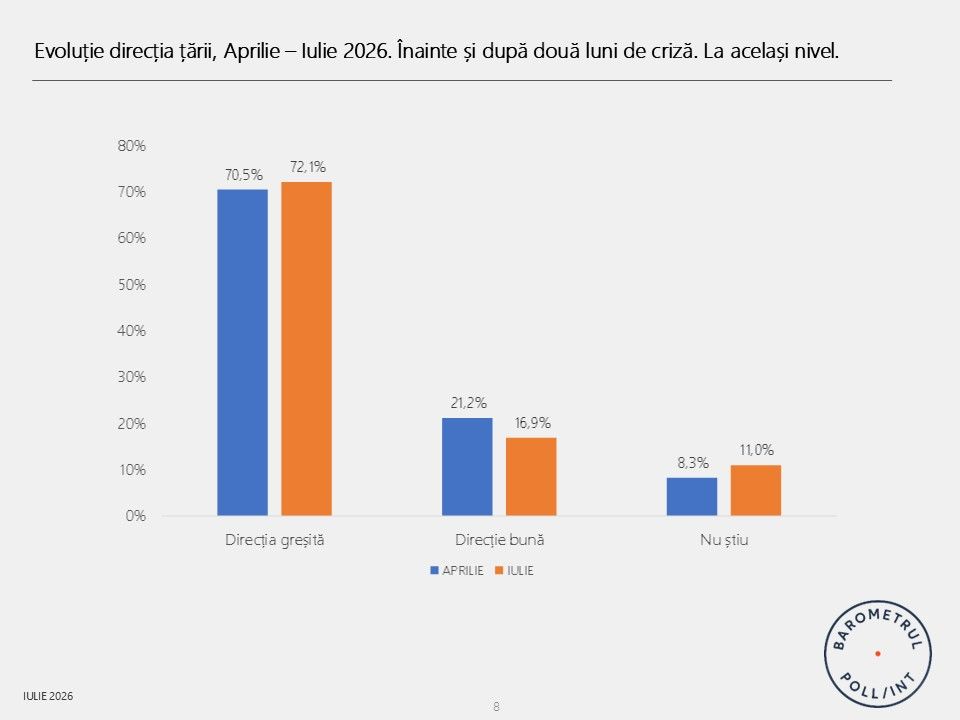
An example is the perception of the country's direction. 72.1% of respondents believe that Romania is heading in the wrong direction, while only 16.9% think the direction is right.
Compared to April, before the two months of political crisis, the perception has changed very little, which, according to the author, shows that distrust in the political system remains at the same level.
According to Cristian Andrei, the perception of the country's direction is "less of an indicator about immediate governance" and differentiates between Romanians who believe they have gained from the evolution of the last three decades and those who think they have lost.
Doctors and teachers inspire the most trust
The Barometer also measured the level of trust in various professional categories and social actors.
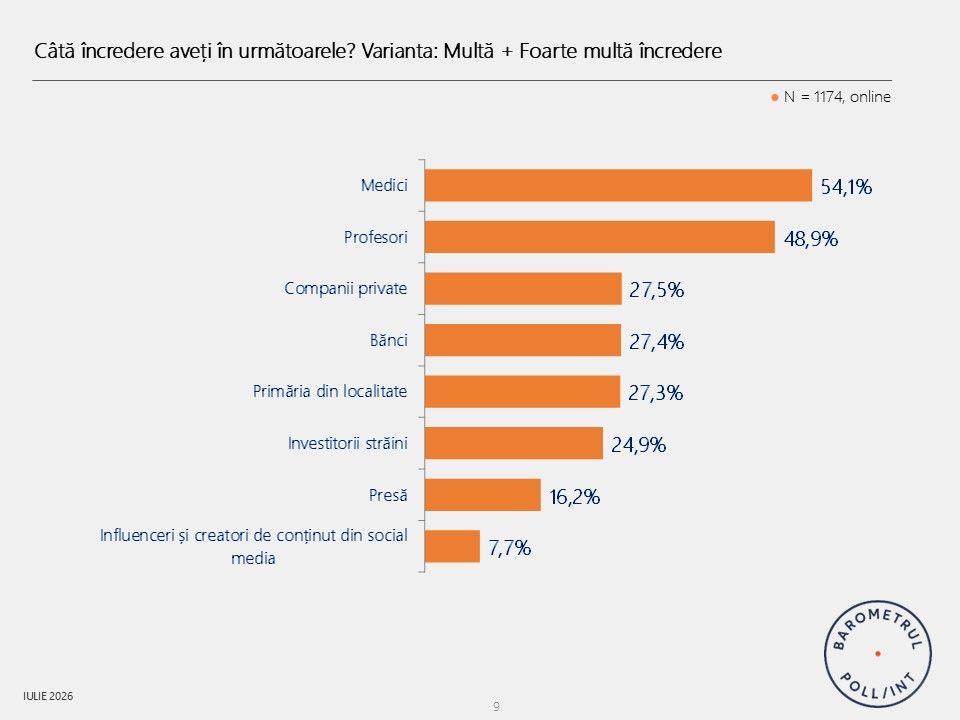
Doctors rank first, with 54.1% of respondents stating they have a lot or very much trust in them. Teachers follow with 48.9%.
At a great distance are private companies (27.5%), banks (27.4%), municipalities (27.3%), and foreign investors (24.9%).
On the opposite end is the press, which is trusted by only 16.2% of respondents, and influencers or content creators from social media, with only 7.7%.
The study's author notes that professions with direct contact with people maintain their credibility, while trust in the mass media is strongly eroded.
Young and elderly have different trust profiles
The survey highlights significant differences between generations and levels of education.
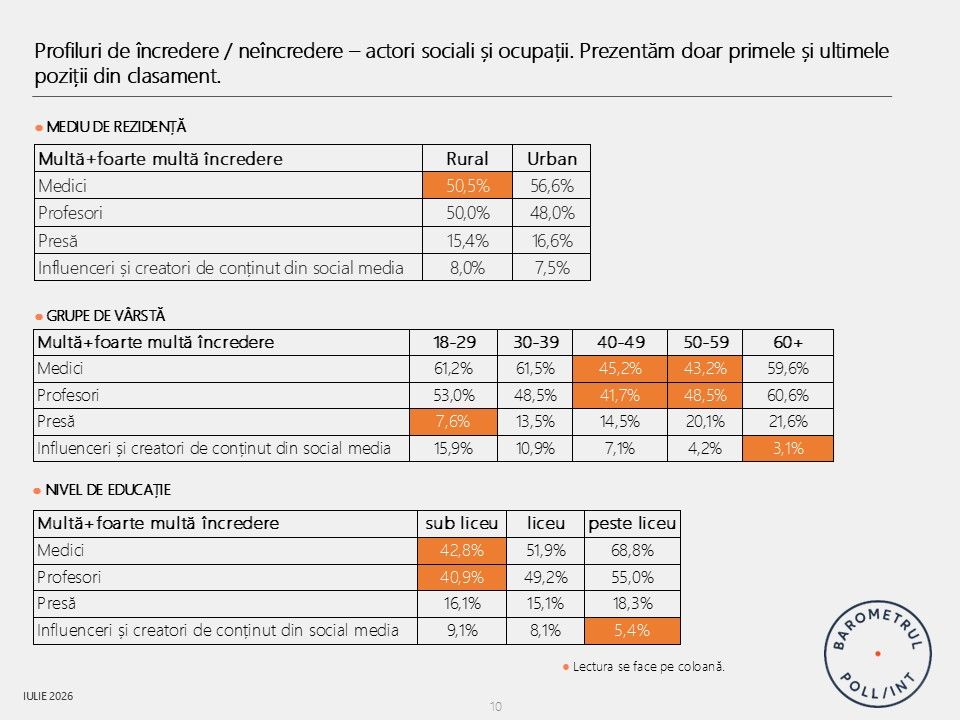
Youth have less trust in the press but more in influencers, while individuals over 60 tend to show the opposite tendency.
At the same time, individuals aged between 40 and 60 have lower levels of trust in doctors and teachers.
The data also show that trust in vaccines is lower in rural areas, among young people, and those with an education level below high school. "Trust in vaccines recommended by doctors in general, especially for children, is seriously eroded," says Cristian Andrei.
Trust in vaccines and products from stores remains low
The Barometer shows that only 56.7% of respondents agree that vaccines recommended by doctors are generally safe.
Regarding vaccines recommended for children, the agreement level is higher, reaching 64.9%.
At the same time, over half of respondents (52.8%) believe that international products sold in Romania have lower quality than those sold in Western countries.
According to the study's author, these results indicate that distrust goes beyond the political sphere and manifests in numerous areas of social life.
G.P.