
Romania’s rental market in major cities stabilized in April after several months of increases and price pressures.
An analysis published by Storia shows that nationally, rents increased by only 1% compared to April 2025 and even decreased by nearly 2% compared to March.
The data sharply contrasts with those published by the National Institute of Statistics on Wednesday morning, which indicated a more than 33% increase in rents in a single month. The figure raised questions in the market and among economists. Furthermore, INS data suggested that the surge in rents was one of the major factors pushing inflation back above 10%.
However, Storia's analysis suggests that, at least in major urban centers and on the active listings market, the reality is different.
Storia: The Market Shows Clear Signs of Stabilization
According to the platform's data, most major cities experienced either stagnation or price decreases in April.
The largest monthly adjustments were recorded in Sector 2 and Sector 5 in Bucharest, where rents decreased by 7% each, followed by Iasi (-6%), Arad (-5%), Brasov and Sector 4 (-4%).
Oradea was the only major city analyzed where rents increased from one month to the next, by 5%.
Compared to April last year, the most significant increases were in Timisoara (+8%) and Sector 1 in Bucharest (+3%). On the other hand, Iasi reported an annual decrease of 3%, Constanta 2%, and Craiova 1%.
"The data for April indicates a moderation in the dynamics of the rental market, after a period where price pressure was more visible in some cities," said Monica Dudau, Head of Marketing Real Estate Europe at OLX Group.
She also highlighted the differences between official data and those observed in the market. "It should be noted that there are differences between official indicators, such as those published by the National Institute of Statistics, which include all types of rents in the economy, and the developments observed in major urban centers based on prices from listings on the Storia platform, where we see more stagnation and occasional adjustments from month to month," explained the company's representative.
How to Explain the Huge Discrepancy Compared to INS Figures
The difference between the 1% growth indicated by Storia and the over 33% jump reported by INS in a single month raises serious questions about statistical methodology or data collection methods.
INS calculates the consumer price index using a broader basket of rents, which includes state-owned or rented housing through mechanisms other than the free market.
On the other hand, Storia's analysis reflects the prices advertised in active listings in major cities, i.e., the segment that directly influences tenants looking for accommodation. In practice, the platform's representatives suggest that INS data and those from the free rental market are not directly comparable, as they are calculated using different methodologies.
Additionally, the platform's data indicates that landlords seem to be becoming more flexible, amid a more cautious demand.
"The declines observed in several local markets, alongside the high number of cities where prices have remained stable, suggest a change in tenant behavior, becoming more budget-conscious, as well as greater flexibility from landlords," said Monica Dudau.
Bucharest Remains the Most Expensive Market
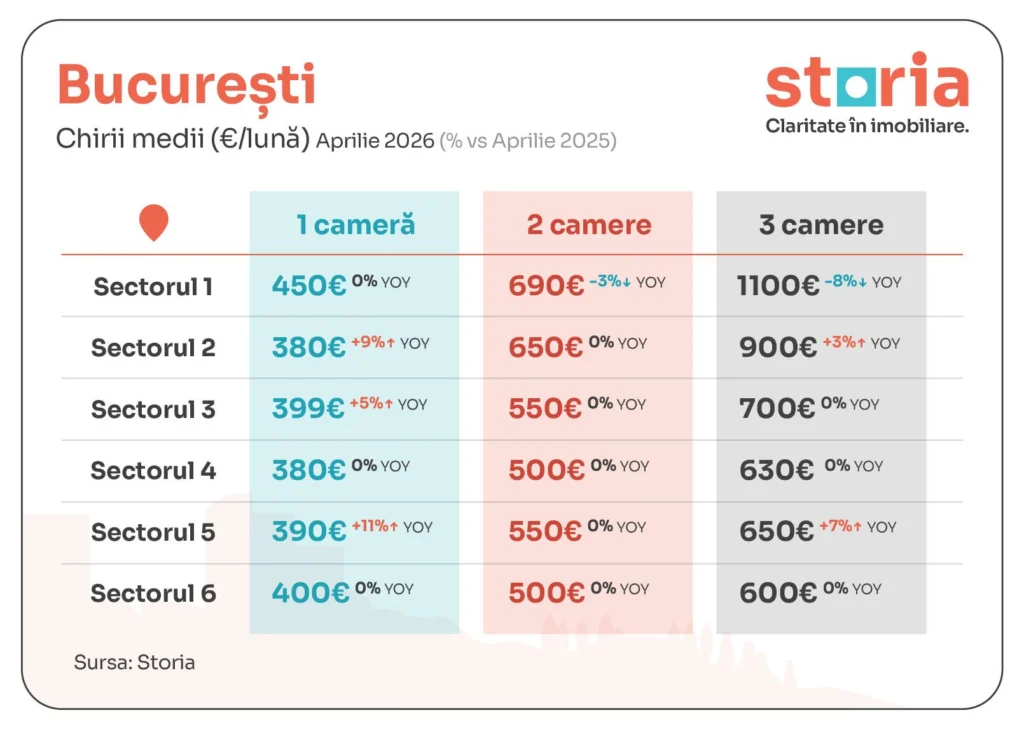
In the capital, the average rent in April was approximately 609 euros, slightly down from March.
Sector 1 remains the most expensive, with an average of around 806 euros per month. At the other end is Sector 6, with about 484 euros.
For two-bedroom apartments, the most sought-after in the market, the average rent in Bucharest was around 582 euros.
Studio apartments have reached nearly 400 euros, and three-bedroom apartments around 843 euros.
The data also show a shift in interest among tenants. Nearly half of the searches on the platform are for two-bedroom apartments, but the segment of three-bedroom homes is growing the fastest, with an annual increase of 12%.
Cluj and Brasov Remain Expensive, but Without New Surges
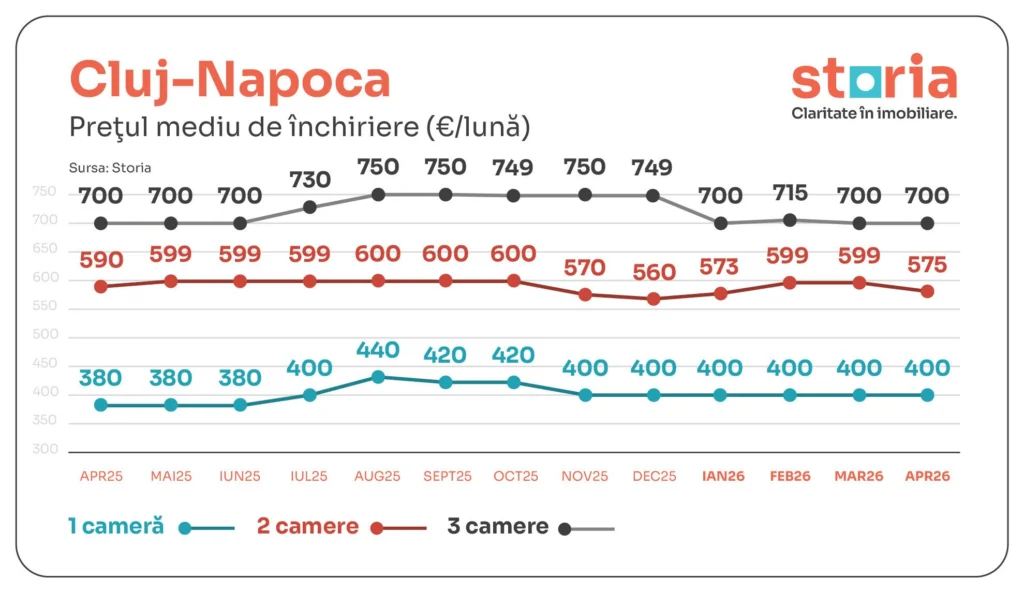
In Cluj-Napoca, one of the most tense markets in the country, two-bedroom apartments had an average price of 575 euros in April, a 3% decrease from the previous year.
In Brasov, rent levels remained high but without significant variations. Two-bedroom apartments stayed at 500 euros, and three-bedroom apartments at 650 euros.
Timisoara has the highest annual rent increase, but even here, the evolution was moderate compared to INS data. Studio apartments reached about 300 euros, and two-bedroom apartments 420 euros.
The Most Affordable Markets
Among the cities with the lowest rents are Arad, Oradea, and Craiova.
In Arad, a studio was rented on average for 250 euros, and a two-bedroom apartment for 350 euros.
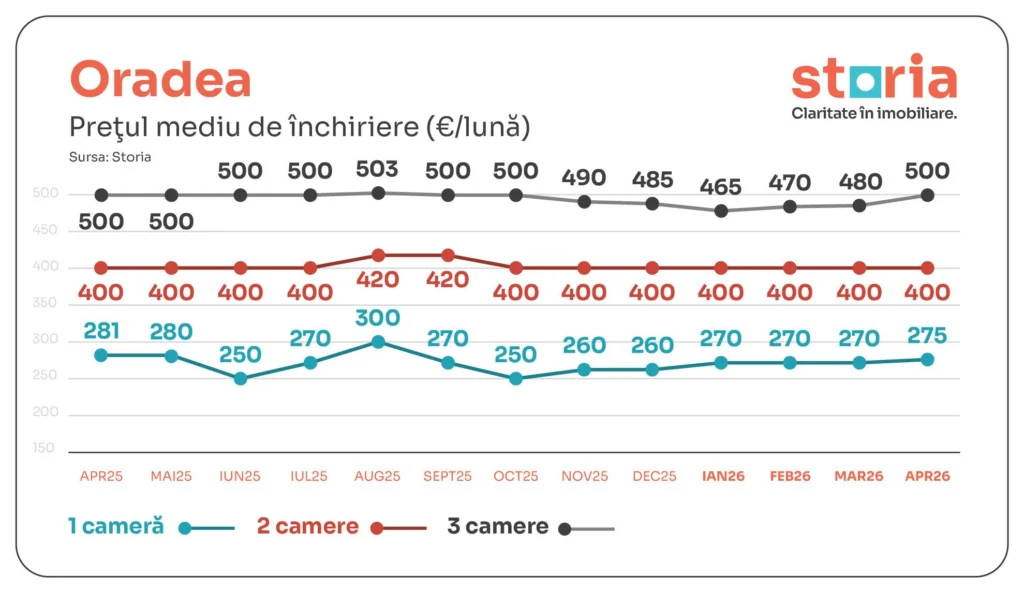
In Oradea, two-bedroom apartments remained at around 400 euros, and in Craiova at 430 euros.
The analysis thus suggests a market that is starting to stabilize, in a challenging economic context with tenants increasingly cost-conscious, far from the image of a widespread explosion in rents.
G.P.