
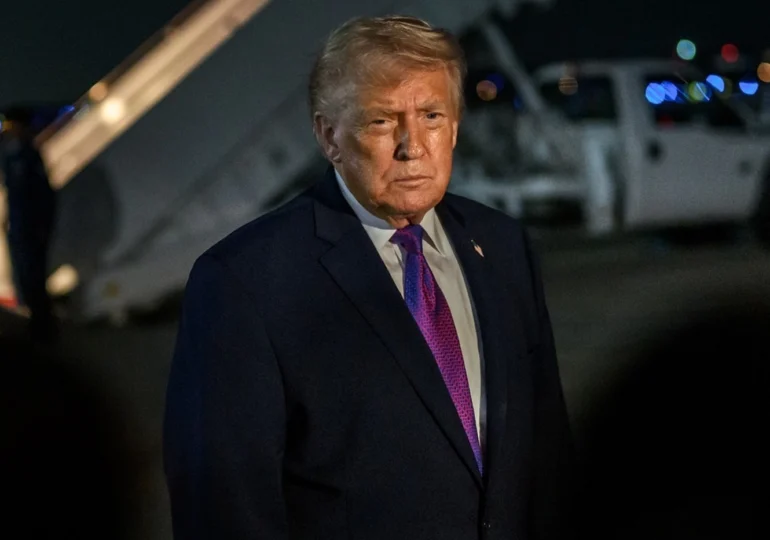
Monday was a day that showed why the longstanding problems in the Middle East are so deceptive for American presidents. Donald Trump learned another important lesson.
The fragile diplomatic effort by the American president to exit the war with Iran suddenly seemed to collapse on Monday morning due to Israel’s threat to attack the Hezbollah supported by Tehran in the southern suburbs of Beirut.
The sudden escalation sparked Trump's fury as he expressed his frustration over a conflict he initiated in February and extended until June, defying his hopes for a quick and clear victory.
"I really don't care. I might not care at all," Trump told CNBC when asked about Iran's statement that it had suspended talks with the US due to what it considered violations of the Israeli truce in Lebanon. "The talks have become 'very boring,'" he said.
However, Trump still initiated emergency diplomacy, calling Israeli Prime Minister Benjamin Netanyahu for an extremely tense discussion, during which the US President used profanity to express his disapproval of the planned offensive in Lebanon.
The White House leader also engaged with Hezbollah through what he called "high representatives." He then announced on Truth Social that both parties agreed not to fire and said that discussions regarding Iran continue at a "fast pace."
The Lebanese Embassy in Washington later stated that Hezbollah confirmed it would refrain from attacking Israel in exchange for the cessation of Israeli attacks on Beirut. Israel stated in a communication that it would continue operations in southern Lebanon but tacitly announced that, at least for now, it would not attack Beirut.
Trump Still Holds Netanyahu in Check
Trump's intervention may keep his efforts towards Iran alive - and with it, hopes that the Strait of Hormuz will reopen and halt the rapidly escalating consequences for the global economy, as shown in an analysis published by CNN.
Monday's drama may have also demonstrated to Iran that Trump still has the ability to keep Netanyahu in check - a factor that could be crucial for the survival of any US-Iran deal that Israel might oppose, the source mentioned.
Ali Fathollah-Nejad, founder and director of the Center for the Middle East and Global Order, stated that the discussion between Trump and Netanyahu "speaks to the type of power relations that exist between the United States and Israel."
Trump later stated to ABC that "there was a little problem today, but we fixed it very quickly, as you probably noticed earlier."
However, the history and brutal realities of Middle Eastern politics suggest that his diplomatic struggle may be a temporary solution. The conflicting pan-regional interests of powers such as Israel and Iran could resurface; as well as the distrust that has shattered much deeper US peace initiatives in the Middle East than those of Trump.
These difficult-to-resolve factors threaten the president's hopes of finding a satisfactory way out, CNN notes.
Lebanon: A Distant Front in the US-Iran War
The country, a narrow strip on the eastern shore of the Mediterranean, is approximately 1,600 km northwest of the Strait of Hormuz, the vital artery of the global economy that Iran effectively closed at the beginning of the war.
The Trump administration insists that tensions in Lebanon are distinct from its confrontation with the Islamic Republic and should not affect the progress of bilateral discussions on nuclear and missile issues. But Iran does not see it that way.
In fact, each party views things through the prism of its own interests.
What Iran Wants
Lebanon is north of Israel and has long been an advanced operational base for Iranian intermediaries threatening the Jewish state.
Tehran wants to keep Hezbollah as a viable force after years of financial and military support from the Islamic Revolutionary Guard Corps.
Although diminished by relentless Israeli attacks in recent years, Hezbollah, the Shiite militia and political network deeply rooted in Lebanon, remains a critical link in Tehran's broader regional ambitions and in any hope that the Revolutionary Guards could rebuild their capacity to threaten Israel after the war.
Unlike Washington, Iran makes no distinction between US and Israeli interests - not surprising given the joint bombing that triggered the current war and killed its former Supreme Leader, Ali Khamenei.
"Iran desperately wants to keep what it has built in Lebanon over the past four and a half decades," said Ronnie Chatah, a regional analyst and host of "The Beirut Banyan" podcast, to CNN.
While Trump may have prevented an Israeli escalation in Lebanon on Monday, he is unlikely to have reshaped Israel's enduring strategic assessments.
What Israel Seeks
Israel views Hezbollah as a terrorist group and a threat to its security. It demands the complete disarmament of the group and holds Lebanon responsible for this.
However, many analysts argue that the weak Lebanese government - leading a fragmented state that includes Maronite Christians, Shiite and Sunni Muslims - lacks the power to meet Israel's demands. Lebanese leaders support disarming Hezbollah but argue that this must follow a comprehensive political settlement, likely involving lengthy negotiations with regional powers.
Meanwhile, Israel may continue to try to suppress Hezbollah's power. Therefore, the conflict in Lebanon will remain a constant threat, capable of erupting and disrupting the US negotiation process with Tehran.
It's another example of differing perspectives between allies who started the war with Iran. Israel sees safeguarding its security as an endless mission that may involve periodic wars. Trump seeks a definitive resolution - and to exit the region.
What Trump Wants
The Trump administration understands how Lebanon threatens this goal. Recently, it held peace talks in Washington between Lebanese and Israeli officials. The meeting made only rudimentary progress in extending the truce at the Israel-Lebanon border - and seems to have already been overtaken by events.
This leaves Lebanon as it has been for half a century - a victim constantly drawn towards political collapse and humanitarian crises. It is in the midst of proxy conflicts involving regional rivals such as Israel, Iran, Syria, and various Palestinian groups. It is still recovering from a 15-year civil war and an Israeli invasion in 1982 that tore it apart.
Although Trump intervened on Monday to salvage the situation, there are few signs that he has the will or political capital to conceive a more lasting peace in Lebanon. This would require a regional pact. He envisioned such a framework through his call to expand the Abraham Accords to include all Arab and Muslim regional powers, recognizing Israel.
But other issues, including the Palestinian question, make this a elusive goal. Therefore, Lebanon will remain an open wound that could undermine his war diplomacy with Iran.
Trump Only Achieved a Delay
All Trump did on Monday was to avoid a deadlock. And Lebanon is not the only threat to this diplomacy.
Iran's intransigence further undermines Trump's credibility domestically and his claims about war, such as his Monday social media post where he said, "Iran really wants to make a deal."
Tehran's behavior suggests that it believes it can pressure the American president and that he is the one who truly desires a deal - after sending back over the weekend a framework proposal with modifications covering Iran's nuclear commitments and its agreement to reopen the Strait of Hormuz.
Hope for progress is not dead, as both Iran and the US have an interest in officially ending hostilities. Trump has been politically humiliated by high gas prices. On the other hand, Iran imports most of its goods by sea and is heavily impacted by the American blockade on its ships and ports.
However, the impasse persists.
The US continues to emphasize that Iran can never possess a nuclear weapon. Tehran insists on its right to enrich uranium. Although American bombings could have destroyed Tehran's nuclear facilities last year, its stocks of highly enriched uranium are still in the country.
The ceasefire between the US and Iran is in place, but it is being tested by both sides.
This situation is fragile enough on its own, without adding the additional danger of a distant front in the proxy war between the US and Israel that could further destabilize it.
Trump may have limited the damage on Monday. But he learned a new lesson: presidential adventures in the Middle East are easy to start, but can be nearly impossible to finish, CNN notes.
T.D.