
The Institute for the Study of War (ISW) appreciates that the reactions of Russian officials following the incident in which a drone crashed on Romanian territory, on a building in Galați, pursue several strategic objectives, including avoiding taking responsibility, shifting blame onto Ukraine, and testing NATO’s response to Russian aerial incursions near the Alliance’s borders.
„The increasingly frequent incursions of Russian drones into NATO airspace indicate that Russian President Vladimir Putin has adopted a reckless policy that accepts the risk of Russian drones penetrating NATO airspace as an acceptable consequence of his attacks in Ukraine. Putin now seems to accept the risk of civilian casualties in NATO countries as an acceptable consequence of Russia’s strike campaign,” explain American analysts.
In this context, NATO may need to consider negotiating possible air defense agreements with Ukraine and Moldova.
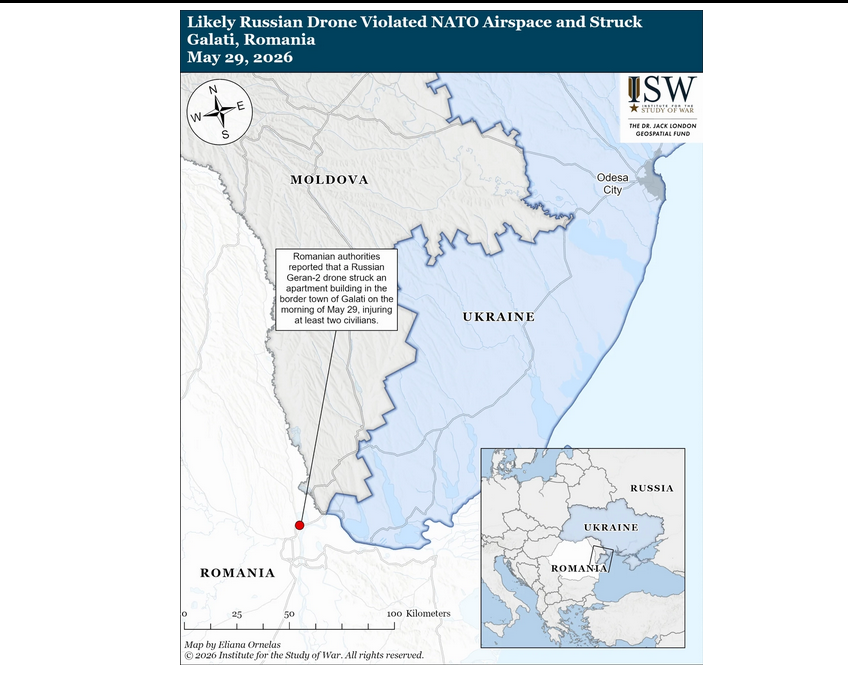
Two Communication Directions Promoted by the Kremlin
In an analysis published after the incident in Galați, ISW experts show that Kremlin officials promote two distinct but complementary lines of communication to manage the political and diplomatic consequences of the case.
According to ISW, the first direction aims to deny Russia's responsibility for the drone that crashed in Romania, while the second tries to suggest that the aircraft belonged to Ukraine.
American analysts believe that these messages serve to "shift Russia's responsibility for the incident, falsely blame Ukraine, and test NATO's response to Russian drone incursions."
Medvedev Launches New Threats Against Europe
ISW highlights the statements of Dmitry Medvedev, Vice President of the Security Council of the Russian Federation, who reacted to the incident by stating that European countries are "direct participants" in the war against Russia.
At the same time, Medvedev conveyed a message interpreted by analysts as a direct threat to countries supporting Ukraine.
"European countries have not seen anything yet... so they better get used to it. It won't be the last time," said the Russian official.
According to ISW, these statements "effectively threaten Romania and other European states with further drone attacks if they continue to support Ukraine."
Putin Challenges the Origin of the Drone
Meanwhile, Russian President Vladimir Putin has rejected accusations that the drone was of Russian origin.
The Kremlin leader stated that the origin of the flying device cannot be definitively established before examining the wreckage and suggested that the drone could be Ukrainian. Additionally, Putin offered to analyze the wreckage if Romanian authorities made it available to Russia.
ISW notes that although Medvedev often makes more radical statements than other Russian officials, his messages reflect threats that the Kremlin wants to convey to the West and that Vladimir Putin himself has formulated in the past.
A Possible Test for NATO
According to the analysis, the Kremlin carefully monitors NATO's reactions to incidents involving Russian drones. Experts recall that Moscow has observed the Alliance's responses to previous incursions into NATO airspace, especially during the intensification of these incidents in the fall of 2025.
In this context, ISW believes that the incident in Romania could be used to evaluate both NATO's military and diplomatic response to the incident and the response to the messages conveyed by the Kremlin.
"The Kremlin will likely use the attack in Romania on May 29 to test NATO's reaction to both the drone incursion itself and Kremlin rhetoric, regardless of whether the drone incursion was accidental or intentional," the analysis states.
ISW: Similar Incidents Could Continue
Experts at the Institute for the Study of War warn that such incidents could continue as long as the Russian military operates drones near NATO borders.
According to the analysis, the North Atlantic Alliance may need to adapt its policies and anti-aircraft defense systems to protect the populations of member states from the risks posed by these incursions.
"Given the restrictions on Romania's air defense operations, NATO may need to consider negotiating possible air defense agreements with Ukraine and Moldova as a self-defense measure against Russian drone attacks on NATO countries, regardless of whether these Russian drone incursions are accidental or intentional," ISW concludes.
B.B.