

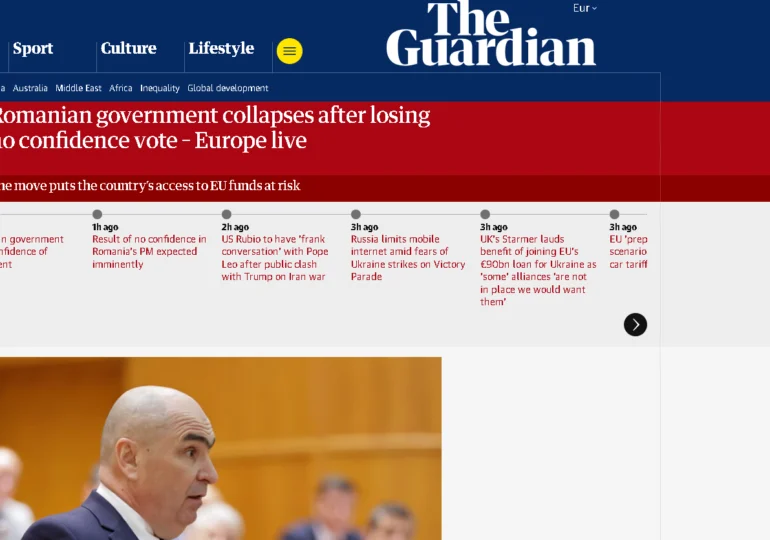
The fall of the Bolojan Government opens the way to a period of political uncertainty in Romania, foreign press reports on the adoption of the no-confidence motion in Parliament.
The Guardian
In his speech before the vote, Prime Minister Ilie Bolojan warned parliamentarians not to adopt the „cynical and artificial” motion, which he said „seems to be written by people who have not been in government every day and have not participated in all decisions.” „Can anyone say how Romania will function from tomorrow, do you have a plan?” Bolojan asked.
Well, evidently he did not convince them, notes The Guardian.
But the question of what comes next is not an easy one, as there is no obvious way to form a majority or a different government. The allies in removing the Bolojan government - the socialist PSD and the far right, including George Simion's AUR party - seem not particularly eager to form a new administration together.
A scenario put forward by rebel socialists would be reshuffling the current coalition with a new prime minister, but it is not clear if other parties would be willing to support this suggestion.
It is anticipated that Bolojan will remain as an interim prime minister with limited powers, as the country's president, Nicușor Dan, will organize consultations to determine the next steps. However, discussions may take weeks to yield a result, as indicated by the British newspaper.
Politico
The Bolojan Government collapses after socialists joined the far right to remove the prime minister.
The Social Democratic Party played a decisive role in the motion's passing. Tired of severe austerity policies, the group withdrew from the government led by Bolojan's National Liberal Party and announced it would collaborate with the Alliance for the Union of Romanians, an extreme right-wing party, to oust the prime minister.
George Simion is widely seen as the mastermind behind Bolojan's fall. His far-right party is gaining ground in polls, and its prospects are likely to improve further in a prolonged period of instability that will threaten the country's already precarious economic outlook, reports Politico.
Romania must finalize key reforms by August to unlock around 11 billion euros in EU funding, and if it does not get its public finances in order, it could also face a credit rating downgrade.
Reuters
Romanian lawmakers overturned Prime Minister Ilie Bolojan's pro-EU government through a vote of no confidence on Tuesday, jeopardizing the country's sovereign debt ratings, its access to EU funds, and currency stability.
Bolojan led a minority government since the end of April when the Social Democrats - the largest party in Parliament - demanded his resignation, then left the coalition of four parties and allied with the far-right opposition to submit a no-confidence vote, notes Reuters.
Although early elections seem unlikely, financial markets are concerned that political turmoil could mean Bucharest fails to meet its commitment to reduce the EU's largest budget deficit. The Romanian leu hit a historic low against the euro before Tuesday's vote, notes the news agency.
The current coalition came to power 10 months ago aiming to curb the gains of the far right after a series of polarizing elections and had begun to reduce the deficit, narrowly avoiding a downgrade from the last step of the investment-grade rating.
However, the Social Democrats - without whom a pro-EU majority cannot be achieved - clashed repeatedly with Bolojan as his austerity measures affected their voters and the networks they patronized, while their popular support waned in favor of the far right.
Romania must continue reducing the deficit and implementing reforms to access around 10 billion euros from the EU's recovery and resilience funds before the August deadline. The deficit is expected to decrease to 6.2% of economic output this year, down from over 9% in 2024, the news agency reminds.
AFP
The left-wing Social Democratic Party (PSD), Romania's largest party, joining forces with the far right to submit the motion has drawn criticism for potentially legitimizing a rising far right.
By aligning with AUR, the PSD has transformed this party "into a significant political player, from an isolated, ostracized, and marginalized party within the political system," according to political scientist Costin Ciobanu, a researcher at Aarhus University in Denmark.
Bolojan's Liberals, the PSD, and two other pro-EU parties formed a government last year following elections in which the far right won an unprecedented third of parliamentary seats. The agreement ended political turmoil marked by the cancellation of the presidential elections due to accusations of Russian interference in December 2024.
The no-confidence motion against Bolojan now threatens to revive disturbances.
Ciobanu foresees possible weeks of political negotiations, which could lead to a new government formed by the same four pro-EU parties but with a different prime minister. "We observe this existential anxiety within the Social Democratic Party," which "does not know what it should do now to return to the previous state," added the political scientist.
Since the crisis erupted, Romania's borrowing interest rates have risen, and the leu has depreciated against the euro, which reached a historic high of 5.21 Romanian lei on Tuesday.
Romania, which had a 7.9% deficit of GDP in the last quarter of last year, has been subject to an EU excessive deficit procedure since 2020, AFP recalls.
Deutsche Welle
Romanian lawmakers voted on Tuesday to dismiss Prime Minister Ilie Bolojan. It is unclear where this will lead in the EU member state burdened by debt, which has long struggled to join the eurozone due to economic difficulties.
What will happen now after Bolojan's fall is not set in stone. As Grindeanu said, Bolojan will most likely lose his position, and the more likely scenario is prolonged coalition negotiations.
These could even lead to the same four-party alliance as before — as all four political formations are needed to claim a stable majority. A new prime minister would likely still be from a party within the alliance, estimates DW.
The Romanian currency, the leu, has slightly depreciated against the euro in recent days amid uncertainty. Bucharest aims to join the eurozone but still does not meet the necessary economic requirements to do so.
France 24
Romania's pro-European coalition collapsed on Tuesday after Parliament voted a no-confidence motion against Prime Minister Ilie Bolojan, triggering a new period of turmoil in the EU and NATO country bordering Ukraine, less than a year after the coalition took office.
The left-wing Social Democratic Party (PSD), Romania's largest party, teaming up with the far right to submit the motion has drawn criticism for potentially legitimizing a rising far right, reports France 24.