

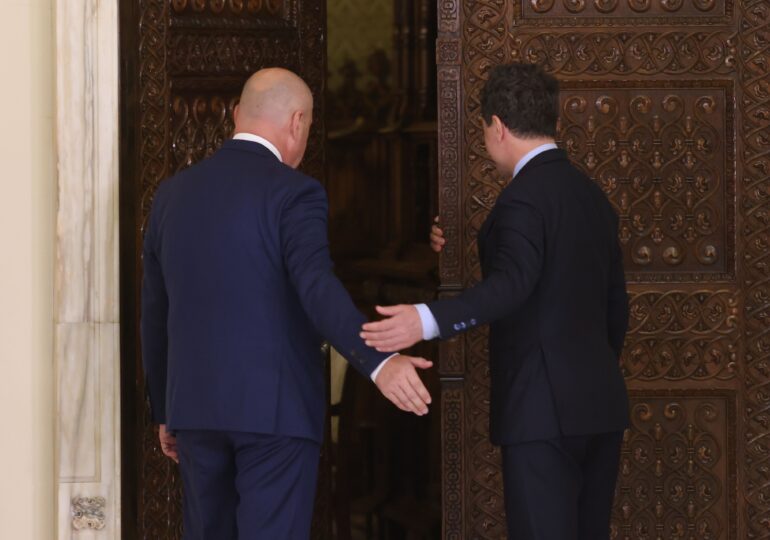
Thursday’s consultations with „free electrons” from Parliament are a cat shown by Nicușor Dan to Ilie Bolojan.
It’s no surprise that the president didn’t truly want Ilie Bolojan as prime minister, even though he used him in last year’s electoral campaign and ended up at Cotroceni thanks to the support of the leader from Oradea.
That's why it took a month and a bit last summer before he decided to appoint him as prime minister. Essentially, no one else wanted the thankless position of implementing the toughest measures.
Now, however, after the "betrayal" by the PSD, Nicușor Dan has the chance to get rid of Bolojan. But what do you know? The ousted prime minister is holding firm, and the liberals and the USR have formed a shield around him.
It is precisely to break through this shield that Nicușor Dan is making these repositioning moves.
The consultations at Cotroceni on Thursday morning, where the president received the "escaped" parliamentarians from AUR, SOS, and POT, are exactly the expression of this game.
We're talking about around 60 parliamentarians who entered Parliament on the lists of sovereignist parties. They left AUR, SOS, or POT, but they haven't at all abandoned their political reflexes, which they were quick to expose today to the president.
In the end, the Uniți pentru România group unequivocally stated that they will support any government formation indicated by the president, including scenarios where AUR could enter the government if their program incorporates their demands.
PACE goes even further, publicly assuming formulas like PACE–AUR or even PACE–PSD–AUR.
In this landscape, the consultations no longer seem like an exercise in building a "pro-Western" majority, but rather an inventory of the pieces available for a continuously reconfiguring political puzzle. The message is simple and brutal: any combination is possible if it adds up to 233 votes for the government's investiture.
In other words, everything becomes negotiable.
These moves inevitably bring to mind the "great betrayal" felt when, after years of anti-PSD discourse presented as the absolute evil of Romanian politics, Klaus Iohannis endorsed a joint PNL–PSD government in the name of stability.
The formula was justified by balance, but it left behind a bitter taste: a state pushed into major budget imbalances, fueled by unsustainable increases in salaries and pensions, later corrected in emergency mode.
And who then footed the bill? The Bolojan government, forced to implement tough, unpopular, and often poorly communicated or even thought-out measures - from cutting benefits to taxes directly felt by vulnerable groups. We all remember the decrease in scholarships, the rising cost of books, or the introduction of CASS for mothers and veterans. This is how the label of "Ilie Poverty" stuck.
Today, however, the difference from the Iohannis era lies in pace and intention.
If back then the compromise came gradually, almost inert, now it seems anticipated and politically embraced.
Moreover, Nicușor Dan wasn't elected because he "wasn't PSD" - during the campaign, he explicitly stated that he would work with the PSD because he had no alternative - but rather for his image as a pro-European guarantor, anti-extremism, and anti-isolationism.
However, since taking office at Cotroceni, the messages have become increasingly blurred. The president attacks European values, embraces MAGA, and exposes a nationalist side to charm AUR-like voters.
What is taking shape is not necessarily a PSD–AUR majority, but the idea that such a formula becomes acceptable as long as it results in a government.
The fact that this majority already exists as a political reality has been seen: in the motion and in the vote on the AUR law requiring NGOs to disclose all sources of funding and donor identities.
And the voices of power in the PSD have already validated the hypothesis, while Sorin Grindeanu continues to shower praises on the head of state, a consummate mediator, isn't he?
In this context, everything seems more like pressure on the reformist area of PNL and USR rather than a real government construction.
The political signal becomes singular: less rigidity, more adaptability, more "management" of parliamentary reality, regardless of costs.