

Artificial intelligence risks amplifying social and economic inequalities, warn economists Daron Acemoglu and Chris Pissarides, both Nobel laureates, who argue that modern technology favors already well-educated and well-paid employees, while deeply transforming the labor market and potentially leaving behind lower-skilled workers.
Employees with higher incomes and more experience are adopting artificial intelligence in their work much faster than others, in a rupture that risks deepening inequalities as the technology spreads in the labor market.
A survey conducted by Financial Times on 4,000 employees in the US and the UK shows that the use of AI is highly concentrated among the highest-paid: over 60% use it daily, compared to only 16% of low-income employees.
The data, the first results of a new AI workforce monitoring tool created by FT in collaboration with research company Focaldata, also indicate a persistent gender gap, with men significantly more likely than women to use AI tools in sectors ranging from technology to education and retail.
The monthly survey analyzes how employees use AI, productivity changes, adoption barriers, and effects on the labor market.
It provides an overview of how technology is spreading in the US and the UK and who stands to gain the most.
"The public rhetoric is that these tools will democratize access to technology. But the reality is that you need a certain level of education, abstract and quantitative skills, familiarity with computers, and programming to use these AI models," says Daron Acemoglu, Nobel laureate in economics and professor at the Massachusetts Institute of Technology.
"Artificial intelligence will increase inequality between labor and capital. Almost certainly. I would say it is leading us toward a... disaster," he added.
The survey shows that knowledge workers are the biggest users of AI among office professions, but the main differences appear between different occupations, not necessarily within the same field.
Lawyers, accountants, and software developers use these tools in similar proportions, regardless of whether they are junior or senior, but much more often than employees in lower-paid occupations in the same industries.
The strong link between income, education, and AI use suggests that technology could accentuate income inequality, increasing the productivity of those at the top of the labor market but not necessarily for those at the bottom.
Economists emphasize that more qualified and autonomous employees are naturally the first to adopt complex technologies.
"The smarter the technology we invent, the more your intelligence matters," said Chris Pissarides, Nobel laureate and professor of economics at the London School of Economics, who has studied the effects of automation on jobs.
"When the technology was simpler, IQ didn't matter as much. But now it matters more and more as technologies become more advanced."
Economic historian Carl Benedikt Frey stated that the same pattern emerged during the personal computer revolution, but the differences diminished as the technology became widespread.
"Inequality will adjust over time," said Frey, a professor at the Oxford Internet Institute. "It depends on how long it takes to close this gap - if it's a decade or two, then the situation is more worrying."
The gender difference is in line with data showing that women are 20% less likely than men to use AI, according to Fabien Curto Millet, chief economist at Google, although the causes are not yet clear.
He emphasized that there are opportunities to reduce this gap, citing research from 2025 showing that AI training sessions for employees in the UK significantly increased adoption among women over 55.
"The intervention led to a tripling of daily usage," said Curto Millet. This is consistent with FT data, which show that professional training in companies is the main factor driving AI use in the workplace.
Researchers were surprised to find that the biggest AI users are not the youngest employees but people aged 30-40 with more experience, suggesting that the technology is more useful to those who already have expertise.
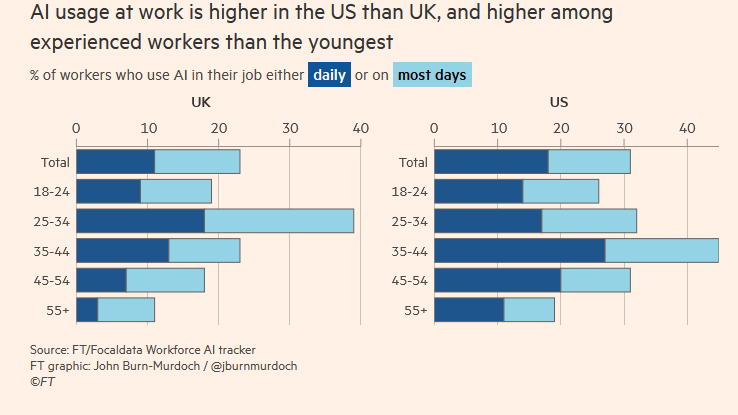
Ronnie Chatterji, chief economist at OpenAI, said this confirms the company's observations that AI complements existing skills and allows experts to become more productive.
The results raise concerns that AI could erode the professional hierarchy base, as some tasks previously performed by junior employees are now taken over by AI at the request of senior employees, which could make it harder for newcomers to gain experience in the labor market.
Google and OpenAI have acknowledged recent data showing a slowdown in the entry-level job market, but have indicated macroeconomic factors, not AI, as the main cause.
"We need to go back to the educational system and think about how we create incentives for people to acquire this type of expertise and critical thinking," said Chatterji. "You need deep expertise, not its replacement - not a situation where you outsource thinking to a machine."
B.B.