

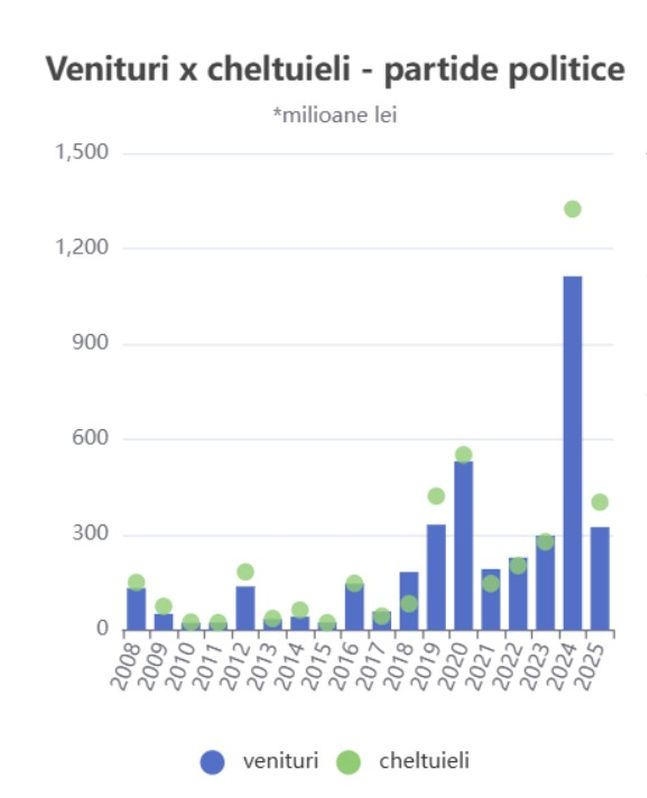
Political parties continued to spend hundreds of millions of lei in 2025, even though the year did not reach the exceptional level of 2024, when subsidies and electoral reimbursements exceeded one billion lei.
The Expert Forum report „Funding of Political Parties in 2025 and the Urgent Need for Reform” shows that the system remains dominated by public funds, loans, and insufficient control mechanisms, while funders seem to pursue political influence rather than ideology.
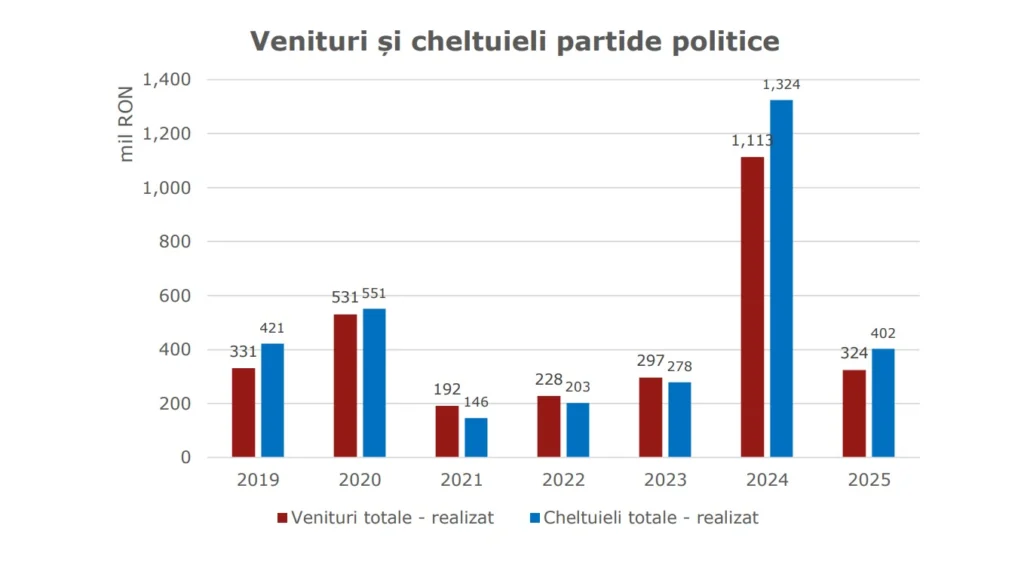
In total, political parties and minority organizations for which there were public data had revenues of approximately 705 million lei, and identified expenses reached 731 million lei.
Of the total, political parties declared revenues of approximately 323 million lei, while national minority organizations had revenues of around 381 million lei. Political party expenses amounted to 402 million lei, according to data collected by EFOR from tax declarations available until May 14.
Large Subsidies, Money Retained from One Year to Another
State subsidies remain one of the main sources of funding.
In 2025, eight parties received a total of 232 million lei:
- PSD – 76.9 million lei
- AUR – 45.5 million lei
- PNL – 41.9 million lei
- USR – 29.8 million lei
- SOS Romania – 19.8 million lei
- POT – 15.9 million lei
- PMP – 1 million lei
- Forța Dreptei – 1 million lei.
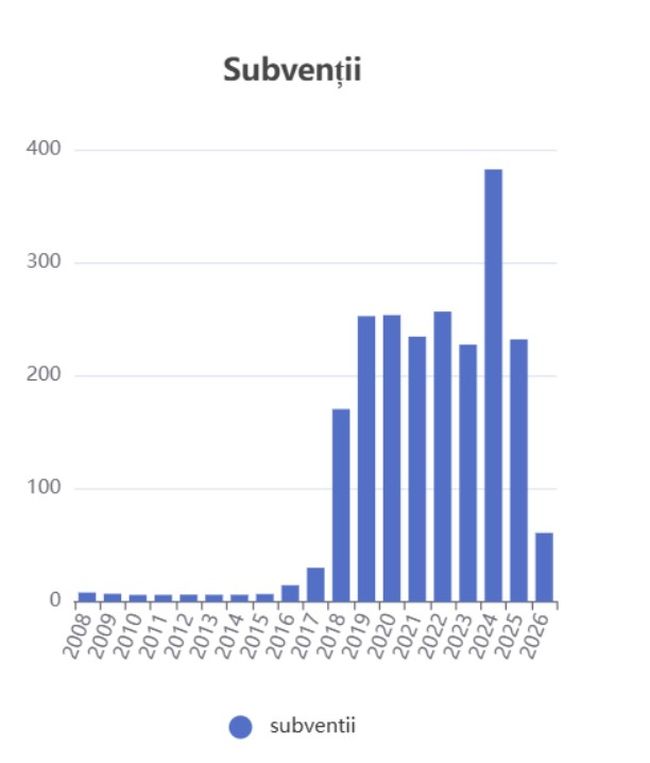
However, parties spent 244 million lei of subsidies, more than they received during the year, as they can retain unused funds from one year to another. In 2025, PSD, USR, and PMP spent more than the amounts received, while POT used only 54% of the funds collected, PNL 98%, AUR 88%, and SOS Romania 85%.
EFOR considers that the value of subsidies is too high and that the system has created a dependency of parties on the state. "Subsidies have significantly increased in recent years without the allocation mechanism being sufficiently justified or transparent," the report states. The authors also criticize the fact that the law does not sufficiently explain how the annual amount allocated to parties is determined, and the unwritten rule has been that the budget should not decrease compared to the previous year.
- Political Parties' Subsidies in 2025: We Know How Much Was Spent, But Not Who Received the Contracts
Nearly Half of Subsidies Spent on Press and Propaganda
The majority of subsidy funds went to press and propaganda: 117 million lei, which is 48% of the total expenditure.
Following are personnel expenses, with 27 million lei, investments in movable and immovable assets with nearly 22 million lei, political activities with 13 million, and political consultancy with 11 million lei.
EFOR warns that this category of expenses remains one of the most problematic due to its impact on media independence and shaping of the public agenda. "The very large sums spent on press and propaganda raise issues of transparency and influencing the public space," the report states.
The authors recommend that parties should not be allowed to use more than 30% of subsidies for press and propaganda contracts.
Loans Have Become the New Key to Political Funding
The report indicates that private revenues represent less than a third of party funding, and loans have become much more important than donations.
In 2025, membership fees totaled 40.6 million lei, large donations from individuals 6.6 million lei, corporate donations approximately 692,000 lei, while loans reached 112 million lei. PSD had the highest loans, 83 million lei, followed by AUR with 25.8 million.
The issue, as EFOR points out, is that loans can function not only as temporary funding but also as a mechanism for building political influence. "In practice, loans can become instruments for consolidating influence relationships between funders and parties," the report warns.
EFOR believes that the repayment term, up to three years, is too long, especially in an electoral context, and the law even allows loans to be transformed into donations within certain limits.
Money Seems to Follow Influence, Not Ideology
One of the most interesting conclusions of the report is that funding appears less ideological and more linked to access to political influence. EFOR notes that some donors who funded PSD in 2024 shifted to AUR in 2025, and individuals linked to PNL or party members provided loans to PSD.
The report describes PSD as the model of funding through companies and individuals connected to the economy, administration, and public contracts. "PSD remains the party with the most extensive funding networks related to the economic environment and local administration," notes EFOR.
AUR is presented as the model of funding through large loans from individuals, elected officials, candidates, and entrepreneurs. The report talks about "a pronounced dependence on large loans granted by individuals," including cases where "visible public financial capacity should be further verified."
About PNL, the authors state that it has "a more institutionalized funding profile," based on candidates, local leaders, and party officials, while USR appears with lower funding, mainly from professionals and entrepreneurs.
Donors with Unclear Revenues or Businesses with Limited Activity
EFOR states that it identified, as in previous years, possible cases where donations or loans do not clearly correlate with data from asset declarations or financial information reported to the Ministry of Finance.
The report mentions large loans granted by individuals or businesses with limited economic activity, losses, high debts, or very recent establishment.
The report gives examples such as Dumitru Spău, with a loan of 800,000 lei, or Valeriu Alexandru Târnăvetchi, also with 800,000 lei, cases where the reported incomes do not seem to fully explain the loan granted.
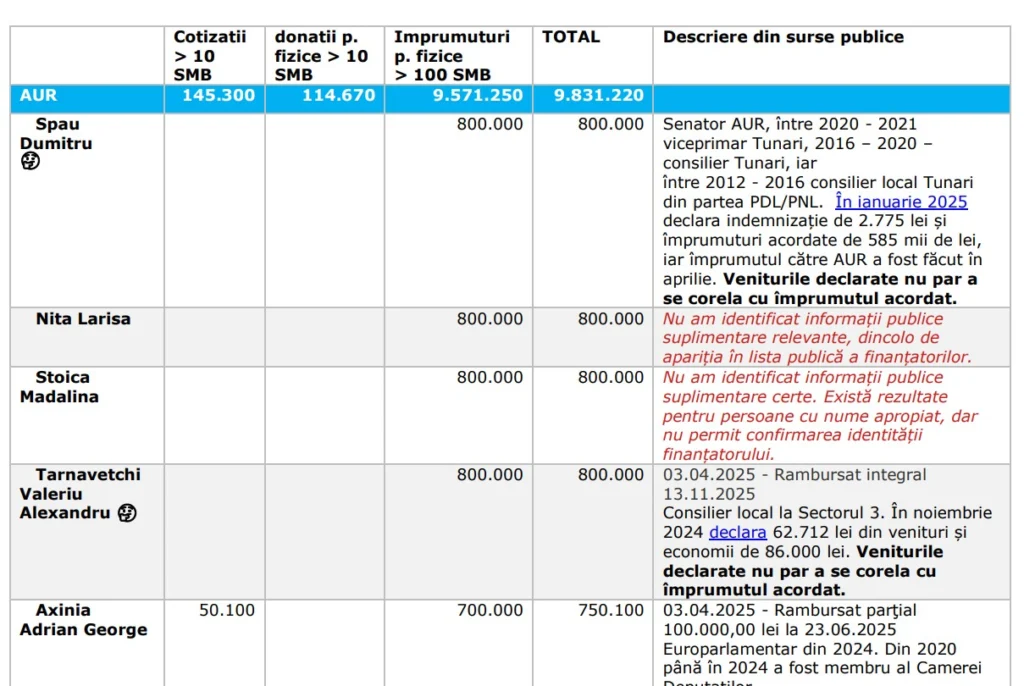
The organization emphasizes that these situations do not automatically demonstrate irregularities but should be further verified by authorities: the source of funds, possible intermediate loans, commercial links with the state, indirect political relationships, or potential expected benefits later on.
In the case of AUR, the report points to individuals who granted loans of hundreds of thousands of lei, although the identified public incomes do not seem to fully explain the amounts.
Limited AEP Control
The report shows that AEP mainly verifies the documents submitted by parties without proactive checks on the real source of funds.
EFOR recommends stronger collaboration between AEP, ANAF, ONPCSB, and ANI, especially considering that the state reimburses hundreds of millions of lei for each electoral cycle. "The limited capacity of authorities to efficiently verify the origin of funds, including through interinstitutional collaboration, limits the transparency of the process," the report states.
The organization also warns that changes regarding access to asset and interest declarations could affect such investigations in the future. "We probably won't be able to conduct such analyses in the coming years," EFOR notes.
Reform Demanded After a Problematic Electoral Year
The report comes in the context of AEP announcing a broader reform of legislation concerning parties, electoral campaigns, and the institution's functioning.
However, EFOR argues that, following the cancellation of the 2024 elections, "decision-makers have not taken any significant measures to improve the legal framework regarding political financing." The authors warn that the lack of real changes maintains "major risks to the integrity of the electoral process."
Among EFOR's recommendations are the reduction of subsidies, limiting amounts for press and propaganda, disclosing the ultimate beneficiaries of public funds, introducing an annual overall limit for each funder, and regulating third-party financing.
The report also calls for "prohibiting political parties from being financed through cryptocurrencies," as well as measures to "reduce the risks of buying political influence."