

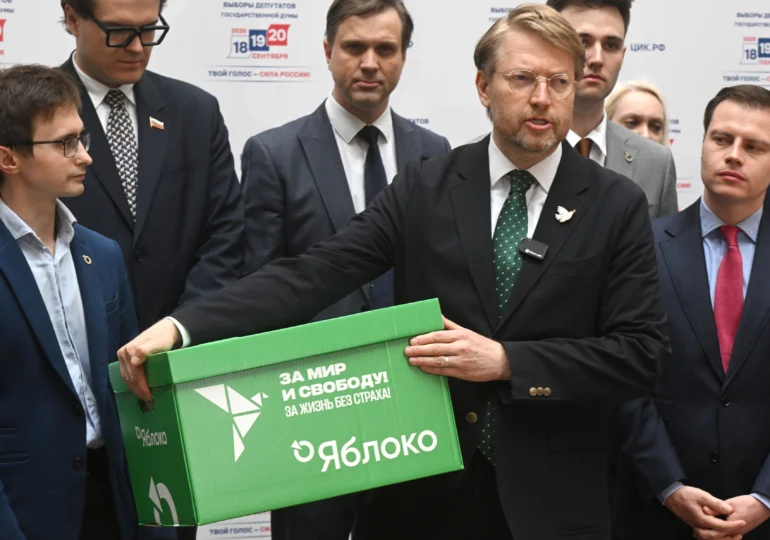
If anyone is tired of democracy in Romania or in the European Union, they can experience the upcoming electoral campaign and elections in Russia.
On September 20, the vote will take place to designate the 450 deputies of the State Duma, the Russian Parliament. A deputy’s term is 5 years, and the election is held on schedule.
The only party that advocated for a pacifist program, meaning to end the conflict in Ukraine, was banned, removed from the electoral register following a decision of the Russian Supreme Court. It is about the Yabloko party, a liberal and moderate formation.
So, there are 10 formations left on the electoral lists, none critical of the war or Putin. Also, the winner of the election is already known, it's the United Russia Party, a formation founded by the Russian leader.
The only mystery that remains is related to the percentage of victory. Here, some political commentators say that a decrease in support for the Russian president might be observed, but there are numerous reports about previous elections in Russia that demonstrate the manipulation of vote counting and aggregation.
A Dark Year
Under Putin's authority, the vote has become a formality that allows the Kremlin regime to claim a certain legitimacy, one that is not valuable for Russians or the rest of the world, but only for the political system.
Boris Nadejdin, who in 2023 had the courage to run for the presidency of Russia, supported by a civic action called Civic Initiative, left Russia in July 2026, shortly after being included in the list of "foreign agents," meaning all his rights were revoked, being forbidden to engage in politics.
Romania also faces major problems with the functioning of the democratic system. What happened in 2024 has not yet been clarified, and President Nicușor Dan and state institutions do not seem to be in a hurry to shed light on the chaos that compromised the free elections in that dark year, despite promising otherwise.
However, there is a huge gap between democracy in Romania and Russia, not to mention the consolidated democracies of Western Europe.
The Mobilization of Hundreds of Thousands of Russians is Being Prepared
For at least 14 years, since his return to the presidency after his term as prime minister, when he swapped roles with Dmitry Medvedev, the elections in Russia have had one goal - the consolidation of Vladimir Putin's autocratic regime.
There will be no difference this time either.
Through the parliamentary elections, the Russian president aims to present himself as a leader supported by the largest party in Russia, which, through the victory obtained, confirms his decisions and, most importantly, his warlike vision.
Vladimir Putin will use the election as a popular validation of his decision to continue the invasion of Ukraine, providing him with the necessary arguments to decree a new round of mobilization of reservists.
"A report from the Defense Intelligence Service has emerged - signed by Oleh Ivashchenko - regarding Russia's preparations for mobilization. Everything is confirmed by internal Russian documents - they are preparing for autumn, immediately after the simulation of parliamentary elections...", announced Volodymyr Zelensky, the President of Ukraine, in a public statement made on August 11.
"Putin's plan is not particularly complicated. He wants to create the impression that the Russians would support the war - every party allowed to run is, in one way or another, against peace," added the leader from Kyiv.
"...after the so-called elections, he plans an additional rapid mobilization of several hundred thousand Russians by the end of the year, plus just as many next year. This will be added to the recruitment he is trying to carry out through contract enlistment...", Zelensky further stated.
The Kremlin, Resistant to Military Defeats
The President of Ukraine has repeatedly demonstrated that when he provides information about the conflict situation, it is real and verified. The situation in his country is extremely serious to allow for exaggeration or lies.
What Zelensky says is also confirmed by European officials, who believe that Vladimir Putin has no intention of ending the war.
"Putin continues the war not because defeat or peace would be politically impossible - although he would benefit if the West believed this - but because the survival of his regime is more resilient to unfavorable military outcomes than is often assumed," a report by the publication "War on the Rocks" states.
"The distinction between military defeat and political collapse is essential for developing a strategy in a war whose political consequences are much less automatic than the narrative of existential traps suggests," the cited analysis further notes.
The Shock of Trump Has Not Passed
The theory of existential traps, regarding the war in Ukraine, argues that Vladimir Putin cannot stop the military conflict without losing his position as Russia's leader.
As long as it continues, he will maintain his authority in a society and political system controlled by fear.
The parliamentary elections in Russia only mean Putin's decision to continue the war and to be able to launch a new mobilization.
The only way to stop the conflict in Ukraine at this moment is through Russia's military defeat, pushing them out of the occupied territories. This can also come through creating a favorable context, after the US elections, when an anti-Putin sentiment will emerge in America, discouraged until now by Donald Trump.
A new majority in the US Congress will bring tougher sanctions against Russia, will finance the arming and development of Ukraine's military technology, and will send a stronger political message to the Kremlin.
Thus, the premises for real negotiations for an armistice will appear, not the shameful strategy of the current American president who, immediately after taking office, sought to produce an unconditional and rapid surrender of Ukraine to Putin.