
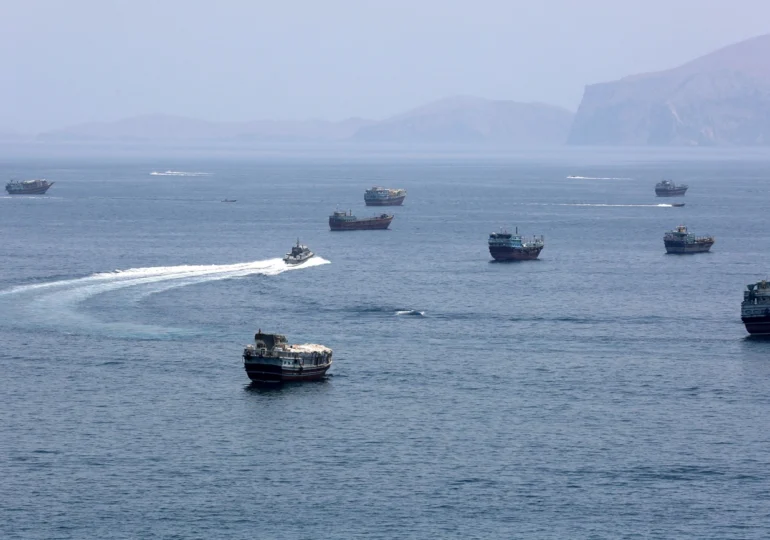
The Trump administration claims that oil exports from the Middle East have returned to normal and even exceeded pre-war levels. However, data on naval traffic through the Strait of Hormuz tells a different story: the number of ships remains well below the levels recorded before the conflict.
American Energy Secretary Chris Wright stated that on Sunday, exports surpassed pre-war levels and that oil flows have been maintained at around normal values for about a week.
CNN compared the statements of the American official with data provided by companies tracking maritime traffic and indicated that the figures are difficult to reconcile.
Wright says that the situation has improved after the US military coordinated a plan with allied Gulf states for the passage of oil through the Strait of Hormuz. Meanwhile, countries in the region have maximized the use of pipelines and other export facilities to bypass the strait.
The issue is that observed naval traffic does not support the figures presented by Washington.
Last week, only 84 ships crossed the Strait of Hormuz, with nine on Sunday, according to Kpler, a company monitoring the oil market using satellite images and ship-transmitted data.
Before the war, over 100 ships passed through the strait every day.
Wright claims that approximately 9 million barrels of oil are transported through the Strait of Hormuz per day. However, JPMorgan estimates that the actual volume is closer to 4 million barrels per day.
"It is not possible to reconcile the difference between what we see and the figures he quotes," says Matt Smith, research director for commodities at Kpler.
The US Department of Energy did not respond to CNN's request to explain these differences.
Pipelines are operating at maximum capacity
Part of Wright's statements is supported by data. The estimate that between 5 and 7 million barrels per day bypass the Strait of Hormuz through pipelines seems to be correct.
Only Saudi Arabia's East-West pipeline now transports over 5 million barrels per day to the Red Sea.
Traffic in this area has remained close to normal in recent weeks, despite threats from Iran's Houthi allies to block the Bab el-Mandeb strait.
However, Middle Eastern countries have pushed their pipeline infrastructure close to maximum capacity to extract as much oil from the region without passing through the Strait of Hormuz. This raises doubts about other figures put forward by the American official.
Wright claims that in the last week, approximately 15 million barrels per day left the Persian Gulf region, and on Sunday, the volume reached 20 million barrels, exceeding the pre-war average.
Actual traffic through the strait, however, looks very different. On Monday, only six ships passed through the Strait of Hormuz: four entered the Gulf and two exited. None were oil tankers, according to Andy Lipow, president of Lipow Oil Associates.
Washington tries to keep prices down
Analysts believe that the Trump administration's statements also have a market-related objective: to reduce pressure on oil prices.
"In theory, the US government, with all its technology and military resources in the region, should have the best data on flows through the strait," says Dan Pickering, founder of Pickering Energy Partners.
However, the data is difficult to verify, he adds, and the administration has been trying for months, through its statements, to push oil prices down.
Donald Trump has repeatedly claimed that the United States controls the Strait of Hormuz. The situation on the ground, however, is much more complicated.
Commercial vessels require military escorts to enter and exit the Persian Gulf, and Iran has attacked 64 ships passing through the strait. The attacks resulted in the death of 17 sailors and the injury of another 35.
"We are far from normality," says Helima Croft, global commodities strategy chief at RBC Capital Markets.
Nevertheless, oil prices have remained relatively low considering the magnitude of the supply shock. CNN indicates that the explanation largely lies in the collapse of demand and the fact that Beijing has started to use China's vast oil reserves.
- After Iran demanded compensation, Trump says it's an interesting idea: He also wants war reparations
"Phantom fleet" further complicates calculations
Traffic through the Strait of Hormuz varies greatly from day to day. Even if on a certain day or week the number of ships returns to usual levels, maintaining this situation is challenging if it requires a coordinated military operation.
Tankers need to re-enter the Gulf to load oil, then cross the strait in the opposite direction. However, shipping companies are reluctant to send vessels to an area where there is still a risk of attacks.
The picture is complicated by the "phantom fleet." According to Windward Intelligence, a significant portion of Middle Eastern oil is transported by tankers that turn off their transponders or by ships using false flags to conceal Iranian oil shipments subject to sanctions.
Of the 84 ships that crossed the Strait of Hormuz last week, 17 were associated with the "phantom fleet," and 10 carried sanctioned goods.
It is not clear whether the US administration has included these in the calculations supporting its claim that oil exports have returned to normal.
G.P.