
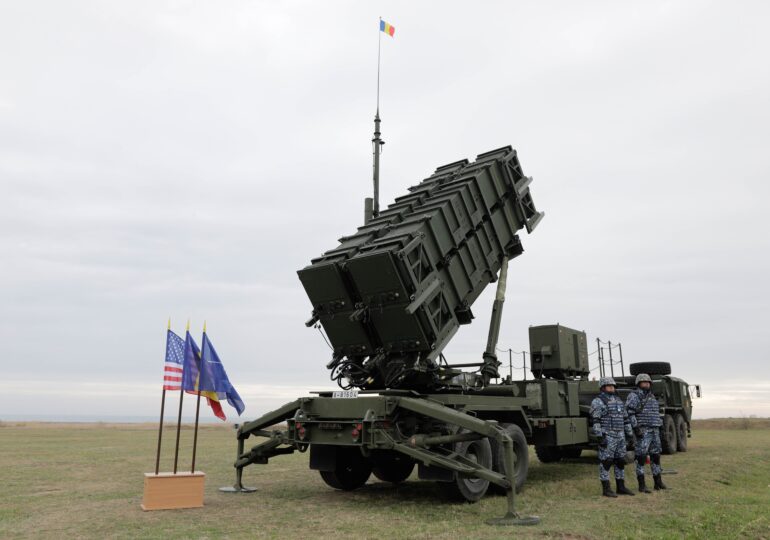
Europe is scrambling to quickly find more Patriot interceptors to donate to an increasingly desperate Ukraine, which is hurrying to bolster its ballistic missile defense ahead of the expected winter offensive from Russia.
Kyiv is seeking hundreds of interceptors, but new production will come too late, the war with Iran has strained US stocks, and several major European countries supporting Ukraine say they have few interceptors they can safely donate, writes Politico.
"In recent months, Russia has fired more missiles at us weekly than we receive from partners in months," former Ukrainian Defense Minister Mykhailo Fedorov said last week.
In July, Ukrainian anti-aircraft defense intercepted only 29 out of 195 Russian ballistic missiles, while 40 did not hit their targets, according to the Ukrainian Defense Ministry.
Germany, one of the main donors of military aid to Ukraine, has already transferred Patriot systems and missiles to Ukraine. However, Berlin now needs to balance Kyiv's increasingly urgent needs with the minimal stocks required to protect Germany and fulfill its NATO commitments. Other European countries are also considering whether to keep their interceptors or send them to Ukraine.
"We're reaching our limits here," said Brigadier General Jürgen Schrödl, a senior official from the German Ministry of Defense, during a debate in Berlin shortly after last month's NATO summit in Ankara. "We also need to ensure our own protection."
Berlin and other capitals in northern Europe are urging counterparts across the continent to assess what other military equipment and financial support they could provide.
"I don't think this is sustainable for Europe in the long run," Norwegian Defense Minister Tore O. Sandvik told Politico. "All European countries need to do more."
This puts pressure on countries like Poland, Spain, and Greece, which hold stocks of Patriot interceptors. The shortage mainly concerns Patriot PAC-3 and PAC-2 missiles, which are among the few effective systems Ukraine has against high-speed Russian ballistic weapons.
Ukraine can use other anti-aircraft defense systems, often cheaper, against drones and cruise missiles. The country is rushing to develop the indigenous Freyja interceptor, but the antiballistic system still needs investment, engineering work, and testing before it can fulfill this role.
Until Freyja is ready, Ukraine needs an immediate response to Russian ballistic missiles. "One of the top priorities is Patriot — PAC-3 or PAC-2," said Mykhailo Podoliak, advisor to the head of the Ukrainian presidential administration, to Politico. "The first solution is to buy or receive existing PAC-3 and PAC-2 interceptors."
Blocked in Washington
Dependence on Patriot systems makes US President Donald Trump essential for Kyiv: most PAC-3 interceptors are produced in America, meaning their sale and any production agreements are subject to decisions from the White House.
During the meeting between Ukrainian President Volodymyr Zelensky and Trump last month, "the main topic was Patriot interceptors," according to a high-ranking official familiar with the discussions.
Trump raised hopes at the Ankara summit when he said that Ukraine would be allowed to produce under license Patriot interceptors designed in the US - a move that could ultimately reduce Kyiv's dependence on limited American deliveries.
However, US Ambassador to NATO Matthew Whitaker clarified that production will not address the immediate shortfall.
"A long-term production agreement will not be concluded before this winter," he told Fox Business, and manufacturing the first missiles would take even longer.
However, Trump has partially walked back this position, saying last week: "We have not agreed to that. We're talking about it. But it's a tough thing to offer - that kind of technology."
Following a Reuters article stating that the US has depleted almost all its missile stocks due to the war against Iran, Trump is now focusing on replenishing American reserves. When asked on Thursday about Zelensky's requests for more Patriot missiles, he said, "We want missiles too."
Ukraine has also signed an agreement to receive PAC-2 interceptors manufactured in Germany, but it is unlikely that these will arrive before next year.
Faced with a lack of interceptors, Kyiv is now considering a more aggressive campaign to target Russian launchers.
"The Russians need to understand that, minutes after launch, the entire team launching the missile must die because of our ballistic missile," Fedorov said.
Europe's Unbalanced Effort
This immediately puts pressure on Europe, where allies are once again looking into their own arsenals - and those of others - for interceptors that could reach Ukraine before winter.
Germany provided three Patriot systems from its own military stocks and subsequently arranged for two more through an agreement in which the US was to replenish Bundeswehr stocks. The Netherlands assembled components for another complete system, including five launchers, a radar, and missiles.
However, with stocks now depleted, governments are facing their own limits.
Warsaw confirmed in July that it had made several PAC-3 interceptors available following requests from NATO Secretary-General Mark Rutte and senior American commanders. The Polish publication Defense24 reported that only five missiles were transferred.
Even this move sparked a political reaction. Opposition parliamentarians accused the government of weakening the country's defense at a time when Russian missiles and drones had repeatedly breached its airspace.
Countries closer to Russia are now less willing to give up their existing Patriot systems, as their armed forces already considered air defense insufficient for national needs, according to a European diplomat granted anonymity to discuss sensitive diplomatic contacts.
This shifts focus to southern European countries, which have contributed less to supporting Ukraine than Germany and many northern European donor states.
Spanish Prime Minister Pedro Sánchez confirmed in 2024 that Madrid is sending missiles to Ukraine, but the government did not disclose the type or quantity.
The Spanish Ministry of Defense did not respond to a request from Politico regarding whether more interceptors have been recently requested or if a new transfer is being considered. Instead, the ministry pointed to broader military support provided by Spain to Ukraine and its commitments to NATO.
Greece - which traditionally views NATO member Turkey as its biggest security threat - has not announced any transfer of Patriot systems to Ukraine. The Greek press reported in July that Ukraine had requested up to 200 older PAC-2 interceptors from Athens.
The Greek Ministry of Defense did not respond to Politico's request for comment on the situation.
Forcing Europe's Arsenals Open
This is not the first time European allies have had to put together deliveries of Patriot missiles from their limited stocks.
At a meeting in February, Fedorov said he and Rutte reviewed a list of interceptors held by European allies, asking governments for any quantity they could spare.
"Dear Polish Minister of Defense, can you give us five?" Fedorov recalled in this week's interview.
Berlin offered to supplement the effort. "If you get 20 from all countries, I'll give you five more," Fedorov quoted German Defense Minister Boris Pistorius as saying. "That's the exercise we had to do to get more than 20. And it's a tough mission."
Kyiv continues these types of discussions with its allies.
"Of course, Ukrainian diplomats have worked with Spain, Greece, and everyone in the world who has PAC missiles," said a high-ranking official familiar with the discussions. "Everything depends on the US, and the lack of political will to help influences everyone else."
"The US administration could have helped, but it didn't. And as a result, it was difficult for everyone else," the official added.
For Kyiv, disputes over allies' stocks are a race against time. With demand for PAC-3 interceptors rising in the Middle East, the Pentagon replenishing its own stocks, and many European countries concerned about their ability to defend against a future Russian attack, Ukrainian Foreign Minister Andrii Sybiha said Ukraine is struggling to buy, exchange, or obtain any available missiles.
"We're literally fighting for every missile," Sybiha said.