


Confusion regarding the repeated violations by Russian drones of Romanian airspace, political leadership crisis, and chaos in national defense and security institutions have generated a blockage on the command decision and military acquisition line that has left Romanian citizens defenseless against Russia’s hostility.
Galati is located directly on the Danube riverbank, facing the Izmail port — the main Ukrainian port on the river and a frequent target of Russian attacks. The incident on May 29, 2026, represents the 28th confirmed case of Romanian airspace penetration since the beginning of Russian attacks on Ukrainian ports along the Danube.
Main threat type: Shahed-136/Geran-2 drones, one-way attack drones, with low radar profile, flying at low altitudes (50–200 m), speed of ~180 km/h, and manufacturing cost of ~20,000–50,000 USD/unit. Their essential feature is flying in swarms on winding trajectories to evade pinpoint defense.
Three-layer defense architecture
Efficient anti-drone defense is mandatory to be stratified - no single system can cover the entire threat. There are three layers:
Layer 1. Detection and early warning (radar)
Current issue: The Danube and the Delta are areas with low relief and dense vegetation, creating a "blind spot" for conventional radars. Drones fly below 200 m, making them invisible to radars designed for classic aerial threats.
Solutions:
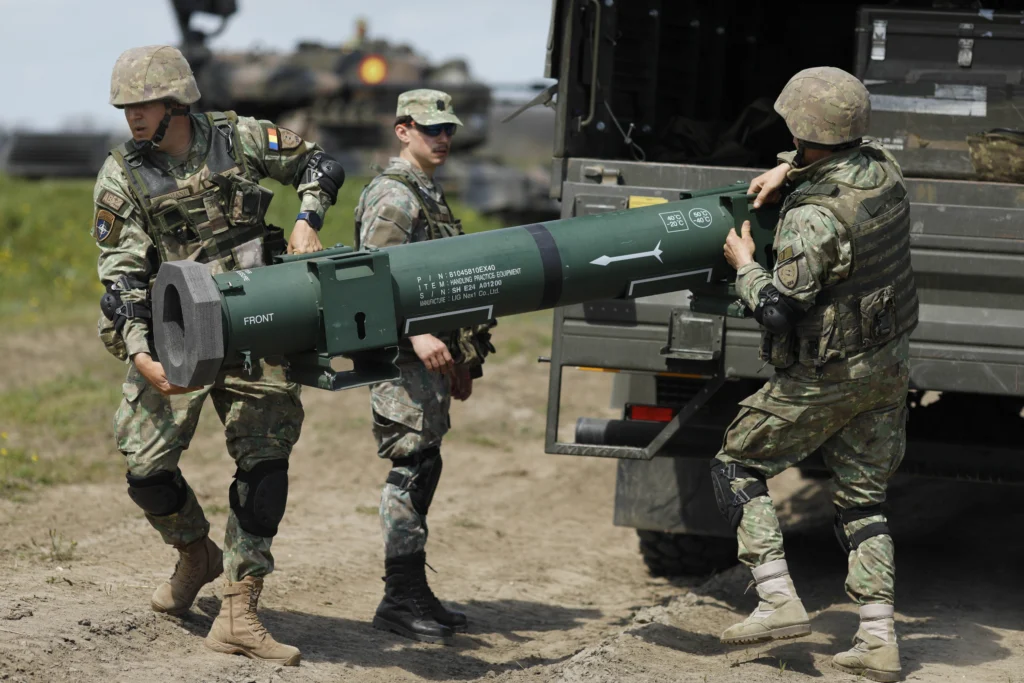
Gap Filler Radar. Romania plans to acquire 12 Gap Filler Radar systems, valued at 258 million euros, capable of detecting UAVs, cruise missiles, helicopters, and hard-to-detect airborne targets in conditions of electromagnetic jamming. These low-altitude radars are specially designed to fill the "gaps" in main radar coverage. At least 4–5 such nodes should be placed on the Isaccea–Tulcea–Galati–Braila axis.
Recommended placement for radar network:
- Node 1: Chilia Veche / Periprava (main entry point for drones)
- Node 2: Tulcea (regional coordination center)
- Node 3: Isaccea (corridor from Ismail)
- Node 4: Galati (vulnerable urban area)
- Node 5: Braila (strategic depth)
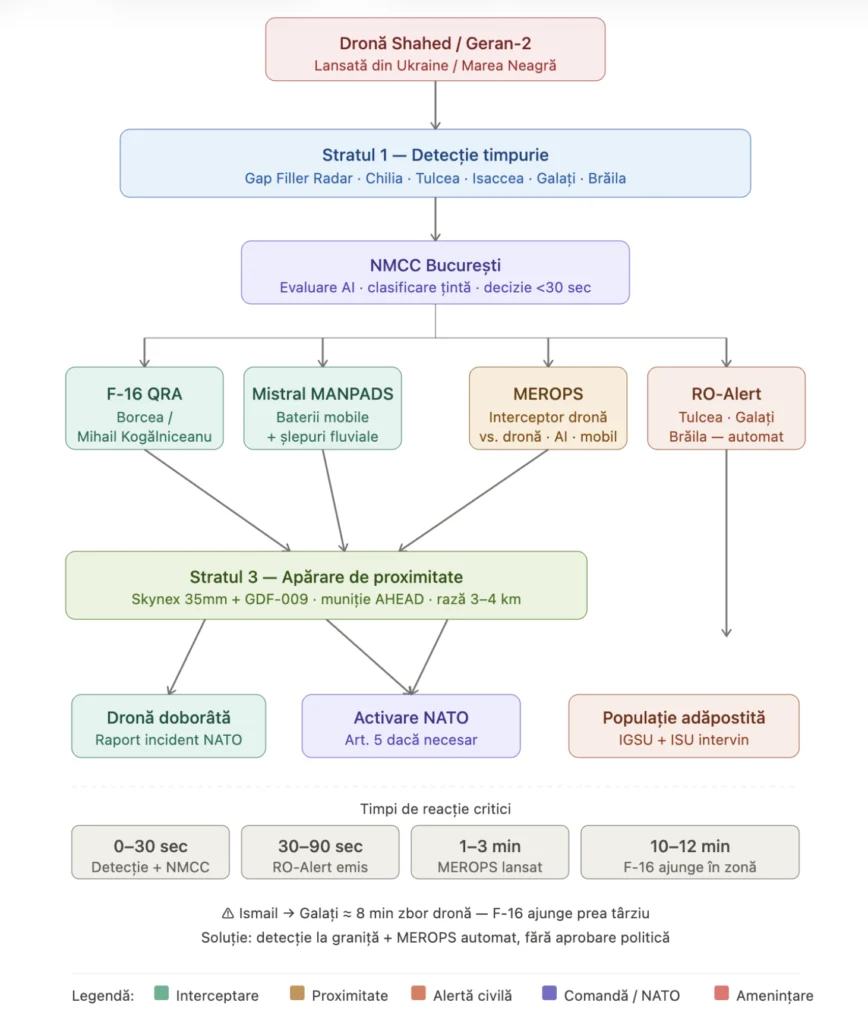
All nodes must be interconnected in the NATO NADGE/ACCS network and linked to NMCC (National Military Command Center), with a reaction time of under 90 seconds from detection to RO-Alert warning.
Layer 2. Medium-range interception: F-16 + Mistral
Rapid reaction F-16
Romania has already developed a functional procedure: surveillance radars detect drone groups, take-off orders are issued, and F-16s from the 86th Borcea Base take off on high alert. The fundamental issue with F-16s against Shahed drones is that a fighter jet costing 50+ million USD and a risky pilot to shoot down a 30,000 USD drone at low altitude above inhabited areas is an unfavorable equation — due to cost, collateral risk, and physics (engagement speed is too high).
General Donahue explicitly acknowledged the issue: pilots hesitated to shoot due to the risk of collateral damage. Romania has legislation allowing drone shooting in peacetime if there is a risk to lives or property, but has not fully utilized this authority.
Mistral MANPADS, key short-range interceptor
Romania signed a contract in November 2025 with France for the Mistral system, totaling 625.591 million euros, covering 231 launchers and 934 missiles, training, simulators, and logistical support. Mistral is an infrared-guided missile with a range of ~6 km and a ceiling of 3,000 m — ideal for intercepting Shahed drones in the final phase of their trajectory. Mistral launchers are portable or can be mounted on light vehicles, making them perfectly adaptable to the terrain in the Danube Delta.
Mistral placement: Batteries in Tulcea, Galati, Braila, Isaccea, and on military fluvial barges (for covering the Danube branches).
Layer 3. Close defense: automatic cannons and interceptor drones
This is the most critical and currently underdeveloped layer.
Skynex (Rheinmetall) + GDF-009
Romania has ordered 7 complete Skynex batteries valued at 476 million euros in the SAFE package, which means 28 cannons, each battery including 4 Revolver Gun 35mm cannons, a CN-1 command-control node with the Skymaster system, and an X-TAR3D radar. Romania has chosen the Skynex architecture and combines it with the already in-service GDF-009 cannons.
Skynex uses programmable AHEAD (Advanced Hit Efficiency And Destruction) ammunition — projectiles that explode in front of the target and generate a cloud of metallic subfragments. Firing rate: 1,000 rounds/minute per barrel. Effective range: 3–4 km.
MEROPS, drone-interceptor against drone
MEROPS is a mobile anti-drone system using its own interceptor to shoot down UAVs, functioning even in electronic jamming conditions. Each interceptor costs approximately 15,000 USD, a tenth of the price of the Shahed drones it combats.
NATO — mainly Poland and Romania, with Denmark's participation — has started integrating MEROPS after repeated airspace violations. The system was publicly demonstrated in Poland in November 2025 and is designed to intercept small UAVs rapidly and at a lower cost compared to conventional armaments. Romania transitioned from testing to operational deployment since November 2025.
MEROPS can be mounted on a pick-up truck, moved quickly, and is AI-controlled — essential for the marshy terrain of the Delta where fixed installations are impossible to place.
Radar alert systems and alert distribution
In the incident on May 29, 2026, Romania scrambled two F-16s from the 86th Base in Fetesti at 01:19, supported by an IAR 330 SOCAT helicopter, with engagement authorization. NMCC notified IGSU, which issued RO-Alert messages in Tulcea, Galati, and Braila counties. Issue: the drone had already hit the block when detected. It means early detection at the border, not late interception over the city, must be the priority.
Key principle: RO-Alert alerts must be automatically issued at the moment of border detection, not after confirming airspace penetration.
Cost of securing the area
The Romanian Parliament approved on April 29, 2026, SAFE acquisitions of 8.33 billion euros, with Rheinmetall set to be involved in acquisitions of nearly 5 billion euros through IFVs, naval systems, Skynex, Skyranger, ammunition production, and industrial projects.
Specific cost for the Danube–Delta zone (estimated):
- 2 dedicated Skynex batteries for the Tulcea–Galati axis: 136 million euros
- 1 mobile Skyranger system for the Delta: 235 million euros
- 4 Gap Filler Radars for the border: 86 million euros
- 50 Mistral launchers for zone coverage: 135 million euros
- MEROPS (20 mobile units): 5–10 million euros
Total minimum for securing the Danube axis: 600–700 million euros.
What needs to be done
Short term (0–12 months):
- Immediate deployment of MEROPS units on the Chilia–Tulcea–Galati axis
- Automatic issuance of RO-Alert at the moment of detection at the border (not after penetration)
- Quick Reaction Alert (QRA), meaning rapid reaction alert, permanently stationed at Mihail Kogălniceanu
- Mistral launchers on military river barges on the Danube branches
- Clear engagement rules: prior authorization for shooting down above populated areas
Medium-term (1–3 years):
- Delivery and deployment of Skynex batteries in Tulcea and Galați
- Operational network of 12 Gap Filler Radars
- Full integration into the NATO ACCS (Air Command and Control System)
- Permanent own reconnaissance drones on the border (continuous surveillance)
Long-term (3–5 years):
- Romanian drone industry (UAV, USV, FPV kamikaze drones) as a top priority in military capabilities modernization — local production to reduce costs and import dependency
- Directed energy systems (20–50 kW laser) integrated on Skyranger 30 for small drone interception — cost per interception: under 1 USD compared to 15,000 USD/Merops or 500,000 USD/missile
Conclusions
The fundamental issue is not the lack of equipment on paper, but the temporal gap: Romania has 28 violations and now the first civilian injured without a dedicated functional proximity system in Galați. Geran drones fly at 180 km/h — from the Ismail border to the center of Galați, it's under an 8-minute flight. F-16s from Borcea need a minimum of 10–12 minutes to arrive and engage.
The only realistic short-term solution is the combination of Gap Filler (early detection) + MEROPS (immediate interception) + Mistral (secondary layer), with clear and automated engagement rules, without waiting for political approval for each drone. Romania already has legislation allowing the shooting down of drones if there is a risk to lives or property — the issue is not fully utilizing this authority.
Sources used and useful links for the above article:
- Russian Drone Breach Near Danube Delta: Romania Deploys F-16s as NATO Stays on Edge — CDIC, September 2025
- Romania Confirms Russian Drone Struck Galați High-Rise, Wounding Two on NATO Soil — The Deep Dive, May 2026
- Russian Drone Penetrates 62 Miles Into NATO Territory, Deepest Breach Yet — DroneXL, November 2025
- Romania Deploys Jets as Russian Drones Target Ukrainian Danube Ports — UNITED24 Media, August 2025
- The Romanian Air Force Has Detected a Drone in the National Airspace — GlobalSecurity / MApN, November 2025
- The Russian Federation Conducted New Attacks Against Ukrainian Port Infrastructure on the Danube — GlobalSecurity / MApN, October 2025
- Romanian Village Evacuated After Russian Drone Strikes LPG Ship in Danube — RFE/RL via GlobalSecurity, November 2025
Defense Systems — MEROPS
- After Drone Breaches, NATO Turns to Merops System for Eastern Flank Defense — Stars and Stripes, November 2025
- U.S. MEROPS: Counter Drone System for NATO's Eastern Flank — Grey Dynamics, February 2026
Defense Systems — Skynex / Skyranger
- Romania to Order 7 Rheinmetall Skynex Air Defense Systems Under European SAFE Program — Army Recognition, January 2026
- Italy Inducts First Rheinmetall Skynex Short-Range Air Defense System to Counter Drone Threats — Army Recognition, December 2025
- Germany to Spend $9B on Skyranger 30 Systems to Counter Drones — Interesting Engineering, August 2025
- MBDA to Arm German Skyranger 30 With Counter-Small-Drone Missile — The Defense Post, November 2025
Defense Systems — Patriot and Mistral
- Romania — PATRIOT Air Defense System — DSCA (Defense Security Cooperation Agency), April 2025
- Raytheon Wins $168M Contract to Supply Patriot Air Defense Systems to Romania — Army Recognition, December 2025
- Romania Advances European Air Defense Capabilities with €626M Mistral MANPADS Procurement Deal — Army Recognition, November 2025
SAFE Package and National Strategy
- Europe Approves €16 Billion SAFE Deal for Romania's Massive Military Procurement Program — Army Recognition, May 2026
- Romania's Emerging Drone Industry: Laying the Foundation for the EU Drone Wall — Saratoga Foundation, February 2026
Legal Framework and Regulations
Drone Laws in Romania (2026): Rules, Fines, Permits — Drones Gator, March 2026