
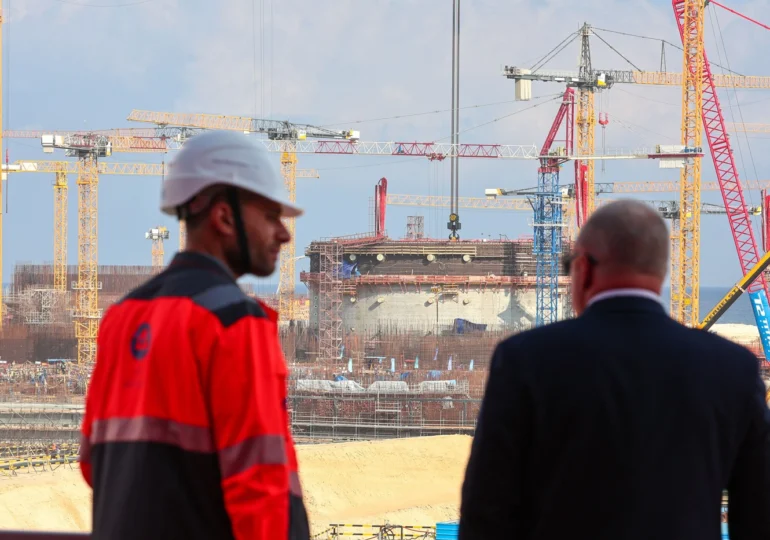
A Russian state-owned company building a nuclear power plant in Hungary is facing accusations of safety, security, and engineering deficiencies at another project in Egypt that uses the same technology.
The accusations are related to the construction of the El Dabaa nuclear power plant in Egypt, according to internal documents obtained by Politico.
What Egypt Wanted and What the Russians Did
The El Dabaa complex will include four units with Russian-designed nuclear reactors, under the supervision of the Nuclear Power Authority. Egyptian Prime Minister Mostafa Madbouly stated in July that construction works on all four reactors at El Dabaa are expected to be completed by 2030, with the first unit set to begin energy production by 2028. To date, no nuclear fuel has been introduced on-site.
After Europe imposed severe sanctions against Russia following the outbreak of the war in Ukraine in 2022, Rosatom attempted to convince European governments that it remains a reliable and competent supplier in the nuclear energy market. However, accusations of safety standard violations could amplify existing concerns about the activities of the Kremlin-controlled company in the EU.
However, in a confidential letter dated June 4 and addressed to a Rosatom leadership representative, the Egyptian Nuclear Power Authority describes "defects" affecting multiple reactor units, as well as violations of "nuclear safety culture" during the construction of the El Dabaa plant. The letter also mentions "deliberate negligence" by an official involved in the project.
The set of confidential documents was provided through an intelligence service official, under anonymity protection, and has not been previously made public, as reported by the cited publication.
Accusations Against Rosatom
In a letter sent to Rosatom by the Egyptian authority, an agency official flagged defects in units still under construction.
"Serious concrete defects have reappeared, including voids behind the metal cladding in Unit 4, defects in the foundation slabs of Units 1, 2, and 3 – whose rectification lasted a year – as well as defects in the cellular structure of the cylindrical wall of the reactor building at Unit 4," details the letter.
Additionally, the Egyptian agency accuses Rosatom of using deceptive methods and reporting fictitious work in an attempt to demonstrate that over half of the plant's construction is completed, "while a visual inspection on-site clearly shows that the main buildings of the nuclear island are still in the underground construction phase."
According to the Egyptian authority, Rosatom also maintains an unprofessional organizational culture, where employees were found with "prohibited alcoholic beverages" at the workplace. Additionally, Russian employees "used forged permits and impersonated others to gain unauthorized access" and took various "photos and videos on-site" that ended up on social networks, "negatively affecting the project's reputation."
The letter mentions a serious accident on-site, where a worker suffered "a severe open fracture" and was later secretly transported in a private vehicle, instead of being attended to by a "properly equipped ambulance" – an action the Egyptian authority claims was aimed at covering up the incident.
Four additional internal documents of Rosatom, consulted by Politico, confirm aspects related to the concerns of the Egyptian authorities, highlighting delays, construction quality issues, and project management deficiencies, as reported by the publication.
Moreover, an internal audit project of Rosatom had already warned in 2025 of a "significant risk of non-compliance" with the company's contractual obligations and estimated that the preliminary deadline for the first unit of the El Dabaa reactor could be delayed by 18 months, from September 2028 to March 2030.
In a statement sent via email to Politico, Rosatom stated that it adheres to the highest nuclear safety standards and has done so throughout the construction of the El Dabaa plant. None of the accusations in the letter presented to Rosatom by Politico has been "confirmed within the contractual, technical, and project oversight procedures," as stated in the company's communication.
What Is the Impact on Hungary
The plant built by Rosatom in Egypt will use the same technology underlying the Paks II project in Hungary, an initiative to expand nuclear capacity supported by the Kremlin, which has repeatedly strained relations between Budapest and the European Commission.
The Commission stated to the cited publication that they were not aware of the confidential documents and the accusations they contain. "For the EU, nuclear safety is a major priority," a Commission spokesperson affirmed. They added that while the Commission monitors the project's progress, "aspects related to nuclear safety fall under the responsibility of the targeted EU member state."
Initially approved in 2014 by Hungarian Prime Minister Viktor Orbán, the Paks II project became a symbol of Budapest's alignment with Vladimir Putin and facilitated the penetration of Russian energy technology into the EU. Works on this project began in February of this year.
For the government led by recently elected Prime Minister Péter Magyar, revelations about Rosatom represent a new thorny issue: the Paks II project remains essential for Hungary's plans to decarbonize the energy system and replace outdated nuclear capacities. In an attempt to reassess policies from the Orbán era, Magyar's government recently launched an analysis of the Paks II project, questioning its enormous costs and its ties to Putin.
Benedek Jávor, a former Hungarian Green Party lawmaker who closely monitored the Paks II project and criticized the Orban government, warned other governments about collaborating with Rosatom. He told the cited publication that in his opinion, the accusations related to the El Dabaa project could have major consequences for Rosatom and the fate of the Paks II project.
"They have already decided to reanalyze the contract, a decision communicated during the election campaign," he said, referring to Magyar's government. "These Egypt-related revelations will certainly be part of the evaluation process," he mentioned.
The Kremlin-controlled company is carrying out nuclear power projects in Turkey and China, while Germany faces criticism after approving, in July, an agreement allowing a Rosatom subsidiary to contribute to the manufacture of nuclear fuel rods for a plant in Lower Saxony. The German government stated that the agreement will be subject to strict national security control measures.
In an extensive commentary, the Royal United Services Institute, a London-based defense and security organization, warned Western states about collaborating with Rosatom, citing the company's close ties to Russian intelligence services and its problematic role in the forced takeover, through military means, of the Zaporizhzhia nuclear plant in Ukraine.
T.D.