

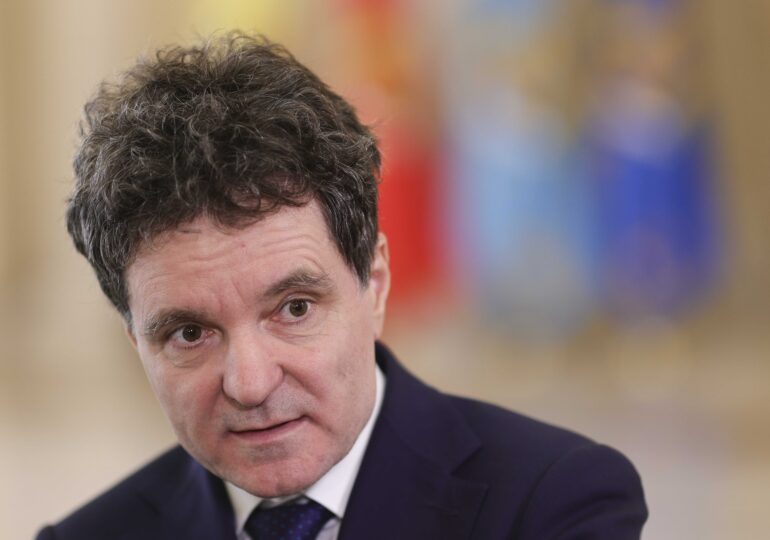
President Nicușor Dan begins official consultations on Monday for the designation of a new prime minister, following the fall of the Bolojan Government. All parliamentary parties and the group of national minorities have been summoned to Cotroceni Palace, starting at 9:00, with the PSD being the first. Next are AUR, PNL, USR, UDMR, national minorities, SOS Romania, and POT.
However, there are no expectations for a quick solution. Nicușor Dan has already stated that, most likely, on Monday and Tuesday, he will not make any public statements regarding the designation of the prime minister.
In addition, he conditioned the nomination on the existence of a clear majority - an atypical approach compared to the usual practice, where the president designates a candidate for the position of prime minister, after which they build their team, government program, and negotiate the necessary parliamentary majority.
The president reverses the political logic of the procedure: he does not first designate a prime minister to negotiate support, but asks parties to show before the designation what majority they can put behind a government. For any scenario - political, minority, or technocrat government - the question is: who secures the votes?
The stakes are even higher as Romania is in a difficult economic situation, under the pressure of short deadlines, and political instability risks complicating decisions regarding the deficit, reforms, PNRR, and external credibility.
The positioning in the last week - both official and from unofficial sources - shows an almost mathematical deadlock. And Nicușor Dan, the mathematician facing his first major test as president, must find a formula that is politically acceptable, parliamentary functional, and sufficiently credible for the country's economic situation.
The most recent positions of political actors
Nicușor Dan: wants clear majority, pro-Western government, without snap elections
Main condition: the president avoids publicly endorsing a prime minister before consultations and shifts the pressure to parties: each one must say what parliamentary majority they have to support the prime minister's proposal and the political configuration for the government.
Official position
- Does not want a government that quickly triggers a new crisis. Asked about a possible renomination of Ilie Bolojan, Nicușor Dan refused to give a specific answer and only said that he would not want to appoint a government that "gives birth to another crisis."
- The option of Sorin Grindeanu as prime minister is not formally excluded, but is currently considered unlikely. The president said it is "a hypothesis," but one that "at the moment does not seem likely."
- The main criterion is not the name of the prime minister, but the majority. Nicușor Dan says that, for any scenario - majority, minority, or technocrat government - the fundamental question is: is there a parliamentary majority to support it?
- Accepts the scenario of a technocrat prime minister, but only with a majority. Nicușor Dan said that the option of a technocrat prime minister "has chances," but not as a solution imposed from above. He wants parties to first come up with a majority formula and a minimum agreement on the program. Only then could a name for prime minister be put on the table, including a technocrat.
- Rules out snap elections. He said that Romania has not had snap elections since 1989 and that the scenario is constitutionally complicated; therefore, he excludes it at this stage.
- Maintains the pro-Western line. He conveyed that the future government will be pro-Western and that Romania will not deviate from this direction.
What is said from unofficial sources
- Unofficially, names of technocrats have been mentioned as potential candidates for the position of prime minister. Digi24 mentioned Radu Burnete, presidential advisor for economic and social issues, and Șerban Matei, director at the National Bank of Romania, as possible options analyzed by Nicușor Dan. The information is not officially confirmed.
- Unofficially or in political analyses, the idea emerges that the technocrat option could be used as a solution to break the deadlock if the PSD and PNL cannot rebuild the coalition, and the options of Bolojan or Grindeanu remain unacceptable for one of the sides.
In short: Nicușor Dan tries to avoid being perceived as imposing a prime minister and asks parties to come up with a functional majority. He does not seem willing to risk a government that falls immediately, but also does not open the door to snap elections. The technocrat option remains possible, but only if parties can support it in parliament.
Ilie Bolojan and PNL: no coalition with PSD. If PSD is in government, PNL goes into opposition
Main condition: PNL, through Ilie Bolojan, has firmly positioned itself against a new government formula with the PSD. It is not just a discussion about who should be prime minister, but about the participation of the PSD in the government.
Official position
- PNL no longer wants a coalition with PSD. Bolojan says the party has made two decisions: it will not enter into a coalition with the PSD and, if the PSD is in government, the PNL will be in opposition.
- Rejects the option of a technocrat government if the PSD is included. For the PNL, a technocrat prime minister does not change the nature of governance if the PSD remains part of the formula. Bolojan conveyed that the party can consider any proposal, but a technocrat government with the PSD does not solve the political problem.
- Accuses the PSD of causing the crisis and not offering a solution. Bolojan says that the PSD should have taken responsibility after triggering the crisis, but prefers to remain "in the second line."
- PNL coordinates with USR. PNL and USR are on the same public line: they do not support a government formula with the PSD. Dominic Fritz confirmed coordination with Bolojan before the consultations.
- The interim government maintains its administrative priorities. Bolojan indicated that, during the interim period, important issues such as renegotiating the PNRR and managing current administrative obligations remain crucial.
What is said from unofficial sources
- Unofficially and in political analyses, the scenario emerges that the PSD could try to attract a part of the PNL into a government formula, despite the official position taken by Bolojan. This would either isolate Bolojan or find liberals willing to accept a government with the PSD.
- Another hypothesis mentioned is the two-step scenario: a prime minister proposal from the PSD or a technocrat could be tested in Parliament, and if it does not gather enough votes, the president could return to the Bolojan option. However, it seems like a strategy with very slim chances of confirmation.
In short: PNL firmly positions itself: no PSD. This makes it very difficult to rebuild the old coalition and pushes the discussion towards minority, technocrat formulas, or towards a prolonged deadlock.
Sorin Grindeanu and PSD: stable government, accepts multiple scenarios, but without Bolojan
Main condition: The PSD tries to present itself as a party willing to participate in a stable government formula, but sets a major political condition: no Ilie Bolojan as prime minister.
Official position
- PSD wants a stable government, not necessarily a quick one. Sorin Grindeanu said he prefers a stable formula, even if negotiations take longer, instead of a makeshift government.
- Does not exclude a minority government, but does not present it as a desired option. When asked about a possible PSD-UDMR minority government, Grindeanu said it is not a preferred option, but can be considered.
- Principally does not exclude a technocrat prime minister. The PSD conveys that it has several options and that the option of a technocrat prime minister can be discussed. However, it is not presented as the preferred solution.
- Would accept being prime minister if the party decides. Grindeanu left open the possibility that if the PSD were to propose him for the position of prime minister, he would accept if that were the party's decision.
- The anti-Bolojan line remains central. The PSD rejects Ilie Bolojan's return to Victoria Palace and holds him responsible for the political crisis and the social costs of austerity measures.
- PSD officially rejects governance with AUR. Social Democrats say there is no governance plan with AUR and that a joint vote on a motion does not mean building a PSD-AUR coalition.
What is said from unofficial sources
- Unofficially, the PSD would consider the option of a technocrat prime minister and a PSD-UDMR-minorities minority government. This option has been discussed within the party after the PNL and USR conveyed that they no longer accept a government formula with the PSD. The central issue of this formula is the majority. The PSD, UDMR, and minorities would not have enough votes on their own, which would require seeking additional votes. Here arises the political risk of support, directly or indirectly, from AUR, SOS, POT, or individual MPs. UDMR explicitly rejects a formula dependent on AUR.
- Another hypothesis mentioned is that the PSD could try to find liberals willing to enter a government formula, despite PNL's official line. Currently, this option is not confirmed.
In short: PSD wants to return to the power table, but without Bolojan. It does not seem to insist publicly on Grindeanu as the only option for prime minister, but rather on the idea of a stable government and removing Bolojan from the equation. The technocrat or minority scenario seems to be used as a negotiation alternative.
USR: without PSD, coordination with PNL, rejects technocrat-paravan
Main condition: USR rejects returning to a majority with PSD and coordinates with PNL. The party sees the option of a technocrat prime minister as problematic if it would allow PSD to remain in power without directly assuming governance.
Official position
- USR maintains its decision not to form a majority with PSD. Dominic Fritz stated that after voting alongside AUR on the motion, PSD can no longer be a partner for USR.
- USR coordinates with PNL. Fritz discussed with Ilie Bolojan, and the common line is that PNL and USR do not support any form of governance with PSD.
- Rejects a technocrat government if it is a shield for PSD. Dominic Fritz said that a technocrat government seems like "a kind of shield" through which PSD would continue to wield power.
- USR would not vote for a PSD–UDMR–minorities government with a technocrat prime minister. For USR, a government with political ministers remains political, even if the prime minister is a technocrat.
- Could discuss a formula without PSD. USR is willing to discuss a formula with PNL and possibly UDMR, but the issue is that such a formula does not have a clear majority on its own.
What is said on sources
- According to sources or publicly discussed scenarios, USR appears in two variants: either in a PNL–USR bloc that blocks PSD's return to government, or in an alternative formula PNL–USR–UDMR–minorities, if PSD is out of the equation. The problem with this variant is parliamentary arithmetic. Without PSD and without AUR, a PNL–USR–UDMR–minorities formula does not seem to have a clear majority. Therefore, the scenario is more of a negotiating position and a political line rather than a complete governing solution.
In short: USR is aligned with PNL: no governance with PSD. This puts it in direct opposition to the preferred formula of UDMR and PSD, which is the reformation of the broad coalition. The technocratic option is rejected if PSD remains behind it.
UDMR: wants coalition reformation, excludes AUR, does not exclude opposition
Main condition: UDMR is the most explicit party in favor of reforming the old coalition. Kelemen Hunor admits, however, that if an acceptable formula cannot be built, UDMR can remain in opposition.
Official position
- The first option is the reformation of the coalition. Kelemen Hunor stated that UDMR's first option is the reformation of the coalition including PSD, PNL, USR, UDMR, and the group of national minorities.
- UDMR wants a majority or transparent support. If a majority cannot be built, UDMR could discuss, at most, a minority government with transparent support.
- Excludes any formula with AUR. Kelemen Hunor clearly stated that UDMR does not accept a governance formula with or supported by AUR.
- Rejects the scenario of PSD–UDMR with a technocrat prime minister. Kelemen stated that there is "no" possibility of a government with a technocrat prime minister and ministers from PSD and UDMR, as such a formula would be a minority one and would end up seeking votes from the AUR area or other formations that UDMR does not accept.
- Does not exclude opposition. Kelemen stated that UDMR can remain in opposition if there is no acceptable government formula.
What is said on sources
- PSD, on sources, would consider a minority government with UDMR and the minorities, but UDMR officially rejects this variant if it depends on AUR or non-transparent votes.
In short: UDMR seeks stability through the reformation of the old coalition, but the red line is AUR. If there is no majority without AUR, UDMR prefers opposition.
AUR: wants snap elections or governance with its own prime minister. Does not support a PSD prime minister
Main condition: AUR uses the crisis to present itself as an alternative to the parties that have governed and to either force snap elections or a formula where the party plays a central role.
Official position
- AUR contributed to the fall of the Bolojan Government. The motion of no confidence was initiated/supported by PSD and AUR and passed with 281 votes, leading to the government's fall.
- AUR does not support a PSD prime minister. George Simion stated that the party will not support a prime minister proposed by PSD.
- AUR would only enter government with its own prime minister. George Simion conveyed that AUR can take on governance if the party's proposal for the position of prime minister is accepted.
- AUR does not want to be used merely as a parliamentary tool. Simion stated that the party will not attend consultations if called only formally, "as a mere formality."
- AUR does not vote for a government it is not part of. Dan Dungaciu, AUR's Vice President, stated that the party will not vote for any government it is not part of.
What is said on sources
- There is no solid scenario in which AUR would effectively negotiate entering a coalition with PSD, PNL, USR, or UDMR. AUR appears more as a pressure actor and a possible source of votes in a minority scenario, but such a dependency would be very politically challenging for the other parties to assume.
- In scenarios regarding a possible minority government of PSD–UDMR–minorities, AUR mostly appears as a legitimacy issue.
In short: AUR pushes for a formula that gives it a central role or for snap elections. It does not seem interested in supporting a PSD or technocrat government from the outside, but through parliamentary arithmetic, it can become a pressure factor on any minority formula.
The deadlock is almost mathematical
Parliamentary arithmetic and public red lines do not overlap.
For a stable majority, the simplest formula on paper would be the reformation of the coalition PSD–PNL–USR–UDMR–minorities. This is also the option UDMR supports most clearly. However, this formula is politically blocked by PNL and USR, which firmly state that they no longer accept governance with PSD.
A PSD–UDMR–minorities formula, possibly with a technocrat prime minister, is discussed on sources, but it lacks a clear majority. To pass through Parliament, it would need additional votes. These votes could come from unaffiliated MPs or from the AUR/SOS/POT area, creating a major legitimacy issue. UDMR explicitly rejects any dependency on AUR, and USR and PNL would use such a formula as an argument that PSD governs, directly or indirectly, with the support of the far right.
A PNL–USR–UDMR–minorities formula, without PSD, aligns with the political line of PNL and USR, but it does not have a clear majority. Additionally, UDMR stated that its first option remains the reformation of the broad coalition, not a fragile minority formula.
AUR, in turn, does not want to support a PSD prime minister and states that it will not vote for a government it is not part of. This further limits the maneuvering space for minority formulas.
Therefore, each variant has a structural issue. The positions of the past week - both official and from sources - indicate an almost mathematical deadlock. In this context, the consultations on Monday are shaping up to be the beginning of a difficult negotiation, with minimal chances of finding a solution that is politically acceptable, parliamentary functional, and credible enough for the country's economic situation.