
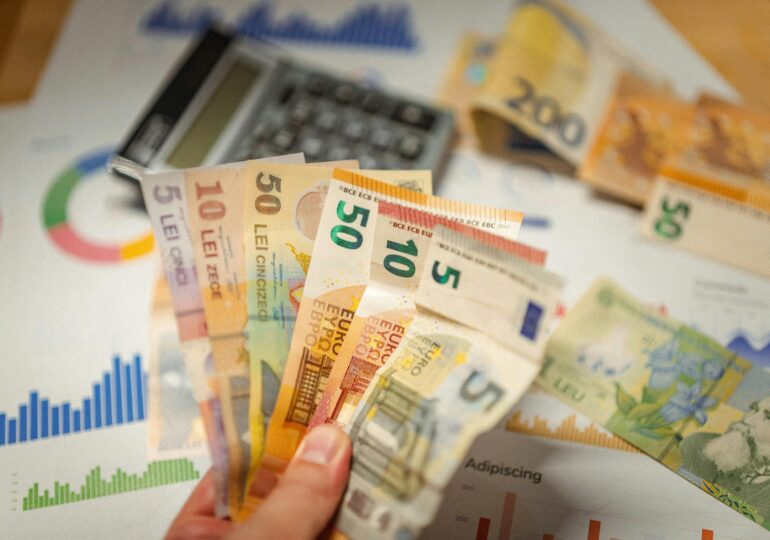
The euro currency sharply increased on Wednesday, May 6, to a historic level of 5.2688 lei. The political crisis triggered by PSD has turned into a governmental crisis through the dismissal of the Bolojan Government, which seems to further evolve into a crisis of confidence in the leu.
This phenomenon comes against the backdrop of the „euroization” of the economy and personal finances over the past year, as a result of the advantage that euro-denominated loans have had so far. This advantage is now rapidly diminishing.
The rapid depreciation in recent days indicates a panic in the foreign exchange market, especially among the population and companies, considering that:
- Sovereign interest rates on bonds in lei remained stable on Tuesday and even decreased on Wednesday (indicating a halt in capital outflows);
- Market interest rates, both ROBOR and short-term rates (for overnight financing and overnight transactions) remained stable, showing that banks still have excess liquidity, there is no speculative activity, and therefore, there have been no major interventions by the National Bank of Romania (BNR) to drain the excess money from the market.
I. Exchange Rate Evolution: The Leu Lost 3.4% in One Week
The depreciation of the exchange rate, now reaching -3.4% in just one week (from 5.0937 on April 29 to 5.2688 on May 6), is an unusual move for the euro/leu exchange rate, given that the BNR uses it as an anchor of stability and explicitly keeps it stable.
The current sustained depreciation of the leu is more negative than that of May 2025 when the BNR spent over 6 billion euros to protect the leu, and the exchange rate still experienced a depreciation of +4 standard deviations.
The depreciation pressure emerged from the early days of the political crisis, as BCR analysts noted that the volume of transactions on the local foreign exchange market surged on Friday, April 15. At that time, the transaction volume exceeded the long-term weekly average, with most transactions taking place on that Friday, representing about 60% of the total weekly volume.
In the context of the political crisis triggered by PSD, which allied with AUR to dismiss Prime Minister Ilie Bolojan, investors began to sell their holdings of Romanian lei-denominated bonds (pushing up sovereign interest rates) and withdraw their money from Romania, putting pressure on the exchange rate as the withdrawal of funds from foreign investors is converted into foreign currency, and foreign investors who remain or enter the market for buying must protect themselves through currency hedges.
BNR seems to have intervened in the market several times in recent days to curb the volatility of the euro/leu exchange rate, but the fact that the rate broke through the thresholds previously defended by the BNR (5.1 lei/euro and 5.2 lei) showed that the depreciation pressure was strong, making intervention too costly compared to possible benefits, considering the degree of overvaluation of the exchange rate before the crisis.
II. Euroization of the Economy: Leu Depreciation Leads to Major Price Increases
At the same time, a financial euroization rate of ~32% - the proportion of loans and bank deposits denominated in foreign currency compared to the total - may seem modest at first glance in terms of its impact on the economy.
Especially compared to the peak before 2015 when foreign currency loans exceeded 60% of the total, euroization seems to have retreated. However, the figures on financial euroization tell less than half of the story because in reality, the degree of euroization of the economy has intensified in recent years.
This is now more pronounced at the level of the real economy, even though euro-denominated bank credit and deposits have decreased as a share of the total. In practice, only the form in which euroization manifests itself has changed: from euro-denominated loans to euro-denominated prices.
Rents, real estate prices (a market of over $1 trillion according to some estimates), a significant portion of services and industrial equipment are quoted in euros - which means that a leu depreciation directly translates into living and production costs, regardless of whether the household or the respective company has foreign currency loans or not.
A depreciation of -3-4%, like the one in the past week, means in concrete terms: higher rents, land, apartments, and cars (cars are quoted in euros, and the conversion is made at payment), higher costs for imports, higher bills for services in euros (e.g., telecommunications, Netflix subscriptions, and other monthly services), pressure on firms' margins that purchase raw materials or equipment from imports, and the list goes on.
The effect is not immediate or uniform, but it will accumulate and be seen in inflation within 1-3 months, amplifying an existing inflationary surge that will erode the purchasing power of the population, already under pressure due to fiscal adjustment measures.
Read the full analysis on Political Crisis Turns into Confidence Crisis in the Leu: How and Why the National Currency Depreciated by -3.4%. Public and Corporate Panic Creates Risk of Abrupt Economic Landing on Curs de Guvernare