

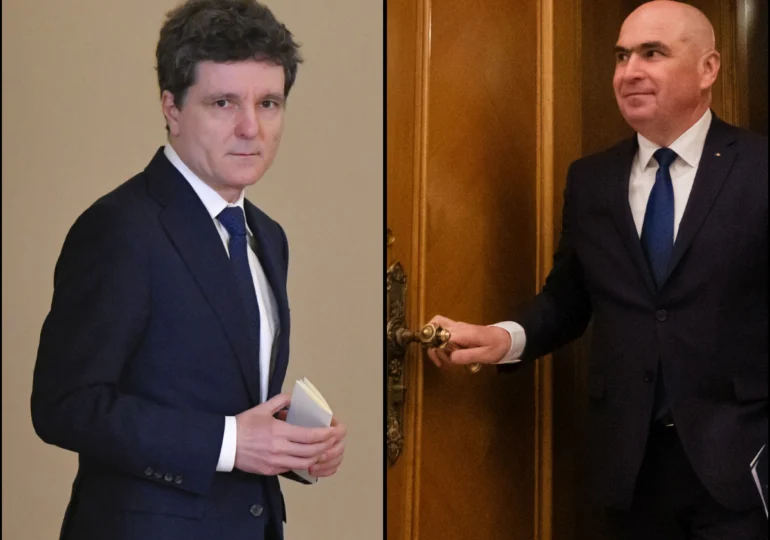
Instability will be the norm until the 2028 parliamentary elections, and the most important objective for responsible political leaders in the country would be to prevent the rise of AUR, a party that would lead to the isolation of the country, as it happened in the ’90s after the mineriads.

Relevant Quotes:
- Morally, the first step towards reconciliation must be taken by the president. Strictly institutionally, it should be done by the Opposition leader, Ilie Bolojan. But after everything that has happened – including Nicușor Dan’s unfortunate gesture of not thanking Bolojan at the end of his term as prime minister, a gesture he could have made without leaving the zone of neutrality – I believe the signal must come from the Cotroceni Palace.
- Ilie Bolojan and Nicușor Dan need to sit down and discuss the future of the country. Not as formal allies, not as a declared coalition, but as individuals who essentially have the same objective: to prevent an extremist party from coming to power.
- From my perspective, at least in the first part of the term, Nicușor Dan treated PSD with too much goodwill. Anyone who knows PSD knows that you cannot rely on them as a stable partner – and they will stab you in the back when you least expect it.
You are a person who has worked within the presidential institution, and I know that you have always shown special respect for it. From the perspective of the current political crisis, what can a president do and what cannot be done?
I believe the president could have done more before the crisis erupted if he chose to get more involved through the levers he has.
Now we are at the point where the motion has passed, the Government has fallen, and what remains to be done is to negotiate in a way that takes into account the interests of each party, but especially those of Romania. I refer to a government as stable as possible, which takes on the continuation of reforms. And, naturally, it must also consider its own political interest - this exists in every decision of any political actor.
Specifically, the president will have to make a nomination for the position of prime minister. And the electorate will look closely at this choice, especially since we are dealing with an extremely divided society.
We are no longer in a normal situation where several electoral bases coexisted relatively peacefully. Now we have a real war between two camps - the sovereigntists, whom I define more as latent conservatives, hostile to change, and the reformist camp. Neither of them is willing to see nuances anymore. Everything appears in black and white. Gray has disappeared, and this unfortunate context greatly complicates the president's mission.
How do you think this crisis will evolve? Are there chances that the designated person will obtain the investiture vote?
President Nicușor Dan's statement suggests that he is considering an independent prime minister, probably supported by PSD. We have had experiences of this kind before. I don't believe this will be the first option put forward. I think it is more of a testing balloon, a backup scenario.

From my point of view, if we look at things objectively, the first nomination will be a prime minister from within PSD. Why? Because a technocratic prime minister, no matter how competent, will govern with the handbrake on. Ministers will not listen to him, he will not have political authority, he will not have the "stick," only the "carrot." PSD will be able to play the same schizophrenic game we know: in the morning you sit at the table with the prime minister and convey messages of good governance, in the evening you criticize him on television.
Furthermore, we have real emergencies: we are in a race against time to attract funds from the NRRP, the SAFE program. National interest requires a government with real powers. A technocratic prime minister, in the conditions of a PSD-UDMR minority government, could last at most three months.
There has also been talk of a mixed form: PSD forms the government, the other three parties vote for it at investiture, then a law project is negotiated with the project. Is this a viable scheme?
Theoretically, yes. But I believe that PSD is simultaneously working on another scenario: to break a group of PNL MPs, offer one or two ministerial positions, and thus build its own majority. We have seen this movie with ALDE before.
If you create a fracture in PNL, bring a few parliamentarians to your side, you put pressure on the entire party and destabilize it. PSD's plan did not stop after the three failures in trying to bring down Bolojan - the budget, immediate resignation, withdrawal of ministers. It has reached a motion. The plan will continue.
Will we lead this government crisis from government to government until 2028?
All indications show that a succession of unstable governments is more likely than a solid government that will see the legislature through to the end.
The current coalition has fallen apart. The question is not if we will have more crises, but how often.
If PSD enters government in a minority form, it will be forced to face, on the one hand, an AUR that continues in opposition on its own path and, on the other hand, a Bolojan who has just left the Victoria Palace and knows exactly the economic situation, knows what reforms were planned and what remains undone.
Bolojan will not be an opponent who will manifest himself primarily politically. He will be a technical opponent who will dissect every measure. And technical consistency is the strongest argument behind a political discourse.
For example, what is the difference in approach to Parliament and to political power in general between Nicușor Dan and Traian Băsescu, a president you know, for whom you have worked?
Traian Băsescu was a player president. Nicușor Dan is, for now, more of an advisor, an arbiter.
Băsescu understood politics from the inside - he had been a party leader, knew how to mobilize, attack, negotiate. And he had a strong party behind him. Nicușor Dan chose to distance himself from both PNL and USR, leaving him without a solid political anchor.
From my perspective, at least in the first part of the term, Nicușor Dan treated PSD with too much goodwill. Anyone who knows PSD knows that you cannot rely on them as a stable partner - and they will stab you in the back when you least expect it.
Băsescu also engaged in communicational battles. Nicușor Dan chose not to do so. However, we must be fair: Nicușor Dan is in the first year of his term, facing a much more complicated external context than in 2004, and Romania is no longer seen as that enthusiastic champion knocking on the doors of the European Union.
In this complicated context, can anything be done against corruption?
Yes, I believe so. One of the major mistakes of the Iohannis term was taking the foot off the accelerator in the anti-corruption field.
People, if they do not have the certainty that those who steal will pay, accumulate frustration and tension. If you ask them for fiscal sacrifices, they want to see a minimum of social justice.
The president now has a prosecutor general and a chief of the DNA whom everyone speaks highly of - professionals, people from the system.
If they are given the freedom to do their job, I believe they will do it.
There are political negotiations regarding the nomination of prosecutors? Certainly. Băsescu negotiated and ended up with Kovesi and Alina Bică. Reality is never as clean as we imagine it, but the results can be good.
What is the dynamic between Nicușor Dan, Ilie Bolojan, and George Simion, and how will it evolve from the perspective of the 2028 parliamentary elections?
This is, in my opinion, the most important question of the moment. In the reformist electorate, where there are two natural leaders - Nicușor Dan and Bolojan - rifts are deepening. On the other hand, PSD and AUR practically act as a team, each using the other as a pressure tool.
The worst possible scenario is for the reformist camp to go divided to the 2028 elections.
If PNL and USR split, if Nicușor Dan acts to the detriment of one or the other, PSD wins without doing much.
That's why I believe that, at some point, Bolojan and Nicușor Dan need to sit down at a table and discuss the future of the country. Not as formal allies, not as a declared coalition, but as individuals who essentially share the same objective: to prevent an extremist party from coming to power.
Who should take the first step?
Morally, the president. Strictly institutionally, the leader of the Opposition should do it, meaning Bolojan. But after everything that has happened - including Nicușor Dan's unfortunate gesture of not thanking Bolojan at the end of his term as prime minister, a gesture he could have made without stepping out of the zone of equidistance - I believe the signal should come from the Cotroceni Palace.
A persistent conflict between the presidency and the main reformist opposition party does not help anyone. It doesn't help the electorate, it doesn't help Romania, and ultimately, it doesn't help Nicușor Dan himself.
Nicușor Dan needs Bolojan. And Bolojan needs Nicușor Dan. The longer the realization of this need is delayed, the more those whom both would like to stop will benefit.