

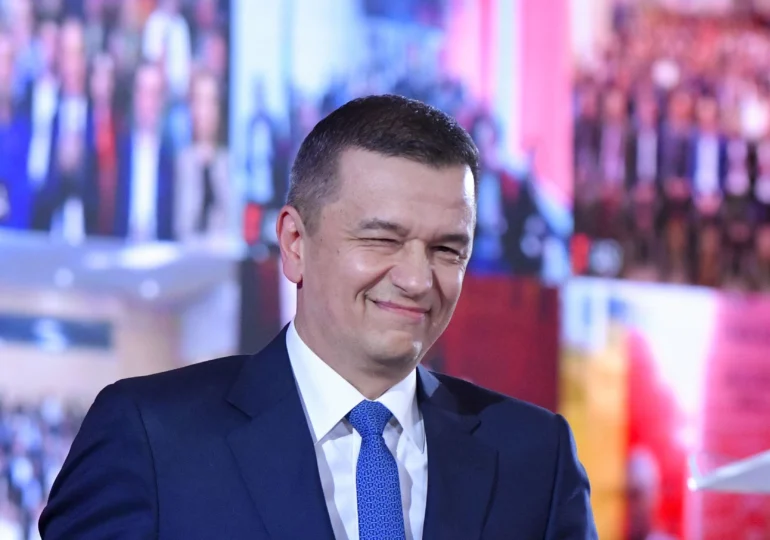
One week after the vote of no confidence that led to the dismissal of the government, Sorin Grindeanu is approaching the moment when he will be appointed by President Nicușor Dan to form a new parliamentary majority and lead a new Executive. But it will be a weak one and dependent on AUR support.

Relevant quotes:
- The crisis we are experiencing is a continuation of a moment that has never ended since the 2024 elections.
- I think about the parallel with Florin Cîțu: after being ousted by a motion, everyone tried to get rid of him. Here it happened exactly the opposite. Bolojan was not the best political strategist – a prime minister’s role is to maintain a majority. But after the motion, he seems recharged.
- PSD performs well in elections where „peace” is at stake – the Iliescu-era peace of the ’90s. When they try to create tension, there is mobilization among the opposing electorate. PSD is good at mobilizing with mayors, but the transition to social media has not been successful.
How is it in Denmark?
Spring has come, and it’s pleasant. Here, too, there are serious political problems: after the parliamentary elections at the end of March, Denmark has one of the most fragmented parliaments in Europe, with 12 parties. Last week, negotiations around the social democrats collapsed, and the main right-wing party was tasked with forming the government. There is also agitation here around the formation of the government.
Should we get used to this type of political fragmentation in Romania?
It is a very visible trend in the last 10-15 years. In political science, it was said that Eastern Europe is more fragmented, and the West is better organized - but levels of volatility and fragmentation have started to become similar. We had a main axis of conflict between left and right economics, now we have a secondary, identity axis. Hence, the emergence of populist, radical right parties and the Greens. We saw this in the local elections in the UK last week, even though their electoral system does not encourage this phenomenon.
How do you see the crisis in Romania? Where are we heading?
The crisis we are experiencing is a continuation of a moment that has never ended since the 2024 elections.
Back then, we had a political shock; all parties told us they understood the message, and we built an unnatural coalition, with four parties plus minorities, with extremely different ideological approaches and electoral bases.
It's hard to keep these parties together even in normal times. And we are not in normal times: we have austerity and a complicated economic situation.
Usually, austerity boosts support for populist parties - exactly what is happening here.
A major cause of the crisis is that PSD has not adapted to its new status. A party that had 45-46% in 2016 is now at 22% - its weakest result in the last 25 years.
It missed twice getting into the second round of the presidential elections and doesn't know how to position itself against AUR because it feels voters are going there. Probably, PSD thought an electoral shock would help.
We have two scenarios: Sorin Grindeanu appointed prime minister or Ilie Bolojan reappointed. How do you see the situation?
These are the most realistic scenarios. Snap elections are very difficult to hold here and have never been held, even when the main actors wanted them.
The President has clearly ruled out this possibility. I think the scenario of AUR entering the government should be taken off the table, regardless of what the parties say.
The natural continuation is a designation from PSD. We did not have the de-escalation the President talked about: PNL, alongside USR, still says they will not form a coalition with PSD. PSD, even at 22%, is the largest party in Parliament and it is natural for them to try to form a government.
The message from PNL and USR was: "You brought a no-confidence motion with an important economic component, so you have an alternative plan - put it into action."
Can PSD form a majority in Parliament? And would it be desirable for them to do so?
There are enough "voyager" parliamentarians to join the government.
But think about what a government with people from SOS, POT, parliamentarians whose political group is unknown in the morning. By evening, it could change.
It would be a circus-like government. I find it interesting that we had all this discourse about "extremists should not support the government" and we only put AUR in this camp.
But SOS is Mrs. Șoșoacă's party, who was at the Russian embassy two days ago, and POT explicitly supports Călin Georgescu.
The question is whether PSD really wants such a government because the premier's party is the one that pays the most. What will PSD do - reduce VAT, increase pensions and salaries? If, after strongly criticizing austerity, they do not change their approach significantly, the disappointment of those who thought "we get rid of Bolojan and things will improve" will be even deeper.
After the no-confidence motion, Bolojan seems more politically recharged than marginalized. How do you explain this?
I think about the parallel with Florin Cîțu: after being ousted by a motion, everyone tried to get rid of him.
Here it happened exactly the opposite. Bolojan was not the best political strategist - a prime minister's role is to maintain a majority. But after the motion, he seems recharged. If PNL continues to govern, there is predictability regarding the measures that will be taken. The uncertainty comes from the other side: expectations have been raised very high, but it is not clear how much fiscal space there is for alternative measures.
How do you explain PSD's communication blockade after the motion, considering Bolojan now has massive support on social media?
PSD performs well in elections where "peace" is at stake - the Iliescu-era peace of the '90s. When they try to create tension, there is mobilization among the opposing electorate.
PSD is good at mobilizing with mayors, but the transition to social media has not been successful.
The internal voting strategy seemed to be taken from the commercial area, without understanding who you are addressing and the potential for counter-reaction - the campaign became a meme.
The structural problem starts with justifying the action. PSD could have centered this moment around key themes: the budget, pensions, and salaries.
Instead, there was a strained relationship at a personal level with Bolojan. There is genuine dissatisfaction - in a January survey, satisfaction with the economic situation was 2.5 out of 10. But you can't automatically transfer 80% of dissatisfaction onto Bolojan. PSD was not clear about what they wanted - even their social plan was a jumble.
Is there a way for PNL and USR to return to government with Bolojan as prime minister?
It is more of a second step. We saw a nuance in Bolojan's communication: after the internal PNL vote, he said that PSD has the first chance, and if they fail, the liberals follow.
We are in a situation where everyone wants to leave the government to remain in power.
PNL was humiliated by the 285 votes against, and now they are trying for a similar humiliation for PSD, so that they say they cannot form the government alone. Only then can PNL come to take over the government.