
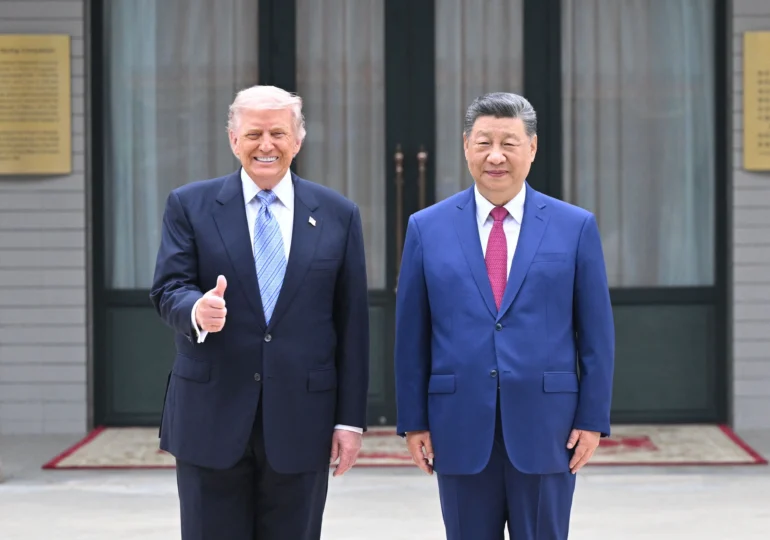
President Donald Trump has expressed great satisfaction with the discussions held with Chinese leader Xi Jinping during the two-day summit in Beijing. Behind the optimistic statements, however, the concrete results of the meeting remain limited, and some of Trump’s statements raise questions about US policy towards Taiwan.
In discussions with journalists aboard Air Force One on the way to Washington, Trump talked about possible trade agreements and cooperation in the field of artificial intelligence, but without clear details. Instead, the most sensitive issue of the summit seems to have been Taiwan, after the American leader suggested that he might reconsider arms sales to the island, a long-standing demand of Beijing, as shown in an analysis by Politico.
Commercial Promises Without Confirmations
Trump stated that Beijing will purchase billions of dollars' worth of American soybeans and announced a possible sale of 200 Boeing aircraft to China. However, Chinese authorities have not confirmed any of the agreements, and Boeing has not responded to requests for comments.
The American president also mentioned that he and Xi Jinping discussed the "possibility of working together to establish safety limits" in the development and use of artificial intelligence systems.
The summit, which Trump had previously presented as a possible "monumental event," ended without major announcements. Instead, the trade relationship between the two powers remains in a fragile balance after last year's trade war.
"The summit produced modest, marketable, and carefully controlled results, which is just about all the US-China relationship can bear right now," said Craig Singleton, a China expert at the Foundation for Defense of Democracies, a conservative-leaning American think tank on security issues.
Taiwan, the Sensitive Subject of the Summit
Although White House officials stated before the meeting that Taiwan would not be on the summit's agenda, Trump confirmed that the subject was extensively discussed with Xi Jinping.
Furthermore, the American leader declared that he is considering a reassessment of arms sales to Taiwan, as the US has been providing defensive weapons to the island for decades to deter potential Chinese aggression. "I will make a decision in a fairly short period," Trump said when asked if he would continue arms sales to Taiwan.
He also mentioned that he will discuss with the "person leading Taiwan" - an apparent reference to Taiwanese President Lai Ching-te - before making a decision.
Trump also stated that he does not feel bound by commitments made by former US President Ronald Reagan in 1982, under which Washington was not supposed to consult Beijing regarding arms sales to Taiwan.
"What should I do? Say 'I don't want to talk about it' just because there is an agreement signed in 1982? No. We discussed arms sales," Trump said.
According to the American president, Xi Jinping warned that mishandling the Taiwan issue could lead to "clashes and even conflicts," endangering the entire bilateral relationship.
Trump has so far postponed the approval of arms sales to Taiwan worth $14 billion, and this is the first time he publicly admits discussing the issue directly with the Chinese leader.
"An actual negotiation or consultation on what arms could or could not be sold to Taiwan would represent a break from precedent," said David Sacks, a former political-military expert at the American diplomatic representation in Taiwan.
No Progress on Iran, Fentanyl, and Jimmy Lai
Despite Trump's displayed willingness regarding China's sensitivities on Taiwan, Xi Jinping did not offer signals that he would be willing to help Washington on other important issues.
The White House stated after the meeting that the two leaders agreed that the Strait of Hormuz should remain open to maritime transport and that no country should impose "passage fees." However, the official Chinese statement did not mention this subject and only mentioned that the leaders discussed the "situation in the Middle East."
Trump later stated that he did not even ask Xi to exert pressure on Iran. "I don't need favors," the American president said.
The White House acknowledged that no significant concessions were obtained on other sensitive points of the relationship with Beijing.
According to Trump, Xi Jinping rejected accusations of Chinese cyberattacks on American infrastructure, recalling "the attacks we have made in China."
Trump mentioned raising the issue of Chinese chemicals used by Mexican cartels to produce fentanyl, but without concrete results.
At the same time, Xi Jinping refused Trump's request for the release of pro-democracy activist Jimmy Lai from Hong Kong.
According to the American leader, Xi stated that he would "seriously consider" the case of a pastor imprisoned in China, but the release of Jimmy Lai would be "much more difficult."
A Summit "More About Symbols"
Expectations before the summit were already low, and the major structural issues in the US-China relationship - such as massive subsidies to the Chinese industry or the expansion of Chinese military presence in the Indo-Pacific - do not seem to have been deeply discussed.
"It was again a summit more about symbols than substance - about managing issues, not resolving them," said Rush Doshi, former Deputy Director for China and Taiwan at the National Security Council in the Biden administration.
However, American officials suggest that discussions between Trump and Xi Jinping will continue in the following months. Treasury Secretary Scott Bessent stated as early as January that the two leaders could meet up to four times this year.
The next direct meeting is scheduled for September, when Xi Jinping is expected to pay a state visit to the White House.
G.P.