
The embarrassing image of the Victory Day parade, shabby and lacking in brilliance, organized in Moscow, comes at a time when Russia’s advance on the battlefield has stalled.
Who is winning the war? Since the launch of Russia’s large-scale invasion against Ukraine, the war’s information space has been obsessed with this seemingly simple question and new answers, writes Kiev Independent in an extensive analysis.
For those waging the narrative war – officials from both sides, vocal online supporters, „armchair generals,” and a certain world leader who likes to talk about who holds the cards – the answers differ radically but are always presented with the same vehemence, emotion, and intellectual certainty.
„Russia has already been defeated, its ‘human wave’ attacks are stupid and hopeless, and at this rate, it would take a century to conquer Ukraine,” says one camp.
„Ukraine, clearly at a disadvantage in terms of numbers and without the support of the United States, cannot hope to resist longer than Russia and should accept any peace deal now, as time is on Moscow’s side,” says the other camp.
– What will happen in Russia after Putin? The West must be prepared
Serious analysts are more cautious, speaking of positive or negative trends while trying to understand the immense complexity of such a large-scale war.
No matter how humiliated Moscow may be by one event or another, as long as its plan to achieve victory through the slow exhaustion of the numerically overwhelmed Ukrainian army continues to work, there is no cause for celebration, they say.
The advantage will be gained by the side for which this long war of attrition evolves.
– This spring, however, something strange is in the air. Ukrainian long-range attacks on Russia are becoming increasingly effective, evolving from isolated explosions to the widespread destruction of some of Russia’s most important oil export and refining installations.
Tension was particularly palpable ahead of Vladimir Putin’s Victory Day parade, held in Moscow on May 9. Instead of the usual „postcard” demonstration of Russian power, the parade has now become a burden, a symbol of the Kremlin’s weakness and paranoia.
Only a very small number of the usually participating dictators were present at the event, which took place without military equipment and for which a ceasefire was desperately requested by Kiev.
But far more important than the facade image is the reality on the battlefield.
Instead of accelerating with the arrival of spring, as usually happens, Russia’s territorial gains have plateaued, leaving Moscow with almost nothing to show for its constantly high losses.
However, in a long war that has seen many ups and downs, perceptions can be deceiving, and hasty conclusions can be a dangerous game.
– ### Slow Spring
Since Ukraine’s failed counteroffensive in 2023 and the transformation of the conflict into a positional war of attrition for both sides, winter has always been the period when the front line stabilizes.
But in spring, with warmer weather and the cover provided by new vegetation improving conditions for infantry assaults, Russian forces typically tend to accelerate the pace, exerting tremendous pressure along the front and usually managing to overwhelm the defense in at least two sectors.
This year, that hasn’t happened – at least… not yet. At the end of winter, taking advantage of the interruption of access to Starlink for Russian forces on the ground, Ukraine launched counterattacks on a broad front in the south.
– Russian offensive slows down after blocking access to Starlink: „They’re like blind kittens”
While these responsive strikes did not lead to a breakthrough in the front, they contributed to thwarting Russia’s plans to continue advancing westward towards the city of Zaporizhzhia.
Meanwhile, further east, Russian forces have advanced and repeatedly halted in the Donetsk region, but have failed to create operational threats comparable to those seen in the springs of 2024 and 2025.
– A major advance effort northwest of Pokrovsk has bogged down in the village of Hryshyne, advances east of Sloviansk are blocked, and the city of Kostiantynivka – the southernmost in Ukraine’s urban „fortress belt” – is playing its role, forcing Russia to pay a very high price for every street and every house conquered.
The front line in the Kharkiv region, which two springs ago was the scene of a threatening cross-border offensive that risked bringing Ukraine’s second-largest city back within range of Russian artillery, is also stable.
The numbers speak for themselves: according to monthly calculations by the reliable Ukrainian mapping and analysis project DeepState, Russian forces have only gained 672 square kilometers, compared to 827 in the same period last year.
– ### Killing Machine
Why can’t Russian forces replicate their usual spring acceleration on the battlefield? Much of the answer lies at the intersection of tactics, innovation, and politics.
With a political imperative to advance and conquer territories, especially the heavily fortified Donbas, the Russian army is compelled to attack almost without pause.
According to Kiev, Russia continues to recruit between 30,000 and 35,000 soldiers monthly, allowing Moscow to sustain its battlefield losses.
However, while the influx of poorly trained soldiers from the poorest regions of Russia – supplemented by criminals, foreigners, and other marginalized groups – remains stable for now, the environment they enter continues to change.
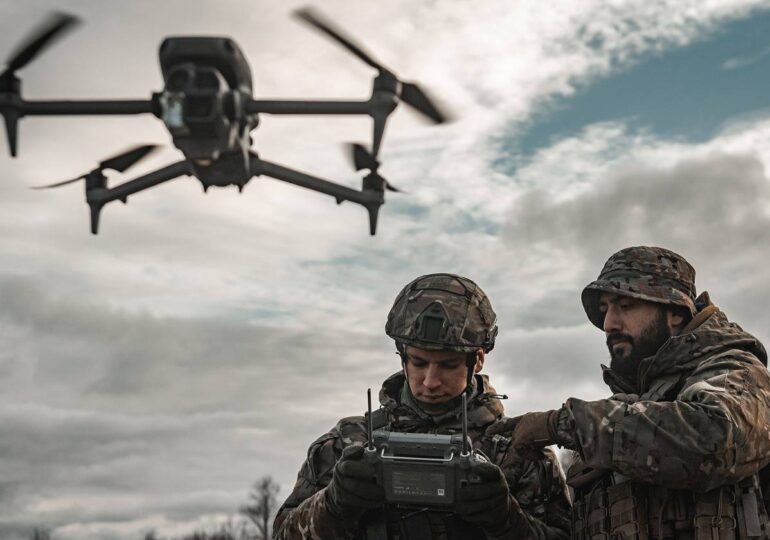
Since FPV (first-person view) drones began to appear in large numbers on the battlefield towards the end of 2023, the ability to hit any moving target with high precision and at a cost ten times lower than an artillery shell has caused a paradigm shift in warfare.
In 2026, approximately 80% of all losses on both sides are caused by drones. Concentrating any kind of forces near the front line has become practically suicidal.
With still enough equipment in depots that it can sacrifice, Russia occasionally attempts mechanized assaults, usually under the cover of unfavorable weather. Almost always, however, these end in failure, and a „good” outcome is when at least some infantry manages to dismount before the armored vehicles are quickly neutralized and destroyed.
Over time, Russian assault groups have diminished in size: where two years ago 12 infantrymen could simultaneously attack a hedge, by the spring of 2025, there were often at most five, and now it is rare to see more than one or two soldiers advancing at once.
Instead of direct assaults on positions on the „zero line,” Russian attack groups now focus more on infiltration: slipping beyond what remains of the enemy infantry to create chaos behind the front line and force Ukrainian drone teams to withdraw.
However, as more and more drones fill the sky, Ukrainian forces are learning to adapt and counter these tactics, as they have done in the past.
Much credit goes to the continuously developing and innovative drone component, both in the elite and highly publicized units of the Unmanned Systems Forces and – often overlooked – in the drone battalions of regular brigades holding the front line.
Confronted with this defensive wall of drones, Russia’s strategy based on infantry attacks quickly runs into serious dilemmas.
– ### Technology-Based Tactics
Since taking over the leadership of the Ukrainian Ministry of Defense in January, Mihailo Fedorov has begun to use modern data and management principles to optimize everything he can control – from defense production and acquisitions to drone distribution and equipment, and perhaps most importantly, the coordination of the actual battlefield.
Many of these processes have their origins in his former role as Minister of Digital Transformation, where he introduced the gamification system for Ukraine’s drone units, monitored by the advanced Delta software.
At a time when the armed forces, led by Commander-in-Chief Oleksandr Syrskyi – known for his Soviet-style mentality – have often been criticized for the lack of a clear strategy and costly systemic command issues, Fedorov’s leadership at the Ministry of Defense hopes to act as an essential counterbalance.
Perhaps most importantly, in February of this year, Fedorov achieved one of the most spectacular rapid victories for the Ukrainian war effort: he convinced SpaceX founder Elon Musk to quickly disrupt Russian forces’ access to Starlink mobile internet terminals.In the months that followed, Russia has tried its best to adapt and find its own alternatives to Starlink.
But, for the moment, as Ukrainian soldiers and commanders across the front report, the clear technological advantage that Ukraine now enjoys is felt throughout the battlefield, and its overall impact is impossible to measure accurately.
Looking ahead, as the „death zone” on the front continues to expand and both sides strive to have as many remote-operated combat systems as possible, **Starlink is likely to represent a lasting advantage for Kiev on the battlefield.**
### Vulnerable Points
No matter how positive the signs on the front line may seem, it cannot be argued that the war is changing direction without acknowledging at least the persistent and evident weaknesses in Ukrainian defense.
First and foremost, there is the geographic factor: the inherent and formidable challenge of defending a front line of over a thousand kilometers against a numerically superior enemy and, at this stage of the war, practically without truly effective strategic reserves.
No matter how effective the defense that Ukraine organizes in the dense fortresses of Donbas may be, Russia has and continues to have the option of seeking weak points on the front line to exert pressure and exploit the advantages gained.
This vulnerability was evident throughout the year 2025 when Ukraine’s deprioritization of sectors in the southern front allowed Russia to make rapid gains in areas defended with difficulty by some of the country’s weakest combat brigades.
Now, as the southern front has stabilized – largely due to the rapid redeployment of Ukrainian assault forces – it is possible that other breaches may appear in other areas.
**One vulnerable point could be the long northern frontier in the Sumy and Kharkov regions**, where Russian forces have already crossed the border in more and more places in recent months, possibly preparing the ground for a broader offensive.
In the drone dominance race, Russia is not standing still either.
Russian elite drone units, especially the Rubicon center, continue to make life extremely difficult for Ukrainian brigades facing them, suffocating logistics through fiber-optic FPV drones, intercepting Ukrainian reconnaissance and high-value bombing drones in the air, and hunting Ukrainian drone teams directly in the field.
Combined with massive artillery bombardments and large-scale ground infiltrations, Rubicon’s ability to suppress Ukrainian drone teams continues to create serious problems for defensive forces and may still create favorable conditions for significant advances.
Despite its cumbersome and centralized structure and the difficulties caused by losing access to Starlink, **Russia continues to heavily invest in its drone force**, and Kiev reported in May that **Moscow plans to produce 7.3 million FPV drones in 2026**.
However, the most serious problem for Ukrainian defense remains the lack of personnel.
In the fifth year of large-scale war, losses suffered in the attempt to withstand the huge Russian war machine must be replaced, as has always been the case.
But Ukraine’s population continues to decline, and internal tensions generated by years of large-scale forced mobilization are constantly rising.
### Moscow’s Moves
It is too early to say whether Ukraine’s promising defensive performance this spring will continue into summer or autumn. But **if the front line can remain stable while Russia’s losses fail to yield results, this could mark the beginning of a new phase of the war.**
So far, despite often chaotic and misguided efforts by American President Donald Trump to negotiate a peace deal, the war has continued simply because Russia was far from exhausting its resources, and Ukraine was far from collapsing and surrendering.
If this balance starts to shift in favor of Ukraine, Putin will not be able to avoid reacting indefinitely.
For now, **Moscow can continue its war as long as it has the people and money for it.**
On both fronts, Putin has been cautious so far. Even spending a third of the state budget on the military, Putin has tried to maintain the image of a leader who provides Russians with strength, stability, and relative prosperity in exchange for obedience and political apathy.
The most obvious example is, of course, Putin’s reluctance to announce large-scale mobilization, doing everything possible – through attractive financial bonuses for recruitment, using prisoners and foreigners – to avoid the image of a country forcibly sending hundreds of thousands of Russians to their deaths.
Putin’s near-total control over power and domination over security services mean that he could almost certainly announce mobilization without risking a revolution. But the fact that he hasn’t done so says a lot.
It is hard to predict when that moment will come, but **if the war continues on its current trajectory, Putin will almost certainly be forced to choose.**
Either to mobilize the population and break the social contract, without it translating into a clear path to victory on the battlefield.
Or – and this would be the moment almost all Ukrainians are waiting for – to scale back war objectives, abandon demands for Kiev to cede new territories, and accept a truce where Ukraine’s true security guarantee is not promises from foreign governments, but a solid defense and one of the strongest and most efficient modern armies in the world.
Whether it will push Putin to overextend his resources or compel him to reduce the scale of the war, here lies the theory of victory for Ukraine.
Ending – in the short and long term – both Russia’s conviction that it can defeat Ukraine and, more importantly, its ability to do so can be achieved through the strongest and most efficient defense possible.
As the weather warms up and Russia intensifies its efforts to regain lost time and accelerate the pace on the battlefield, **many things will become clearer in the coming months.**
In the meantime, Kiev’s ability to strike deep and its defensive performance unequivocally demonstrate that those who called for a quick „land for peace” agreement were deeply mistaken.
And that, in itself, is already a victory.