

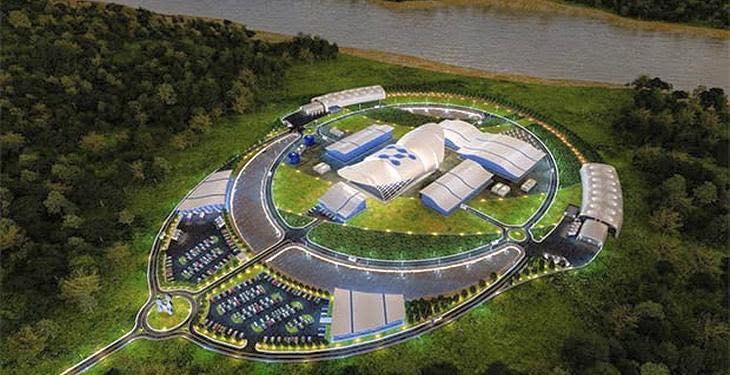
Energy and infrastructure public policy analyst Ana Otilia Nuțu believes that interim Prime Minister Ilie Bolojan is right to question the small modular reactors (SMR) project at Doicești.
The expert argues that the investment risks becoming extremely costly for consumers and may never recover the invested money.
Nuțu argues that Romania urgently needs investments in "cheap" energy, with low marginal costs, such as renewables and storage, rather than very expensive nuclear projects that would only come online in almost a decade.
"We don't have enough cheap energy"
Ana Otilia Nuțu explains that Romania has some of the highest energy prices in Europe because it lacks sufficient low-cost production. "The reason why spot prices in Romania are among the highest in Europe today is because we don't have enough 'cheap' electricity (with low marginal costs) to meet demand," the expert states.
She compares the situation to Spain, where the price is mostly determined by renewable energy, and to Italy, where gas decisively influences costs.
"That map, showing the same thing daily, indicates that Romania needs massive investments in energy with low marginal costs - renewables (plus storage)," Nuțu further states. The expert refers to the European platform displaying daily spot electricity prices in EU countries, where Romania frequently appears among the countries with the highest energy prices.
"We will all pay the costs of the SMR plant"
The analyst argues that the Doicești project has a fundamental economic problem: a very high cost compared to the energy produced.
According to her, it is "extremely unlikely" that a 460 MW nuclear plant, estimated at 5-6 billion dollars, will be able to recover its investment from market prices.
"Most likely, a CfD (contract-for-difference) scheme will be used. In short, if the investment recovery requires a price of, let's say, 300 EUR/MWh and the market price is 100, the state will have to cover the 200 difference through subsidy," the expert explains.
She warns that the difference would ultimately be borne indirectly by consumers through energy bills.
"We will all pay the costs of the SMR plant regardless of where we buy energy," says Nuțu, adding that "no benefit for consumers" is evident in such a scenario.
Renewables and batteries considered more efficient alternatives
In her analysis, Ana Otilia Nuțu argues that renewable technologies and storage solutions are evolving so rapidly that SMRs risk becoming uncompetitive by the time they actually come into operation.
"There are already today intermittent renewable technologies + storage that can produce competitively with classical technologies," she states.
The expert points out that batteries and renewable technologies "have decreased in cost by 10-15 times in the last 15 years," with continued rapid development. "If we talk about the time horizon of 2033, we will certainly have SMR competition with renewables with storage much, much cheaper and more efficient than today," Nuțu further explains.
She even cites the failure of the SMR project in Idaho, stating that it demonstrates the difficulty of these technologies becoming economically competitive.
Criticism for the state's "giant" projects
The analyst criticizes the delayed large energy projects of state-owned companies, stating that they hinder the development of other investments. "All the mammoth projects of state-owned companies, delayed for years, block network capacity and hinder investments that could have been made in this time," she asserts.
As an example, Nuțu mentions that reactors 3 and 4 at Cernavodă have blocked connection capacities in Dobrogea for years, one of the best areas for solar and wind energy.
"The fact that we have already spent 200 million doesn't mean we should throw another 5 billion"
Another argument raised by the expert is related to the costs already incurred for the project studies. "The fact that we have already spent 200+ million dollars on studies and papers does not necessitate throwing another 5 billion 'so as not to have spent the first 200+ million in vain,'" she states.
According to her, the decision should be based on future costs and revenues, not the sums already spent.
Political scandal following Bolojan's statements
The discussion about the Doicești project erupted after Ilie Bolojan stated that the project has "serious problems" and risks not recovering its investments. The interim Prime Minister mentioned that he even informed the US Embassy about these concerns.
Government spokesperson Ioana Dogioiu clarified on Thursday that "there is no question of stopping" the Doicești project, but only a reevaluation of its feasibility. According to her, Ilie Bolojan informed American partners that there are "a series of issues" that need to be analyzed before the project moves forward.
Dogioiu also stated that there is "no intention or action" that would affect the strategic partnership between Romania and the US.
These statements have sparked strong reactions. Energy Minister Bogdan Ivan defended the project, stating that nuclear energy represents "a strategic project, not just a few papers", while PSD leader Sorin Grindeanu accused Bolojan of endangering the strategic partnership between Romania and the US.
The SMR project at Doicești is being developed by the state-owned company Nuclearelectrica together with the American company NuScale and is presented as the first European project of small modular reactors.