
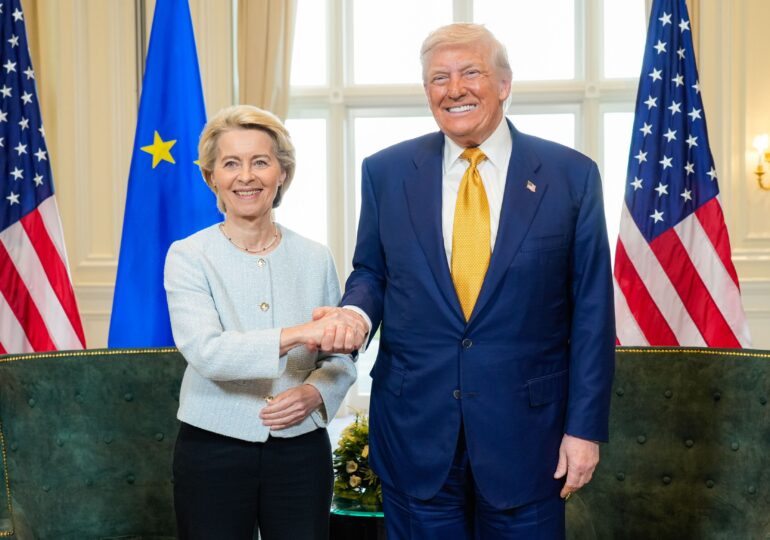
The European Union is approaching a compromise regarding the trade deal negotiated with the administration of Donald Trump, but the biggest dispute is no longer with Washington, but rather between European institutions and member states.
Negotiators from the European Parliament, the Council, and the European Commission are meeting on Tuesday evening in Strasbourg to try to finalize the trade pact agreed last year at Turnberry, Scotland, at Donald Trump’s golf resort, writes Politico.
The stakes are high: the transatlantic trade relationship is worth around 1.7 trillion euros and represents almost 30% of global trade.
EU wants a "Trump-resistant" agreement
The main point of contention is how the European Union can introduce guarantees to prevent Washington from changing the rules after signing the agreement.
Brussels has committed to eliminating tariffs for American industrial products and for some agricultural products from the US. In return, Europeans want the US administration to limit tariffs on the majority of European exports to 15%.
"In recent days, there have been many discussions and reflections, and I am quite optimistic that we will find a solid compromise for good legislation, resistant to Trump, and reflecting European interests," said Bernd Lange, head of the European Parliament's negotiating team.
The German Social Democrat, who leads the international trade committee in the European Parliament, is one of those insisting on the introduction of stricter protection mechanisms.
Member States want a quick agreement
However, the position of the European Parliament conflicts with that of the European Commission and several governments, especially Germany, which want quick approval of the agreement with as few additional conditions as possible.
European capitals fear that a delay or the introduction of too harsh clauses could provoke reprisals from Washington. "It's like an unhappy marriage. Sometimes you just have to make it work," said a European diplomat involved in the negotiations.
Tensions have escalated after Donald Trump threatened this month to impose 25% tariffs on European cars if no compromise is reached by July 4.
Meanwhile, the US Ambassador to the EU, Andrew Puzder, issued a public warning to Brussels.
"Trump has repeatedly shown that he prefers an agreement over a conflict, and we have an agreement. The EU still has time to choose cooperation over confrontation. We sincerely hope it will," he wrote in an editorial published by Politico.
The European Parliament demands additional guarantees
Social Democrats, Liberals, and Greens in the European Parliament are calling for the agreement to take effect only after the US reduces tariffs on European steel and aluminum to 15%, from current levels that reach up to 50%.
In addition, MEPs also want an "expiration clause" so that the agreement automatically expires in March 2028, ten months before Donald Trump ends his current presidential term.
The European People's Party and conservative groups have reluctantly accepted some of these demands, but member states believe they go too far and risk maintaining uncertainty for European exporters.
To avoid a deadlock, the European Commission has proposed a compromise: Brussels could suspend tariff concessions granted to the US if Washington does not reduce tariffs on European steel and aluminum by the end of 2026.
"We need clear guarantees, the possibility of suspension, and an expiration mechanism," Bernd Lange insisted.
A vote that can change everything
Negotiators are now trying to avoid a rejection of the agreement in the European Parliament plenary, where the vote is scheduled for the period of June 15-18. "It's a complete package. I've always said we need guarantees," said a European Social Democrat official.
The official refused to say whether the S&D group will vote in favor of the compromise proposed by the European Commission. "It all depends on how all the elements come together. Substance matters more than the timeline," said the European official.
In Brussels, there is also a fear that the Trump administration could escalate the trade conflict after July, when the 10% interim global tariff introduced by the American president after the Supreme Court's decision in February expires.
"I am pleased that we are reaching the final act of implementing this agreement and that we will respect our part of the deal," said Croatian MEP Željana Zovko, the EPP's chief negotiator for this dossier.
"This will allow better cooperation with the US and in other areas of our joint statement," she added.
G.P.