
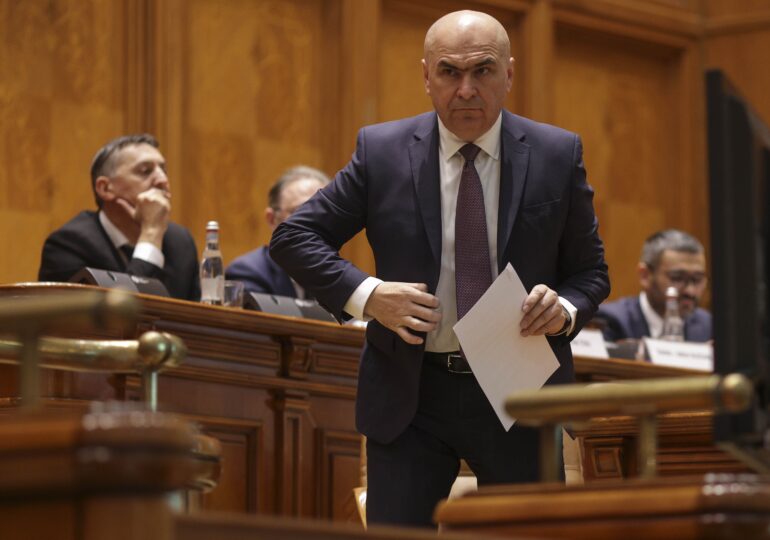
The political crisis has deepened following the withdrawal of PSD ministers from the Government, and calculations in Parliament show that neither side currently has the necessary votes to carry out their plan to the end.
Both the motion of censure prepared by the Opposition and the vote of confidence requested by Prime Minister Ilie Bolojan depend on dozens of missing votes, as shown by an analysis by News.ro.
In a Parliament with 463 elected officials, the decisive threshold is 232 votes – an absolute majority.
Motion of censure: The Opposition has the signatures, but not the votes
The Opposition can easily trigger the procedure to dismiss the Government. For initiating a motion, 116 signatures are required, and the bloc formed around AUR exceeds this threshold.
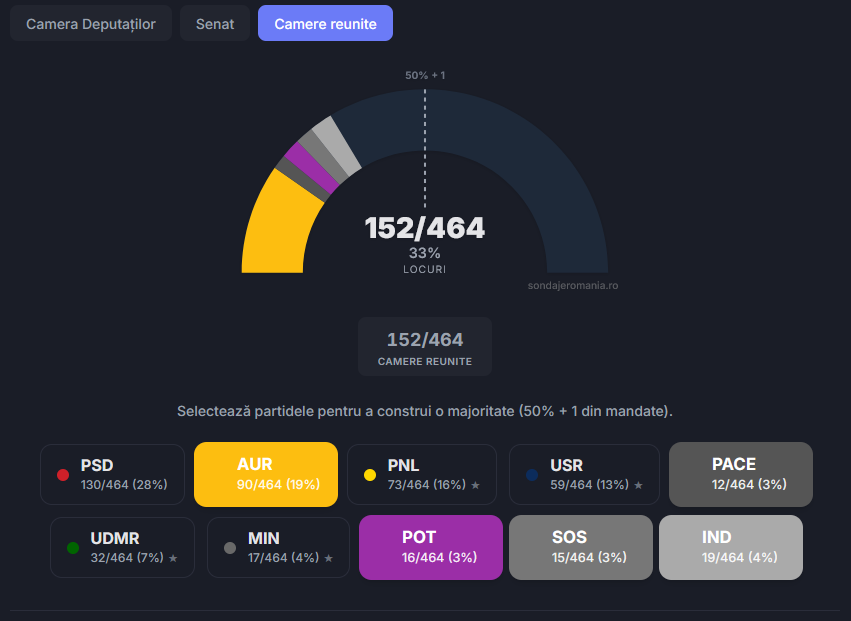
George Simion announced that his party will submit a motion in May and will support any initiative to replace the Executive. AUR relies on its own 90 votes, to which parliamentarians from SOS Romania, POT, PACE, and non-affiliated members could be added.
In total, this bloc would reach approximately 152 votes – enough to submit the motion, but insufficient for its adoption. To pass, an additional 80 votes would be needed.
PSD avoids association with AUR and remains below the threshold
On the other hand, PSD has not officially announced the submission of a motion, but signals that it is considering this scenario. The party leader, Sorin Grindeanu, stated that social democrats can initiate their own action or support a motion submitted by another party.
Alone, PSD has approximately 130 votes. Even if they were to attract the support of other opposition parties and non-affiliated members, the total would reach about 198 votes – approximately 34 votes below the necessary threshold to dismiss the Government.
In addition, social democrats avoid direct association with AUR due to competition for the same electorate.
PACE tries to take the lead
The PACE group has already opened its own list of signatures and is trying to position itself at the forefront of the Government's dismissal process.
Senator Ninel Peia stated to News.ro that his party will support any initiative leading to the fall of the Executive, but will not sign a "blank check," demanding that the motion text reflect "national, Christian, and conservative values."
Vote of confidence: The Government lacks 51 votes
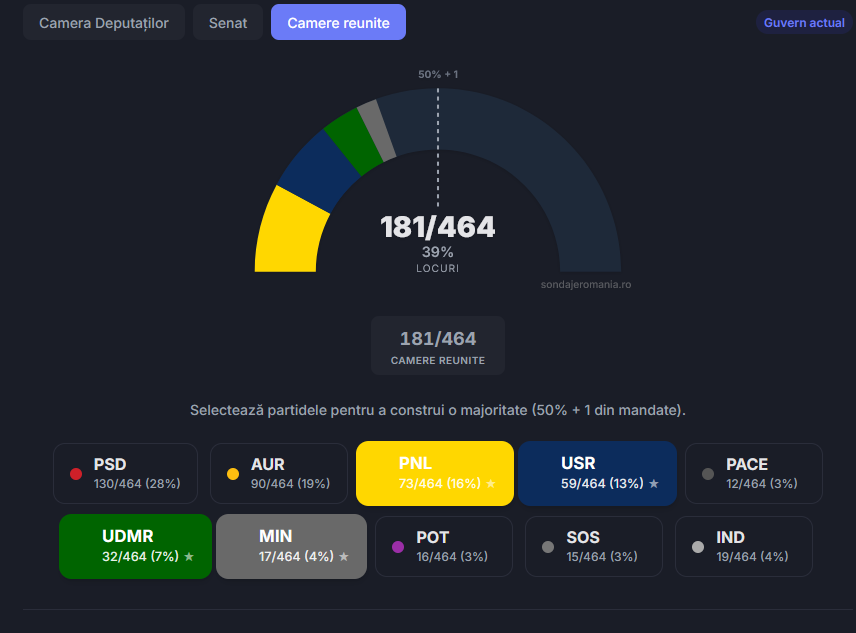
Prime Minister Ilie Bolojan also faces a complicated equation. To remain in office after the political restructuring of the Executive, he needs a new vote of confidence, which requires the same threshold of 232 votes.
At this moment, the remaining governing coalition – PNL, USR, UDMR, and the minority group – gathers approximately 181 votes. This means that the Executive lacks 51 votes to ensure its survival.
Why the votes are missing: a fragmented and shifting Parliament
The situation is further complicated by numerous moves in Parliament since the beginning of the legislature. Several groups have disbanded, others have reorganized, and a number of parliamentarians have migrated between parties or become non-affiliated.
Data on the current structure of the groups show that PSD is the party that has gained the most in recent months, reaching 94 deputies after attracting 8 parliamentarians from other parties, while SOS Romania decreased to 15 deputies, losing 13 members. POT reached 16 deputies after significant losses – 11 parliamentarians left the group.
Meanwhile, new formations emerge, such as the "United for Romania" group, consisting of 10 deputies from POT, which has not yet announced support for either side.
In this context, the calculations become fragile: each moved or non-affiliated parliamentarian can tip the balance.