
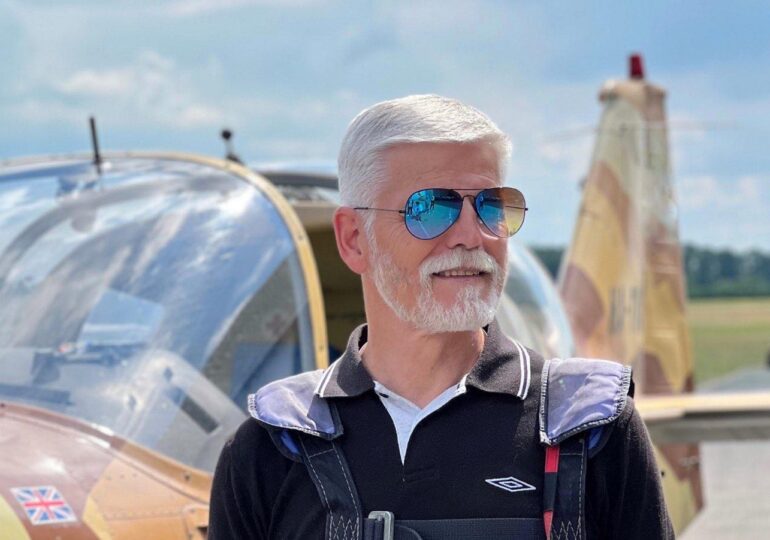
The President of the Czech Republic, Petr Pavel, has urged NATO to „show its teeth” in response to Russia’s repeated testing of the alliance’s determination on the eastern flank, suggesting a range of options including cutting off Russia’s access to the internet, disconnecting its banks from global financial systems, and shooting down aircraft that violate allied airspace.
Speaking to The Guardian in Prague, Pavel called for „sufficiently decisive, possibly even asymmetric responses” to counter Moscow’s provocative behavior towards the alliance, warning that otherwise, the Kremlin will escalate its actions.
A retired general and former Chairman of the NATO Military Committee, Pavel's military experience is rare among European leaders. His years of dialogue with Moscow within the suspended NATO-Russia Council have made him an influential voice on the alliance's future and the threats it faces.
He expressed his frustration with the "lack of determination of the United States to continue pressure on Russia," although he avoided direct criticism of Donald Trump, as the American president continues to question Washington's future commitments to the alliance.
Pavel had previously stated to the Czech press: "Trump has done more to undermine NATO's credibility in the past few weeks than Vladimir Putin has managed in many years."
However, he refrained from emphasizing this statement, stating that he does not believe that "any direct criticism of the United States would help at this time."
Instead, he focused on the need to push NATO members to take a strong stance against Russia. After Russia's illegal annexation of Crimea in 2014, he said, Moscow learned how NATO operates and "developed a behavior style meant to almost touch the Article 5 threshold, but always staying slightly below that level."
Article 5 of the NATO treaty stipulates that an armed attack against a member state is considered an attack against all members.
Pavel stated that Russian military leaders sometimes laughed at the alliance's decision-making paralysis.
"When I asked them why they engage in these provocative actions in the air, dangerous encounters, or flyovers above warships in the Black Sea or the Baltic Sea, their answer was: 'Because we can.' It is exactly this kind of behavior that we have allowed," he said.
NATO risks being divided
A NATO fighter jet shot down a drone over Estonia this week, and similar incidents have disrupted daily life in Latvia and Lithuania. In most cases, the drones are believed to be Ukrainian devices targeting Russia but being jammed and redirected towards NATO territory through electronic warfare.
Russia also accuses the Baltic states of collaborating with Ukraine to launch drone attacks from their territories, accusations firmly denied by these countries.
"After the annexation of Crimea, we discussed many times the potential continuation of aggression, but my biggest fear was not an open military aggression against a NATO country, but rather a challenge below the Article 5 threshold," he said.
If some European leaders "always prefer a diplomatic solution, although the Russians show no willingness for that," NATO risks being divided and unable to act, he warned.
"Russia, unfortunately, does not understand gentle language. It mainly understands the language of force, accompanied by action. If violations of NATO airspace continue, we will have to make the decision to shoot down either unmanned aircraft or manned aircraft."
"Asymmetric" measures
Pavel said that the alliance should also consider "asymmetric" measures "that do not kill people but are sensitive enough to make Russia understand that this is not the path it should take."
"For example, cutting off the internet or satellites - you've seen what a difference Starlink made on the battlefield - or disconnecting Russian banks from the financial system," he said.
Echoing recent warnings from Polish Prime Minister Donald Tusk, Pavel said that "if we do not react to the violations we face today, then Russia will likely move forward."
"In their doctrine, there is the concept of 'escalate to de-escalate'... I believe that whatever we allow, they will try more and more," he said.
The EU has been discussing Russia's phantom fleet for years, but when it finally acted, "suddenly the entire fleet was redirected to other regions," he said.
Europe's failure
Pavel insisted that Ukraine needs "more pressure and determination from the United States." American negotiators, Steve Witkoff and Jared Kushner, should probably be tougher with Russia and condition easing sanctions on a potential peace agreement, he said.
He also criticized Europe's failure to define its policy towards Russia and how a possible post-war security arrangement should look like.
"Instead, we are largely waiting for what comes from Washington. And even the United States could be more satisfied if Europe were more active. If we do not come up with our own proposals, then we seem weak or disoriented," he said.
Pavel believes that the best time to exert more pressure on Russia would have been last year, when it faced economic and military difficulties, but the US and Israel's war against Iran helped Moscow by increasing its oil revenues.
However, Russia remains in a difficult position, and Europe and the US should make "one last effort" through sanctions to force it to come to the negotiating table.
"If you want to get rid of sanctions, which you desire; if you want to start a debate on European security, something you have suggested several times, we are ready for that. But the condition is clear - ceasefire and peace negotiations in Ukraine," he said.