
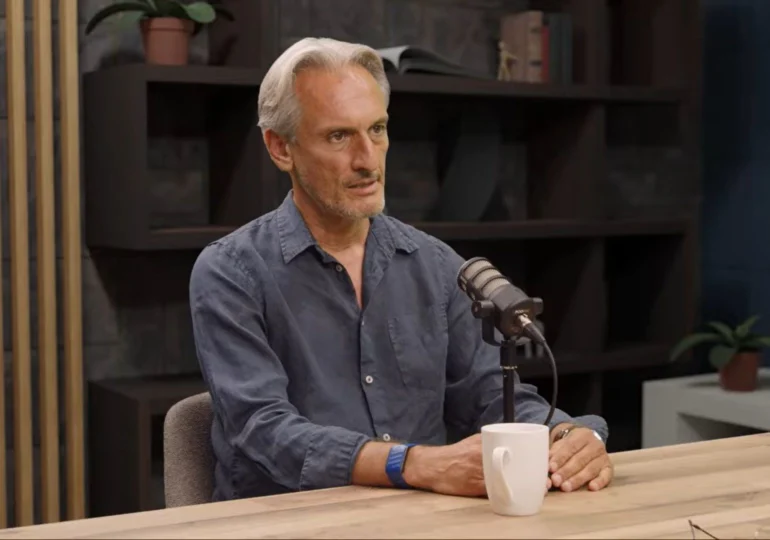
Businessman Matei Păun, former campaign strategist for Nicușor Dan and one of the President’s close associates, spoke about how the head of state views the current political and economic crisis. Păun’s central message is that Romania is currently facing a credibility crisis, an economic crisis, and a governance crisis simultaneously, and solutions cannot be found through ongoing political confrontations.
In the „Vorbitorincii” podcast, Păun stated that Nicușor Dan is unhappy with the deadlock created by political parties but refuses to push the constitutional limits or play the role of a president who imposes solutions through political pressure. He describes the head of state as a politician concerned with procedures, upholding the Constitution, and building long-term solutions rather than seeking immediate tactical gains.
A significant part of his intervention was dedicated to the relationship with the Social Democratic Party (PSD). Păun rejects the idea that Nicușor Dan is protecting the social democrats and asserts that the president did not enter politics to wage war against the PSD.
In his view, a direct conflict with the largest parliamentary party could push the PSD towards even more problematic alliances and reduce the chances of finding a functional majority. Therefore, negotiations with the PSD are presented as an institutional obligation of the president, not as a political alignment.
When asked why Nicușor Dan did not intervene more firmly to save Ilie Bolojan before the fall of the government, Păun replied that the president did not have the necessary leverage to change the outcome of a motion of no confidence. He believes that responsibility for the current situation must be shared among all parties and insists that Ilie Bolojan is not the cause of the credibility crisis Romania is facing.
Regarding governance solutions, Păun expresses support for a technocratic transition formula. In this context, he also includes Eugen Tomac, whom he describes as sufficiently independent from traditional clientelistic networks and capable of leading an executive without major political debts.
On the other hand, both the PSD and the National Liberal Party (PNL) are criticized for primarily pursuing their party interests at a time when the economic situation calls for compromise and responsibility.
Păun warns that Romania is in a severe macroeconomic imbalance marked by high inflation, budget deficit, economic stagnation, and the risk of losing its country rating. In these conditions, he says that the rise of populism is almost inevitable if the economy is not stabilized.
Additionally, Păun does not rule out the possibility of early elections if parties continue to block the formation of a majority, although he believes that such a scenario could bring surprises even to those who desire it.