
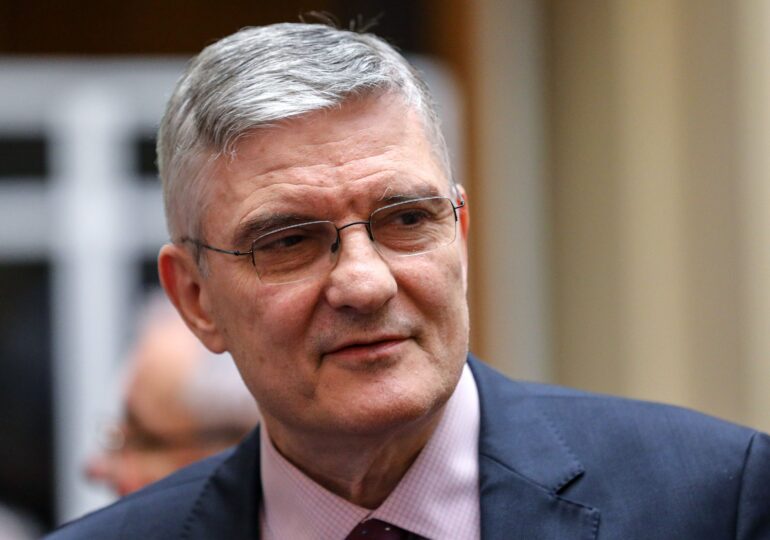
The exit of the PSD from the government risks seriously complicating Romania’s economic and political situation, but it is not a total surprise, says the President of the Fiscal Council, Daniel Dăianu.
He warns that tensions were predictable after months of disputes within the coalition and calls for a rapid solution to avoid negative effects on financial markets.
The PSD's exit from government, a predictable moment
Dăianu believes that the political rupture comes at a delicate moment but cannot be labeled as a "black swan."
"There is the saying that misfortune never comes alone. Just what we needed! Although it cannot be said that it is a black swan because there has been a fierce dispute for months," he said in an intervention on Digi24.
The economist points out that tensions within the coalition were evident, given that the PSD contested a series of government measures despite having ministers in the Cabinet.
The deficit, decreasing but still dangerous
One of the key points of the analysis concerns the evolution of the budget deficit. After a level of over 9% of GDP in 2024, corrections in 2025 lowered the deficit to 7.65%, and for 2026, it could reach around 6.2%.
"This is an important achievement of this cabinet, of all the ministers, so of this coalition, because Romania was under the Damocles' sword," explained Dăianu.
However, he warns that this level remains high and cannot be sustained in the long term.
"If we were to remain stuck at a deficit around 6%, even this figure would be among the highest in Europe, and we would have troubles. Financial markets would not tolerate such a level of deficit, and we would have great difficulties in financing and refinancing ourselves," says the head of the Fiscal Council.
- The political crisis kills the PNRR at the last minute: 10 billion euros at risk before the deadline
"We are not Greece," but risks exist
In the context of alarmist scenarios regarding the leu-euro exchange rate, Dăianu rejects the idea of an imminent collapse.
"I've seen figures thrown in the air, six, seven lei per euro. So, we are not 'Greece.' A very difficult situation can be avoided," he affirms.
The main argument is that Romania's public debt remains, for now, at a "reasonable" level.
However, the major question for investors and rating agencies remains what will happen after 2026 and how the budget correction will continue.
The political crisis must be resolved quickly
Dăianu insists that the current crisis cannot be prolonged without serious costs.
"The country is paying for this political crisis. The cost of Romania's loans will increase," he warns.
In his opinion, the solution must be found within a maximum of six weeks, through a coordinated political effort "from Cotroceni to those in good faith in Parliament."
2027, a challenging test
Looking towards the coming years, the head of the Fiscal Council says that a return to harsh measures, such as freezing incomes, is no longer possible.
"It's impossible. You have to consider that there is a tolerance threshold from the population," he pointed out.
In this context, the solution cannot come from new sacrifices imposed on the population but from increasing state revenues.
The solution: better collection and combatting tax evasion
Dăianu argues that Romania must fundamentally change its tax approach. "We will have to collect taxes and duties much better. That's the solution," he says.
He speaks of the need for legislative changes, firm combat against tax evasion, and harsh penalties for those who practice it, as raising taxes would be socially difficult to bear.