
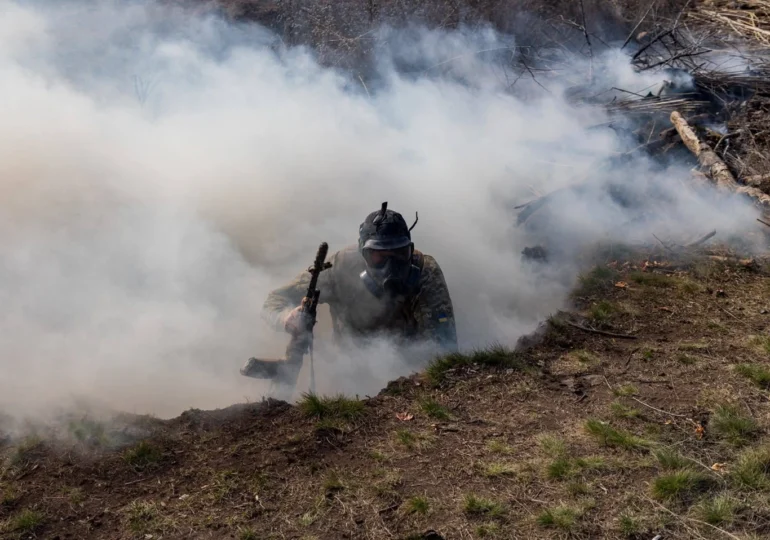
In the new era of a battlefield dominated by drones, the Russian army takes advantage of an extensive system of underground infrastructure from the Soviet era, using it as a drone-proof route to infiltrate behind Ukrainian lines. However, the safety underground can only help the Russians to a certain extent.
The longest period of time a Russian soldier can hope to survive after emerging from the underground pipeline that leads to the Ukrainian sector is only an hour, as shown by those hunting them down.
"But usually it's 10 minutes, and that's it," said Tovstî, the chief sergeant of a company from the Khartiia Brigade in Ukraine, at a command post in the northeast of the Kharkiv region, to Kiev Independent.
Tovstî watches live drone footage showing a scene that repeats itself over and over, for months - Russian soldiers coming out of decommissioned pipes, attempting to infiltrate Ukrainian lines.
In the new era of a battlefield dominated by drones, the Russian army takes advantage of an extensive system of underground infrastructure from the Soviet era, using it as a drone-proof route to advance.
"You can't really walk on the ground now in the drone war, so everything is done underground," explains Tovstî.
However, the safety of the pipelines can only help them to a certain extent. For months, the Khartiia Brigade has been monitoring the pipelines to find exits, eliminating enemies emerging to the surface, filling the holes, then looking for the next exit point.
Despite huge losses and horrible conditions in the pipelines, Russia continues to push its people through them.
Dying in droves underground
The Russian soldiers that Tovstî is tracking are heading towards Kupiansk, a strategically important city just 40 kilometers from the border with Russia. Situated at a crossroads of highways and railways, the city was occupied by Russian forces in the early days of the invasion, before being liberated in the same year in September.
Since then, Russia has been trying to recapture it. In the past year, Russian soldiers have taken advantage of four abandoned gas pipelines that converge in two over the Oskil River. The Shebelinka-Ostrogozhsk gas pipeline, originally built as part of Soviet efforts to pump gas from the Kharkiv region to Russia, links the Russian-occupied territory on the eastern bank to the back of Ukraine in the Kupiansk area.
Russian troops have deployed the infiltration tactic through pipelines all along the front wherever they could, from Avdiivka in the eastern Donetsk region to the northeast of Sumy region, as well as in the Russian Kursk region, where Ukraine launched a cross-border raid in August 2024.
"(The pipelines) can be an effective local strategy to cause confusion," said Pasi Paroinen, an analyst at the Finland-based Black Bird Group, closely monitoring the war through open-source imagery.
The pipelines leading to Kupiansk have a diameter of only 1 to 1.2 meters. Those inside must crawl 15 kilometers to reach the Ukrainian lines. According to the commanders of the Khartiia Brigade, some spend months waiting inside while gathering people and materials.
"People die there. They are simply thrown in there, with guns taped to their backs so they don't lose them," said the deputy commander of the Ukrainian brigade hunting them down.
Reports of the Russians' tactics surfaced last year when the Ukrainian monitoring group DeepState announced that Moscow's soldiers were using makeshift wheeled platforms and electric scooters to move inside the pipelines.
The independent Russian news outlet Astra published a video with a soldier describing the chaos inside a pipeline in the Kursk region, claiming that "dozens of soldiers suffocated, committed suicide, or died in panic and delirium."
"People were going crazy in there. One shot himself. One pointed a machine gun at himself. Another smashed his head," he says in the video.
Despite this, the tactic worked at that time.
Ukrainians have learned the enemy's strategy
Russian troops managed to infiltrate the northern outskirts of Kupiansk in September 2025 through pipelines and threatened the city, advancing from the north.
An Ukrainian counterattack followed, pushing Russian forces back from certain parts of Kupiansk and liberating villages on the northern outskirts. President Volodymyr Zelensky visited the contested city in December 2025, denying Moscow's earlier claims that it had been captured.
Since then, Ukraine has largely managed to neutralize the threat posed by pipelines, a small part of Ukraine's broader successes in recent months, which have begun to tip the balance in favor of Kyiv.
The threat posed by Russian infiltration through pipelines in the Kupiansk sector was "actually uncontrollable," but Ukraine has since isolated certain sections and better understands the routes, said the commander of a drone systems company in the Khartiia Brigade.
Russians are doing the same things
Meanwhile, Russia has not changed its strategy and is trying to do "the same old things," according to retired Australian Army Major General Mick Ryan. Using an infantry-based tactic, including on the front at Kupiansk, the Russian army has continued to rely on a costly strategy, attempting to gradually wear down Ukrainian defenses.
"Ukraine has developed more efficient solutions to Russia's key advantages, which are a larger number of people and greater industrial production, and this is beginning to affect Russia," Ryan said.
"These are all small pieces of a puzzle that indicate to me that we may be approaching a turning point if (Ukraine) continues to move in this direction," he said.
However, maintaining the advantage in the ongoing battle with Russia's "moles" is an intensive process, concludes the Ukrainian publication.
T.D.