
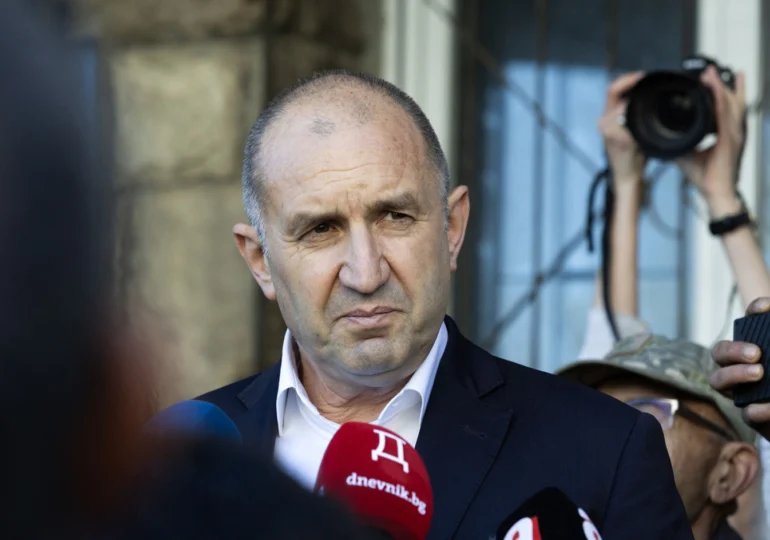
Former president and pro-Russian candidate of Bulgaria, Rumen Radev, has won a parliamentary majority in the snap parliamentary elections. Radev, who called for the resumption of ties with Russia, stated that Bulgaria will continue its European path, but criticized the European Union for not adapting to „a world with new rules.” The Kremlin expressed its admiration for his speech.
Former Bulgarian president Rumen Radev secured an absolute majority in the parliamentary elections that could end the country’s five-year political uncertainty, according to nearly complete voting results from Monday. The poorest member of the European Union has had eight elections in 2021, when anti-corruption protests toppled the long-time pro-European conservative administration of leader Boiko Borisov, as reported by France 24.
What the results show
Radev (62 years old), who resigned earlier this year after nine years as president, ran in Sunday's vote promising to fight corruption. The election attracted a broad spectrum of voters, with the voter turnout being the highest in 2021.
Radev's group, Progressive Bulgaria, garnered 44.7% of the votes on Sunday, according to official results with 91.7% of votes counted, positioning him well to secure around 130 seats in the 240-seat parliament.
The overwhelming victory marks the first absolute parliamentary majority for a single party in Bulgaria since 1997, the year a center-right, pro-European grouping won.
Borisov's GERB party dropped to 13.4% of the votes, tying with the liberal PP-DB coalition, which stood at 13.2%, according to the electoral commission results.
The far-right Vazrazhdane party and the Turkish and Roma minority party MRF also entered Parliament, according to the nearly complete vote count.
What's next in Bulgaria
"PB has won unequivocally – a victory of hope over distrust, a victory of freedom over fear," Radev declared on Sunday as projections began to emerge.
Radev stated his intention to rid Bulgaria of the "oligarchic governance model."
Although he can govern alone, the "real question" is whether Radev will take "real action" against high-level corruption, including through justice system reforms, stated political analyst Teodor Slavev.
For significant judicial or constitutional changes, which require a two-thirds majority, he will need to find support in Parliament from other parties.
Youth lack confidence in Radev
Compared by some to Viktor Orbán, Radev relied mainly on the votes of older, rural voters. However, the youth are more skeptical of him, as noted by Eden Maclachlan, correspondent for The Guardian in Sofia.
For voters like 22-year-old law student Alexandăr Tanev, Radev is not a credible option. The law student believes that Radev, who resigned from the presidency to run in these elections, "is part of the same model" of politicians and "had the opportunity to use interim governments to fight against this mafia" as president, but did not do so.
Dimităr Keranov, a Bulgarian fellow at the German Marshall Fund's European Resilience Programme in Berlin, stated that voters were broadly divided along generational lines. "(...) I think (Radev) represents the same status quo that young Bulgarians would like to see dismantled. He represents the same old guard or usual political elite," he said.
European path continues, but with Euroscepticism
The victory of Radev's Progressive Bulgaria (PB), a coalition with left-leaning tendencies but friendly to Moscow, could pose another headache for Brussels and its allies just as the EU breathes a sigh of relief after Orbán's resignation.
Radev stated after the victory announcement that Bulgaria will "make every effort to continue its European path." However, as a sign of future tensions, he emphasized that "a strong Bulgaria and a strong Europe need critical thinking and pragmatism."
"Europe has fallen victim to its own ambition to be a moral leader in a world with new rules," stated the former air force general.
On Wednesday, amid concerns about rising living costs, Radev criticized the previous government for introducing the euro "without asking" the voters. "And now, as you pay your bills, always remember which politicians promised you to be in the 'rich club'," he said.
It is expected that the former president will face pressure both from within his own party and from the far-right opposition to lead Bulgaria on a "Eurosceptic" path, according to Daniel Smilov, a political scientist at the Center for Liberal Strategies.
"His initial signals are that he will pursue a pro-European policy and will not block the EU... The big question is whether these signals will indeed be followed," said Smilov to AFP.
During the campaign, Radev called for "pragmatic relations with Russia based on mutual respect and equal treatment," sparking concerns about his future government's approach to Moscow, including regarding energy imports.
Additionally, he opposed the sending of weapons from Sofia to Ukraine, although he stated that he would not use his country's veto right to block EU decisions.
Kremlin "impressed" by Radev's speech
In one of the first reactions to the elections in Bulgaria, the Kremlin expressed admiration for Radev's words about pragmatic dialogue with Moscow, as reported by The Guardian.
"Of course, the words of Mr. Radev... as well as those of other European leaders about their willingness to resolve issues through dialogue attract us," stated Kremlin spokesperson Dmitri Peskov, as cited by AFP.
T.D.