
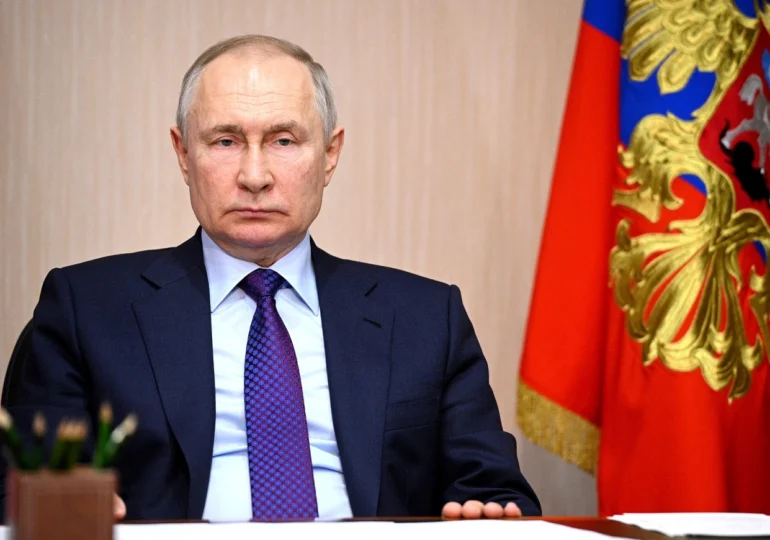
The Russian Parliament has approved a bill that gives Vladimir Putin the legal basis to send troops to other countries, under the pretext of protecting Russian citizens abroad.
According to Politico, the law allows Moscow to militarily intervene beyond its borders if Russians are arrested, investigated, tried, or, in Moscow’s authorities’ wording, „abused” by foreign states, international courts, or organizations of which Russia is not a part.
The "protecting Russian citizens" pretext
The Speaker of the State Duma, Vyacheslav Volodin, argued that the measure is necessary to defend Russians abroad, accusing the West of using justice as a political tool.
"Western justice has turned into a repressive machine designed to suppress decisions that do not align with those imposed by European officials. In these circumstances, it is important to do everything to protect our citizens abroad," Volodin stated.
Putin has 14 days to enact the bill.
Kyiv: Russia legalizes its expansionism
Ukraine believes that the new legislation only turns military aggression into an official instrument of Russian policy. "This decision can be described in two words: aggressive anarchy," said the spokesperson for the Ukrainian Ministry of Foreign Affairs, Heorhii Tîhi, to Politico.
He stated that by granting unlimited rights to use Russian forces abroad under the pretext of protecting Russian citizens, Putin actually acknowledges that aggression has become a state norm. "The current composition of the State Duma of the Russian Federation has decided to go down in history as a factory for legalizing political adventurism, occupation, and terror," the Ukrainian official added.
An argument already used against Ukraine
Moscow also invoked the protection of Russian speakers in Ukraine in 2022 to justify its large-scale invasion. The Kremlin claimed at the time that they were persecuted by Kyiv, and the issue continues to be part of Russia's conditions for a potential peace agreement.
The new law comes at a time when European intelligence services describe Russia as a direct threat to NATO and the West.
According to Politico, defense officials and EU parliamentarians fear that the next two years could be seen by the Kremlin as a favorable window to test the West's commitment to NATO, amidst Donald Trump's return to the White House and Europe's slow pace in strengthening its defense.
Last month, Ukrainian President Volodymyr Zelensky warned that the Baltic states could be Moscow's next target if Ukraine does not receive enough support. Estonia later rejected this scenario, but Kyiv sees the new law passed by the State Duma as confirmation of Russia's increasingly pronounced militarization of its policy.
G.P.