
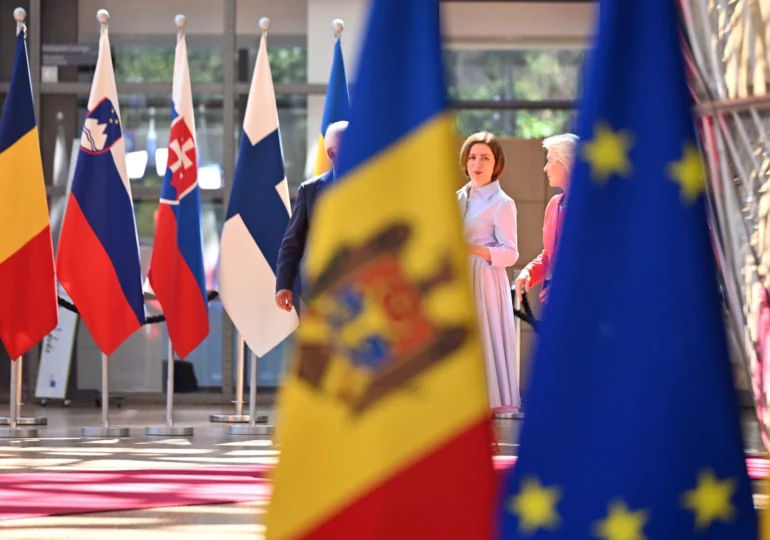
Moldova is rapidly advancing on the path to the European Union, although it started the accession process later than the candidate countries in the Balkans. European Commissioner for Enlargement, Marta Kos, considers it the country with the best results among those she monitors.
„Moldova is the best student in my class,” Kos said. The appreciation refers to the pace of progress made by Chisinau and does not mean that the Republic of Moldova will be the first country to join the EU.
In an interview with France 24, the European Commissioner explained that Montenegro remains the most advanced candidate in negotiations. Alongside Montenegro, Albania, Moldova, and Ukraine are the four countries leading the enlargement process.
"Montenegro, which is indeed in the lead, could conclude technical negotiations by the end of the year and then become a member in 2028. Albania is on the right track. Moldova is showing increasingly better results, and of course, so is Ukraine," Marta Kos stated.
"The year of enlargement," without new members for now
The Commissioner calls 2026 "the year of enlargement" due to the pace of negotiations, not because a country is expected to join the EU this year. "In the nine months of this year, we have opened and closed more negotiation chapters than in any other year in the last 25 years," Kos said.
The last country to join the European Union was Croatia in 2013. According to France 24, it is unlikely that the bloc will receive a new member before 2028.
European funds depend on reforms
Marta Kos also spoke about the differences between candidate countries in the Balkans in implementing reforms. For this reason, up to 330 million euros of European funds could be redirected from states with the weakest results.
"We will see how much money we will reallocate. Montenegro, for example, has implemented 91% of reforms so far. But we also have Bosnia and Herzegovina, with a zero percent, because its politicians are unable to ratify two important agreements that would allow us to pay the money," the Commissioner explained.
Kos emphasized that funding is linked to fulfilling commitments: "The European Union is not a charitable organization. In order to help economies and societies develop, they must make reforms. We only give money if they do."
Relationship with Serbia affected by Ratko Mladic's funeral
In the case of Serbia, a candidate for accession since 2012, the Commissioner says that the trust of member states has been further affected by the homage paid to war criminal Ratko Mladic at his funeral. Kos canceled a planned visit to Serbia for this reason.
"We can have different opinions on how quickly a country should implement reforms. But there is no place for glorifying a war criminal or denying the genocide in Srebrenica," she stated.
Kos said that the EU expects candidate countries, especially those in the Western Balkans, to support reconciliation. "Sometimes I have the impression that instead of healing the wounds of the past, leaders are pouring salt on these wounds," the Commissioner added.
Armenia is approaching the EU
The interview also addressed the situation in Armenia, which has not officially applied for membership but is strengthening its ties with the European Union. Kos said that Brussels is helping the country redirect its exports to the European market after Russia stopped importing numerous Armenian products.
The EU is also working on visa liberalization, which would allow Armenian citizens to travel visa-free in the bloc. For this, Armenia needs to adapt its legislation. "They are doing a very good job. I admire the people of Armenia," Marta Kos said.
G.P.