
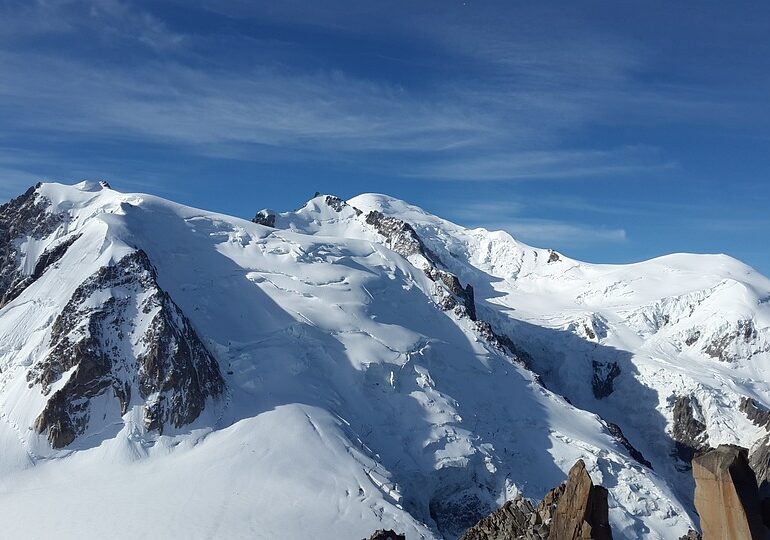
The Tour du Mont Blanc is one of the most popular long-distance hiking routes in Europe, a 170-kilometer circuit through France, Italy, and Switzerland, annually traveled by about 80,000 people, causing increasingly significant issues.
On some of the most popular sections of Mont Blanc, hikers’ groups are now so close to each other that there is barely any distance between them.
At the same time, not all visitors show respect for nature. Local residents complain and consider the situation unbearable, as reported by Euronews.
"It's like walking in single file. People can only see the backs of those in front of them. It's not pleasant at all," said the mayor of Saint-Gervais-les-Bains, Jean-Marc Peillex, to the Swiss public broadcaster SRF.
He is requesting that access to the trail be restricted starting from next spring, and the measure be enforced through checks and sanctions.
Saint-Gervais-les-Bains is located on the French side of the Mont Blanc massif, in the Haute-Savoie department of the French Alps.
The town is a major starting point for excursions in this area. The French access route to the Tour du Mont Blanc (TMB) also passes through here.
In the future, those wishing to complete the Tour du Mont Blanc will need to reserve a spot in a mountain refuge or an authorized bivouac area. A bivouac area is an officially designated space where hikers or climbers are allowed to spend the night temporarily in the open air or set up their tent.
Unlike a refuge, such areas usually lack infrastructure or only provide basic facilities.
"If this is not possible, you postpone your plans for the following year," suggests Peillex.
Only a small part of the Tour du Mont Blanc crosses the territory of the town of Saint-Gervais. However, other localities along the French section of the route are collaborating to introduce the new rules and ensure they will come into effect next spring.
Switzerland opts for coordination
Switzerland currently has no similar plans to restrict access. Joachim Rausis, the mayor of Orsières in the canton of Valais, also believes that measures are needed, but does not speak of a pronounced overtourism phenomenon.
"There are warning signs, and we need to regulate the situation. But, above all, we need coordination between Switzerland, Italy, and France," says Rausis.
One thing is clear: the huge influx of visitors creates difficulties even for mountain guides.
"You have to book hotels and refuges a year in advance. For someone working independently, this is almost impossible," as an independent mountain guide rarely has clients who make reservations a year in advance.
The debate highlights a fundamental issue of mountain tourism: how can the international popularity of the Alps be reconciled with nature conservation and the interests of locals? Introducing a reservation system could reduce the flow of visitors, but at the same time, it questions the traditional idea that mountains are freely accessible to everyone.
A mandatory reservation system would not be entirely new on Mont Blanc. On the normal French route to the summit, overnight stays at the Nid d’Aigle, Tête Rousse, and Goûter refuges already need to be reserved through a special system. The names of all participants must be provided, and the reservation confirmation must be presented during checks.
The Goûter and Tête Rousse refuges were open for the 2026 season until recently, but are temporarily closed from August 11, 2026, due to the risk of rockfall.