
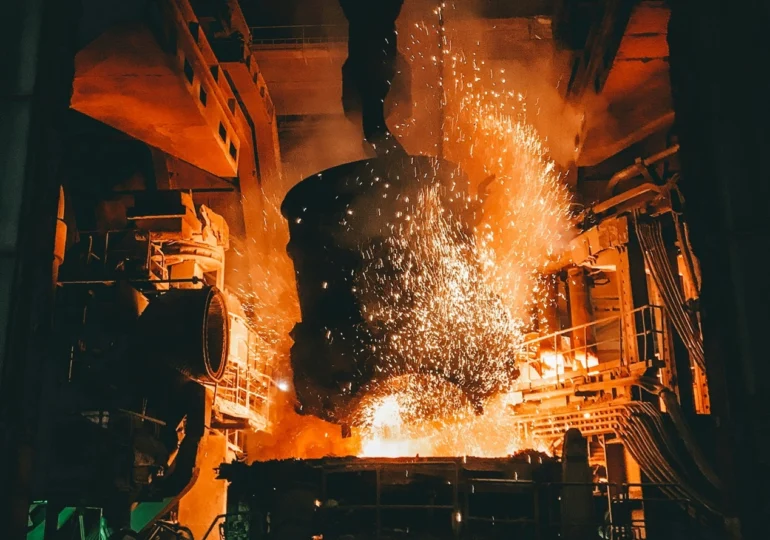
Steel represents one of Ukraine’s main sources of export revenue, but it is affected by the carbon tariffs imposed by Europe.
Ukrainian steel producers say that the new carbon tax applied at the EU border is causing European customers to cancel orders, threatening one of Kiev’s most significant sources of export income, reports Politico.
The Carbon Border Adjustment Mechanism (CBAM), which came into effect in January, requires importers to pay a carbon tax for certain industrial goods manufactured abroad, including steel. The aim is to „clean up” the most polluting industries reliant on fossil fuels that contribute to global warming.
However, Ukrainian steel giants, facing the effects of the Russian invasion, say they need a temporary exemption from CBAM, stating that this mechanism has already driven away regular buyers.
Metals represent one of Ukraine’s largest export industries, with a value of nearly $4 billion in 2023, according to the World Bank. The EU is by far the largest market for Ukrainian steel – with Poland alone accounting for a third of Ukraine’s metal exports.
During a roundtable discussion last week, the CEO of ArcelorMittal Krivoy Rog – one of Ukraine’s largest steel producers – stated that after the introduction of CBAM, the company „almost instantly” lost the European market.
„Once customers learned about the additional tax (CBAM payment) of $60 to $90 per ton, they canceled all orders for the first quarter of 2026 – around 300,000 tons,” said Mauro Longobardo.
– [UE a pierdut 7 mld. euro din limitarea exporturilor de produse alimentare în SUA. Exporturile de carne de porc au scăzut cu 99%. Cele mai lovite țări](https://spotmedia.ro/stiri/economie/ue-a-pierdut-7-mld-euro-din-limitarea-exporturilor-de-produse-alimentare-in-sua-exporturile-de-carne-de-porc-au-scazut-cu-99-cele-mai-lovite-tari)
The company also closed one of its factories and claimed that due to CBAM, „at least 3,400 jobs” were lost, as no market absorbed the exports intended for EU member states.
Metinvest, Ukraine’s largest steel and mining producer, also says it is facing difficulties with CBAM. „The EU is the main market for Ukrainian steel producers, operating under significantly worse conditions than their competitors,” a company spokesperson explained in an email to POLITICO. „Officially, CBAM aims at environmental objectives, but in practice, it also functions as a tool to protect the European market,” the spokesperson added.
European steel and cement lobby groups largely welcomed CBAM as a way to level the playing field for continental producers against foreign competitors enjoying weaker pollution regulations, potentially flooding the EU with more polluting and cheaper products.
But in Ukraine, struggling to join the EU, industries also face the effects of war. However, at the start of CBAM negotiations within the EU, both Ukrainian and Russian producers complained that the carbon emission taxation regime would unfairly affect their industries – before their armies devastated key steel production areas in eastern Ukraine’s Donbas region following Moscow’s 2022 invasion.
– [Ziua 1513 Atac devastator al Rusiei în timpul nopții. Rafinărie în flăcări în Krasnodar (Video). Ucraina are un nou model de luptă, rușii au început să atace pe toată linia frontului](https://spotmedia.ro/stiri/eveniment/ziua-1513-atac-devastator-al-rusiei-in-timpul-noptii-rafinarie-in-flacari-in-krasnodar-video-ucraina-are-un-nou-model-de-lupta-rusii-au-inceput-sa-atace-pe-toata-linia-frontului)
„We operate under bombardments, with energy supply interruptions, labor force losses, and constant uncertainty. Therefore, we appeal to our European partners: Although Ukraine is ready to comply with EU rules, it needs transitional measures and support to prepare for these requirements,” a Metinvest spokesperson said.
Metinvest added that the EU could consider channeling potential CBAM payments for Ukrainian steel into „dedicated accounts” that could then be used to modernize Ukrainian companies, simultaneously boosting „demand for European technologies.”
Last year, Ukraine was one of the largest steel exporters to the EU, alongside India and China. However, under the Carbon Emissions Trading System (CBAM) and the broader Emissions Trading System – the EU’s flagship framework – domestic producers are incentivized to adopt an eco-friendly approach and sell in European markets, where the carbon price dominates.
Trade wars with Washington have also popularized customs tariffs as an economic weapon and spread protectionism, notes POLITICO. On Monday evening, the EU reached a temporary agreement to halve imports of foreign steel and impose substantial customs duties on large orders, in an attempt to favor steel manufactured within the EU.
T.D.