
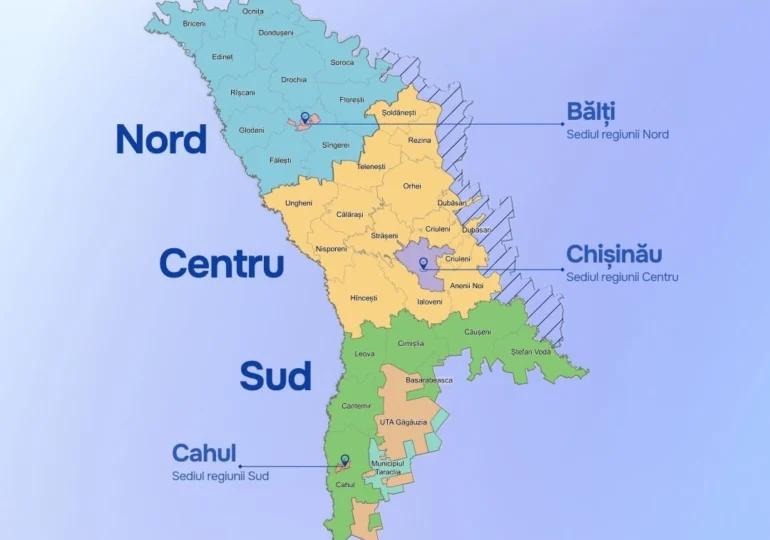
The administrative reform in the Republic of Moldova involves replacing the current 32 districts with three regions: North, Center, and South. The reform aims to simplify the administrative organization, reduce responsibilities and costs, with the funds allocated to district administration being redirected towards the needs of local communities.
The Prime Minister of the Republic of Moldova, Vasile Tofan, launched a public debate on Thursday on a project for the country’s administrative-territorial reorganization, a subject almost taboo for politicians in Romania.
The 32 districts will be replaced by three regions, as reported by Ziarul de Gardă.
- The North Region will bring together 11 districts and will have its administrative center in Bălți, although the city of Bălți will not be part of the region. In total, this region will have approximately 514,000 inhabitants.
- The Center Region will include 13 districts and will have its center in Chișinău. However, the capital of the Republic of Moldova will not be part of the region. The population of the region will be approximately 670,000 inhabitants.
- The South Region will consist of 7 districts, will have its administrative center in Cahul, and will include approximately 280,000 inhabitants.
Chișinău, the city of Bălți, and the Gagauz Territorial Unit will retain their current status.
The town of Taraclia will be reorganized into a second-level municipality.
Reform Objectives:
- Fewer regions: Instead of the current 32 regional administrations, there will be only three regional administrations.
- Fewer competencies at the second level of administration. "If the responsibilities of the current district level are more logically divided between municipalities and central administration, obviously we will have fewer competencies at the second level, and we do not want to create them artificially and unnecessarily there," Tofan stated.
- Fewer officials and bureaucracy. "If we have fewer structures and fewer responsibilities, I think it is logical not to maintain the same level of officials and bureaucracy at the second level. But fewer officials do not mean simply cutting people, because we want compact, professional teams with sufficient resources and decent salaries, where each person can produce more and better. A state with smaller but stronger and more productive teams," explained the Prime Minister.
- Stronger municipalities. The three regions will aim to assist municipalities in implementing large projects, but "they are not coming to lead the municipality," Tofan said.
"At the same time, we do not want to replace 32 districts with three regions and gigantic districts. That is not the intention. The role of the regions will also be different. They need to focus primarily on strategic matters, coordination, regional development, and large projects (...) So the region is not coming to lead the municipality; the region must help the municipality carry out those tasks that the municipality cannot accomplish alone," the Prime Minister specified.
Public services will continue to be available in the villages and districts as they are now.
Additionally, the administrators of several institutions, such as museums or libraries, will come under the authority of the municipalities they belong to and will no longer be managed by the district centers.
The Number of Municipalities Will Halve
The Secretary General of the Government, Alexei Buzu, mentioned that discussions will be held with local administrations across the country, and subsequently, a legislative package will be prepared. He further stated that in the general elections of 2027, citizens will elect the local council, the mayor of the locality, and candidates for the regional council.
Alexei Buzu announced on September 2 that 561 municipalities in the Republic of Moldova have made final decisions for voluntary mergers, representing 63% of the total number of municipalities in the country. The next stage of this process involves another 254 municipalities moving towards normative mergers, so by 2027, the estimated number of municipalities will be reduced to just 292.
T.D.