

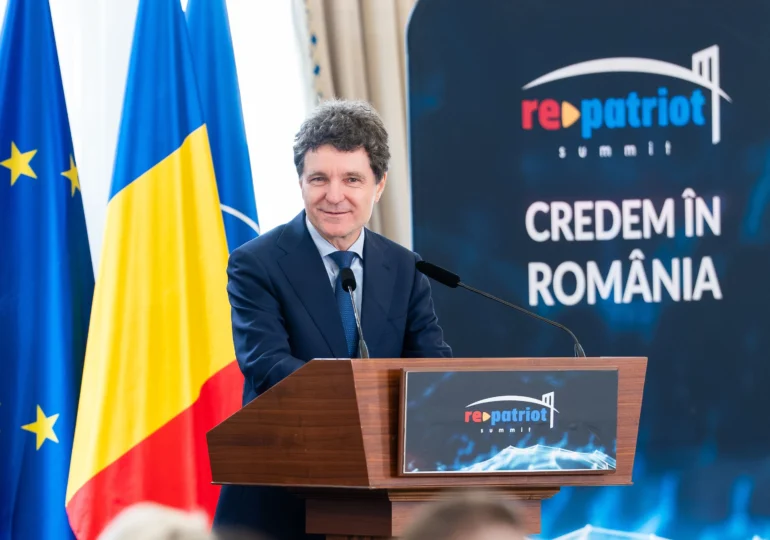
President Nicușor Dan says he refused French citizenship during his studies in France because he knew he wanted to return to Romania and considered it would not have been „honest” to accept it. The head of state is convinced that, in the medium term, some of the millions of Romanians living abroad will return home.
In an interview with Antena Stars during a full-blown political and economic crisis, Nicușor Dan talked about his own experience as a Romanian living abroad and what the state should do for the diaspora.
"No One Left Out of Joy"
"No one left out of joy. People left who felt they couldn't support their children in school, people who couldn't bear injustice anymore, and it's never easy," Nicușor Dan said about Romanians who left the country.
He recounted that, in his case, the decision to return to Romania had been made even before leaving for France. "I left determined to come back. I had no hesitation the moment I left. I said I'd stay for a year, I stayed for six, as I found interesting what I learned there for my profession. I left to return," the president said.
Nicușor Dan went to France in 1992 and returned to Romania in 1998. He studied at the École Normale Supérieure in Paris, pursued a master's in mathematics at the University of Paris XI, and then obtained his Ph.D. in mathematics at the University of Paris XIII.
He admitted that, despite integrating and making friends, he never truly felt at home in France: "I felt like a stranger."
The president mentioned that he was even offered French citizenship, but he declined. "I was offered French citizenship, but I said no. I had that discussion and said it wouldn't be honest. Of course, I highly respect both the people and the French culture and am grateful for these years of training funded by the French state," Nicușor Dan said.
What Romania Should Do for the Diaspora
The president believes that the state should first improve consular services and programs through which the children of Romanians abroad can learn the Romanian language. "We have a program for the Romanian language for the children of Romanians, but it's not sufficient. It doesn't reach certain places and is not enough even in the places where it exists. It needs to be improved," the head of state stated.
Another issue is the difference in how administration works in the countries where many Romanians live compared to Romania. "You come home to settle an inheritance, something with the authorities, and you see it takes ten times longer than it would there, and this is something we need to solve for everyone, both for those abroad and those here," Nicușor Dan said.
"Come and Test Romania"
When asked how Romania would look if two to three million Romanians living abroad were to return, the president expressed confidence that the return would happen, but "in the medium term."
"I meet with ambassadors, foreign politicians who said, 'Wow, it's amazing how much you've progressed in 20 years.' To us, it seems like we've done nothing. No, Romania has progressed a lot. And it has great potential. Come and test Romania, because there are many prejudices and many changes that have occurred. For example, the healthcare system. We are in a different place than we were 20 years ago. Of course, we still have much to do," Nicușor Dan concluded.
According to the most recent data from the Ministry of Labor, cited by G4Media, approximately 5.1 million Romanians live in European countries, with the largest communities in the United Kingdom, Spain, Italy, and Germany.