
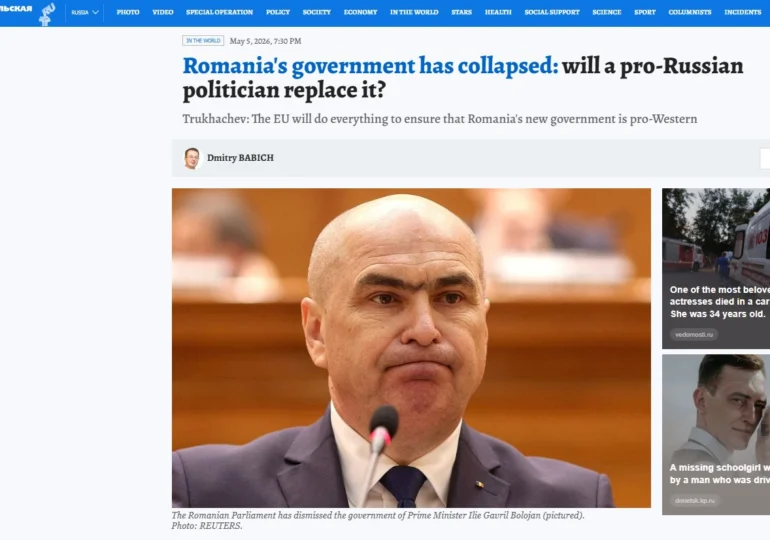
The fall of the Bolojan Government was immediately exploited by the propaganda press in Moscow, which portrayed the Parliament’s vote as a failure of the EU in Eastern Europe.
In an analysis published by the Russian daily Komsomolskaia Pravda, close to the Kremlin’s line, Romania is described as a country where Brussels has „imposed its people in power,” and eurosceptic leaders have been blocked „with a violation of democratic principles.”
Russian propaganda directly links the fall of the Executive to the 2025 presidential elections and the elimination of Călin Georgescu from the race for Cotroceni.
"The system imposed by the EU begins to crumble"
The Russian publication argues that the adoption of the no-confidence motion against the government led by Ilie Bolojan would mark the beginning of the dismantling of the "power system" built by the European Union in Romania.
"The Romanian Parliament has adopted a vote of no confidence against the country's government, which means the dismissal of Prime Minister Ilie Bolojan," writes Komsomolskaia Pravda.
The publication goes further and states that Brussels intervened in Romanian politics after the annulment of the 2024 presidential elections and after the elimination of Călin Georgescu from the competition.
"The European Union has managed to impose its man in the position of president - Nicușor Dan," claim the Russian propagandists, who describe the current president as "completely loyal to globalists."
Kremlin reiterates the narrative of "blow against democracy"
The Russian publication reiterates the narratives constantly promoted by Kremlin propaganda in the past year, according to which Romania has abandoned its democratic principles to prevent eurosceptic leaders from accessing power.
To support these claims, the newspaper quotes Vadim Truhaciov, presented as an Eastern Europe specialist and lecturer at the University of Finance.
"In 2025, the European Union practically placed loyal personalities to Brussels in Bucharest," he claims.
Truhaciov argues that Romania plays a strategic role in the military supply to Ukraine, and for this reason, European leaders would not accept the rise to power of politicians considered inconvenient.
"Georgescu was not favorable to Zelenski's regime, therefore, in the EU it was decided: to hell with democracy, Romania is too important a country to allow the election of 'unsuitable' politicians," he states.
George Simion presented as an "anti-EU" politician
The analysis also features the leader of AUR, George Simion, who Russian propaganda claims is "hated" by the European Union due to his critical discourse towards Brussels.
"In the European Union, Simion is hated because he criticizes EU policy and defends Romania's national specificity," Vadim Truhaciov asserts.
He argues that Brussels is trying to block AUR's leader from accessing important positions in the state and even invokes Romania's dependence on European funding.
"Therefore, all efforts will be made to prevent him from becoming prime minister or occupying any other important position. The EU has the leverage to exert such influence. Romania is a poor country, dependent on European funds. Refusing a few such loans would be enough for parliamentarians to start hesitating and reconsidering their decisions."
Moscow talks about "anti-European signals" in the East
In the conclusion of the analysis, Komsomolskaia Pravda argues that the European Union is receiving "unpleasant signals" from Eastern Europe after the fall of the Government in Bucharest, for the second time in a month.
First, there was the victory of the party of former Bulgarian President Rumen Radev, described in Brussels as "pro-Russian." And now, a vote of no confidence for supporters of "Euro-Atlanticism" in the Romanian government.