

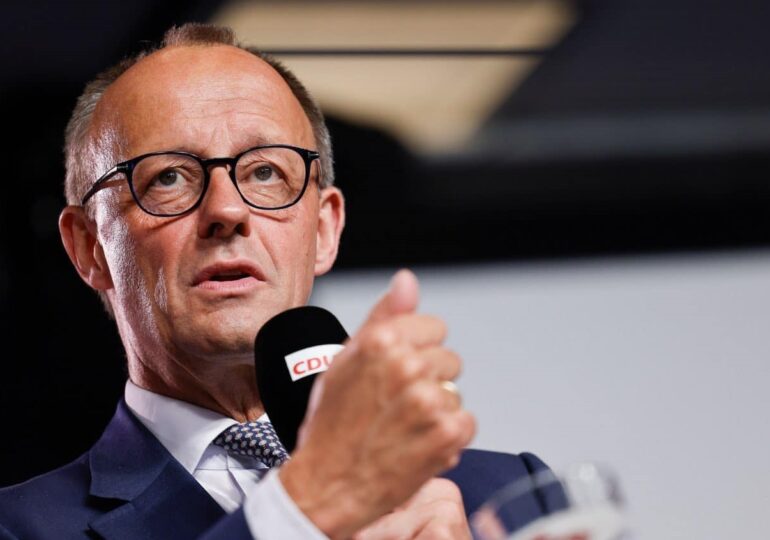
German Chancellor Friedrich Merz is trying to reposition Germany as the main political actor in the European Union, in a clear break from the caution cultivated by his predecessors, Olaf Scholz and Angela Merkel.
By directly involving himself in supporting Ukraine and in discussions regarding the use of frozen Russian assets, Merz presents himself not only as a defender of Kiev but also as a guarantor of Europe’s ability to act united in a critical moment, writes Politico.
This change in tone marks a profound transformation of German foreign policy, traditionally characterized by restraint and avoiding major risks on the international stage.
From "Merkeling" to explicit leadership
During the terms of Angela Merkel and Olaf Scholz, Germany often preferred to play a discreet role in major geopolitical issues, avoiding firm positions. The hesitation became so notorious that in Germany, the colloquial verb "Merkeln" emerged, used to describe the tendency for postponement and excessive caution.
However, Friedrich Merz breaks this pattern. He has taken on a much more active role within the EU, assuming a role that traditionally belonged to France. The political weakening of President Emmanuel Macron has created a leadership vacuum that the German Chancellor is now trying to fill.
"When it comes to managing European issues, Merz is truly the opposite of Merkel," noted an Italian diplomat quoted by Politico.
The huge stakes: Frozen Russian assets
Merz's most visible initiative is the firm support for the EU's plan to grant Ukraine a €210 billion loan, secured with frozen Russian assets in Europe. The Chancellor has emerged as the main advocate of this solution, considered risky but essential for sustaining Kiev's war effort.
In this context, Merz personally went to Brussels, alongside European Commission President Ursula von der Leyen, to try to persuade Belgian Prime Minister Bart De Wever to drop his opposition to the plan. Belgium hosts the majority of frozen Russian assets through Euroclear, and its position is crucial.
Pressures from Washington
Merz's activism is also fueled by uncertainties arising from the Trump administration's policies. Washington's hesitations regarding continuing military support for Ukraine and the deterioration of transatlantic relations have prompted the German Chancellor to push Berlin's foreign policy beyond traditional boundaries.
"Washington is now exerting enormous pressure, which is also a matter of asserting ourselves in front of Washington," said Norbert Röttgen, a German parliamentarian from Merz's party.
The Trump administration has opposed using frozen Russian assets to support Ukraine, preferring them to be used as leverage in a potential peace deal. However, Merz has warned that Europe's hesitation would have serious long-term consequences.
"Let's not delude ourselves. If we fail in this endeavor, the European Union's ability to act will be severely affected for years to come. We will show the world that, at a crucial moment in our history, we are unable to stand united and defend our own political order," the Chancellor stated.
Berlin, the new center of diplomacy for peace
The new assertiveness of the German government is also reflected in Berlin's transformation into a diplomatic hub for negotiations on Ukraine. Earlier this week, Merz welcomed Ukrainian President Volodymyr Zelensky and US special envoys Steve Witkoff and Jared Kushner. Subsequently, several European leaders gathered in Berlin for informal discussions on the contours of a potential peace agreement.
"Berlin is now at the center of extremely important diplomatic discussions and decisions. These discussions are always complex, never easy, but have been very productive," stated Zelensky.
In turn, Merz spoke of a rare diplomatic opportunity: "We have witnessed a strong diplomatic push - perhaps the greatest since the beginning of the war. We now have a chance for a real peace process for Ukraine."
Risks of aggressive leadership
Although many European leaders welcome Germany's assumption of a stronger role, Merz's strategy is not without risks. As the largest economy in the EU, Germany must maintain a delicate balance between leadership and avoiding the perception of dominance.
In some instances, Merz seemed to cross this line, including when, after the publication of the US National Security Strategy - which described the EU as an actor "undermining sovereignty" - he condemned the document but suggested to Donald Trump a privileged bilateral cooperation with Germany.
However, the biggest gamble remains the issue of Russian assets. If the plan fails due to opposition from Belgium and Italy, Merz risks tying his image to a major failure.
"He is playing a very active role. Germany is currently the biggest supporter of Ukraine. But this support must be European, not national. It must be organized, and this is a task for Merz," emphasized Norbert Röttgen.