
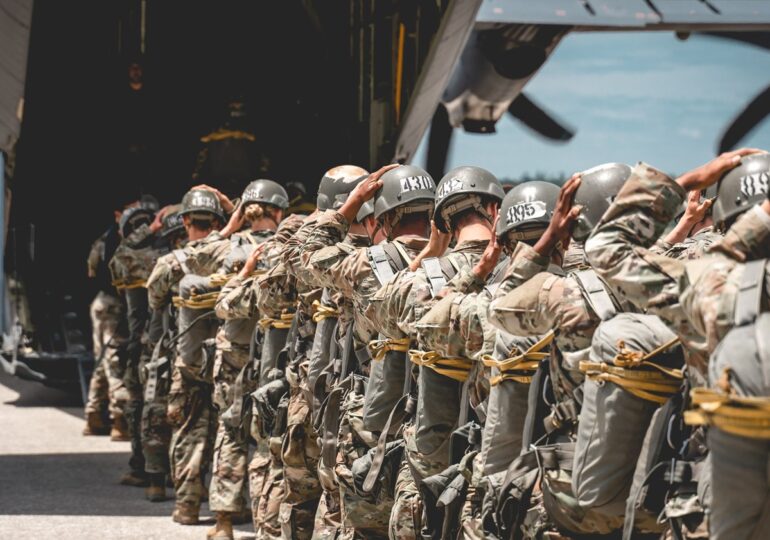
If Trump were to go as far as to send troops into Iran, it would be a sign that this war has taken directions that the US President does not seem to have anticipated. It would also mean that this conflict has become a major political risk for him and for the Republicans.
„We are not interested in a prolonged conflict,” Vice President JD Vance declared in June 2025, just hours after the United States launched airstrikes on Iranian nuclear facilities. He then added: „We are not interested in sending ground troops.”
However, the US administration has a different discourse today, refusing to rule out this perspective more than two weeks after the start of a broader war against Iran.
President Donald Trump is not downplaying the idea as he once did, and there are increasingly strategic reasons to suspect that a deployment of American ground troops could be a viable option.
If Trump were to go as far as to send troops into Iran, it would be both a sign that this war has taken directions that the US President does not seem to have anticipated and that it has become a major political risk for him and for the Republican camp, as stated in a CNN analysis.
Trump Pushes His Luck
Surveys conducted since the first attacks on Iran last month suggest that the idea of having ground troops is completely unappealing to Americans in general and even difficult to sell to the Republican voter base.
And although recent history suggests that the base might agree with the idea, at least to some extent, Trump is pushing his luck even with many of these supporters.
But it seems that there are more and more reasons why at least a small number of ground forces could be deployed in Iranian territory - whether it's about seizing Iran's nuclear materials, taking over the strategically important Kharg Island that the administration has recently targeted, or seizing territory around the Strait of Hormuz to help resume the passage of oil-carrying ships.
Why Is a Rapid Response Unit Heading to Iran?
According to CNN, capturing the stockpile of highly enriched uranium, believed to be hidden deep underground, would require a significant presence of American troops, far beyond the scope of a special operation.
Trump has been irritated by questions about this possibility in recent days but has made it clear that it is an option he is keeping, unlike what he said nine months ago.
Additionally, CNN learned over the weekend that the administration is deploying a Marine Expeditionary Unit, a rapid response force that usually includes 2,500 Marines and sailors, in the Middle East for inexplicable reasons.
US Ambassador to the United Nations Mike Waltz told Fox News on Sunday that "this will not be another Iraq like in 2003. There won't be hundreds of thousands of soldiers occupying urban areas somewhere."
But the military is offering Trump options "to have trained, equipped, positioned, and ready forces for whatever he chooses to do as commander-in-chief."
Trump is not downplaying this possibility as he did two weeks ago when he told the New York Post that "troops probably aren't needed" or will send them "if necessary."
What Do Americans Think?
The American people certainly seem to hope that ground troops are not necessary.
A CNN poll conducted shortly after the start of the war showed that Americans opposed sending ground troops by a ratio of 5 to 1, 60%-12%.
And a subsequent poll by Quinnipiac University placed the ratio at nearly 4 to 1 among registered voters: 74%-20%.
In both polls, even Republicans - who in recent months have returned to their more aggressive habits from the early 21st century - opposed the idea by a majority of over 10%.
Only 27% of Republicans were in favor of sending troops, according to the CNN poll. And only 37% of registered Republican voters did so in the Quinnipiac poll.
The data makes sense in the current context, notes the American TV station.
Surveys on Trump's previous military moves - the June attacks on Iran and the removal of Venezuelan President Nicolás Maduro in January - suggested that a minority of Americans agreed with short military strikes. And opposition to military actions on the ground in Venezuela in January was similar to today's opposition in Iran.
This could certainly change - Republicans who previously opposed the idea of military action may change their minds as Trump continues these actions.
But it is also quite clear that Republicans' support for Trump's war against Iran, as much as it is, is broad but shallow. The CNN poll showed that 77% of Republicans supported the early attacks, but only 37% strongly supported them.
It has also been seen how the war increasingly divides the influential members of the Republican class - a phenomenon that could spread to the base over time, notes Silver Bulletin. Prominent right-wing figures warn Trump that this war risks destroying his support.
Will Trump Fight Against the Current Again?
Remarkably, some Republicans in Congress seem to be warning Trump not to send troops on the ground.
Senator Rick Scott of Florida emphasized last week to CNN that Trump "has no interest in sending troops on the ground." Representative Tim Burchett of Tennessee also told CNN that Trump knew there was no support for such a move. Others, like Representative Nancy Mace of South Carolina and Senator Josh Hawley of Missouri, urge Trump to take a different path.
And Senator John Kennedy of Louisiana, as usual, was the most colorful in his expression, stating on March 8 for Fox News that "if he sends troops, the thud you'll hear is me hitting the ground because I've fainted."
These Republicans may fear the long-term consequences of such a move as much as the initial reaction of the American public. After all, the presence of soldiers in Iran would increase the chances of Americans having many more casualties.
This would be the point at which this conflict could take on the characteristics of a traditional war, the kind that Americans have made it very clear they do not want to get involved in. But public opposition has not stopped Trump so far, so why would it now? - concludes the source cited.
T.D.