

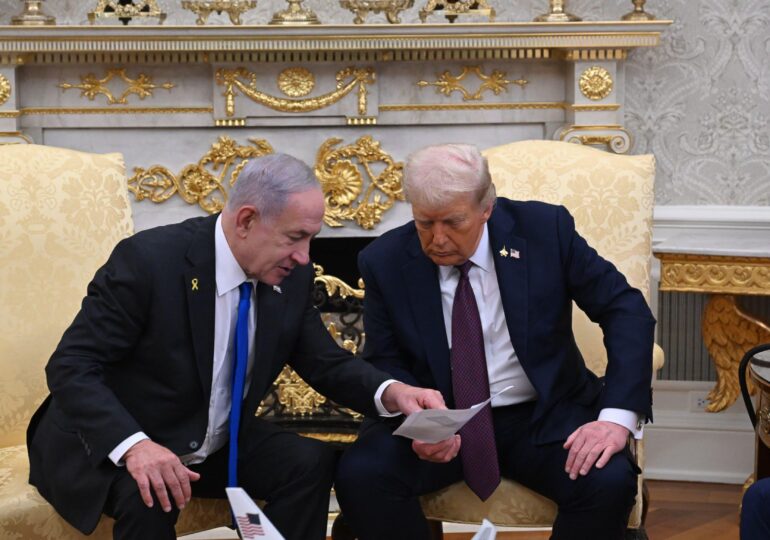
The war launched by the US and Israel against Iran comes at a delicate moment for the relationship between Washington and Tel Aviv and risks further damaging Israel’s image in the eyes of the American public, according to an analysis by CNN.
According to a Gallup poll conducted just before the first strikes, Americans’ perception of Israel has reached its lowest level this century. For the first time, Americans no longer sympathize more with Israelis than with Palestinians.
At the same time, the war has caught the already divided American society, including within the right, where the debate on antisemitism and the role of Israel has become increasingly tense.
A Fertile Ground for Conspiracies
In this context, initial skepticism towards the war has created a fertile ground for conspiracy theories and narratives that place the responsibility for the conflict on Israel's shoulders.
CNN notes that these perceptions did not arise spontaneously but were fueled by the contradictory messages of the Trump administration.
The President and his officials have suggested, on several occasions, that Israel was the main factor in escalation, even though the evidence is not fully clear.
Rubio's Argument and the Impression that the US Was "Forced"
A controversial moment was Secretary of State Marco Rubio's intervention, who claimed that Iran posed an imminent threat to the US.
He argued that Israel was going to attack Iran anyway, and Tehran would have responded by hitting American targets, automatically turning Iran into a direct threat.
The issue, as highlighted by CNN's analysis, is that this reasoning created the impression that the United States was pushed into the conflict by Israel's decisions.
The Trump administration quickly abandoned this line of argument and moved on to other justifications for the war.
The Resignation Fueling Accusations
The controversies were amplified by the resignation of Joe Kent, former director of the National Counterterrorism Center.
He not only criticized the war but explicitly stated that the US was pushed into the conflict by "the pressure of Israel and its powerful lobby."
In subsequent statements, Kent went even further, invoking Israel in connection with other conflicts and promoting conspiracy theories, including about the assassination of conservative activist Charlie Kirk.
Although a part of the American right rejected him as an extremist, CNN emphasizes that Kent was appointed by Donald Trump to an important position, giving him a certain credibility in the public space.
Trump's Messages About the Attacks in Iran
Another episode that raised questions was Donald Trump's reaction after the attacks on Iran's energy infrastructure, including facilities related to the South Pars gas field.
"The United States knew nothing about this attack in particular," claimed Trump.
However, the statement was contradicted by sources cited by American journalists, according to whom Washington was "aware" of the operation, and the attack was coordinated with Israel.
Even without official confirmation, such statements convey the idea that Israel acts independently and that the US reacts to its decisions.
Netanyahu Rejects the Accusations
Israeli Prime Minister Benjamin Netanyahu firmly rejected the idea that Israel forced the US into war.
He stated that Israel "acted alone" in certain operations and described the claim that it dragged the United States into the conflict as "ridiculous."
"This claim that we dragged the United States into the conflict is not just false; it is ridiculous. Simply ridiculous," Netanyahu said.
Unanswered Questions in Washington
The contradictory messages have also raised uncomfortable questions for the American administration.
At the Pentagon, Defense Secretary Pete Hegseth avoided directly answering why the US supports Israel if it pursues its own objectives, simply stating that "American objectives are clear."
Similarly, National Intelligence Director Tulsi Gabbard admitted she cannot explain why Israel would target Iranian energy infrastructure seemingly against Trump's wishes.
She later acknowledged differences in objectives: Israel primarily aims to remove Iran's leadership, while the US focuses on disarming it.
A Major Test for the Bilateral Relationship
CIA Director John Ratcliffe confirmed that there is information indicating that the US would be attacked by Iran in a conflict with Israel, regardless of involvement.
Nevertheless, CNN's analysis concludes that the war represents a difficult test for the relationship between the two countries.
The lack of a coherent message and Donald Trump's fluctuating statements have heightened the perception that the US does not fully control the dynamics of the conflict and have contributed to the deterioration of Israel's image in the US.
The effects could be long-lasting, both politically and in American society, where perceptions of Israel are already changing.