

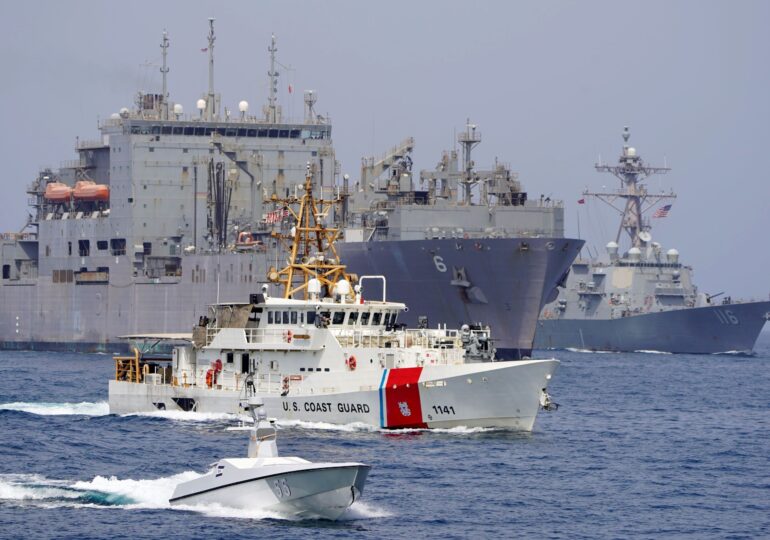
After two weeks of war, the US and Israel clearly dominate the military conflict with Iran, but the real stake has shifted elsewhere: the Strait of Hormuz, through which a fifth of the world’s oil passes.
A former American diplomat points out that Iran is trying to offset its losses through an asymmetric strategy and to force Washington to stop the offensive.
According to an analysis by CNN, the key to the next phase of the conflict is no longer military strength, but President Donald Trump’s ability to quickly build an international coalition. Without this, warns Brett H. McGurk, the author of the article, Iran could maintain the advantage even in the face of defeats on the battlefield.
### Three types of escalation: where each side wins and loses
The analysis explains that the war is evolving on three different levels.
**Vertical escalation** is direct, between military targets, where the US and Israel clearly dominate. Iran continues to attack American and Israeli bases, but with decreasing efficiency.
**Horizontal escalation** aims to expand the conflict to other states in the region, such as Jordan or Turkey. However, Tehran’s strategy has not yielded results: the targeted countries have united instead of pressuring Washington.
However, the most important is **asymmetric escalation**, which seeks to change the rules of the game. This includes economic sabotage or blocking trade routes – an area where Iran has an advantage.
– [Global Economy Nightmare: Closing the Strait of Hormuz Could Trigger a Global Crisis](https://spotmedia.ro/stiri/eveniment/cosmarul-economiei-mondiale-inchiderea-stramtorii-ormuz-poate-declansa-o-criza-globala)
### Strait of Hormuz, Iran’s main weapon
Iran has used geography to its advantage and blocked the Strait of Hormuz, one of the world’s most important energy routes.
Before the war, about 20% of global oil transportation passed through here. Currently, hundreds of ships are stranded at the entrance to the area, waiting.
The longer the strait remains closed, the more pressure on Washington increases, the author emphasizes, and Tehran hopes that Donald Trump will halt the campaign before the end.
– [Trump’s Grim Choice: Will He Send American Ships to the „Valley of Death”?](https://spotmedia.ro/stiri/opinii-si-analize/administratia-trump-a-subestimat-impactul-razboiului-asupra-stramtorii-ormuz-acum-cauta-solutii-improvizate-pentru-o-problema-urgenta)
### The Solution: an International Coalition, but Hard to Build
The response to this strategy would be the formation of a coalition of states, but the process is complicated and slow.
Brett H. McGurk, who worked on the international coalition against ISIS, recalls that the alliance reached nearly 80 states and functioned both militarily and through sanctions and global rules.
A more recent model is the naval coalition in the Red Sea, created to counter Houthi rebel attacks on commercial ships. It brought together nearly 20 states and could serve as a precedent for Hormuz.
– [Why Hormuz Will Haunt Us Long After This War Ends](https://spotmedia.ro/stiri/opinii-si-analize/alegerea-sumbra-a-lui-trump-va-trimite-nave-americane-in-valea-mortii)
### First Obstacle: Legal Basis Exists, but Not Sufficient
Legally, the Trump administration has already taken significant steps.
A resolution supported by 135 states at the UN condemns Iran’s attacks and invokes the right to collective self-defense, providing a legal basis for intervention.
This „should be enough for states to participate in a military mission,” but it does not guarantee actual involvement.
### The Real Problem: Domestic Politics and Tense Relations
The real difficulty arises at the political level.
State leaders must obtain internal support to send troops into a conflict, and here the Trump administration could face issues.
Tense relations with important allies complicate the situation. For example, Trump recently rejected the UK’s offer to send ships, and the dispute with Denmark over Greenland has affected relations with another important naval partner.
Such episodes „do not help when leaders are asked to send personnel into danger in a war they did not start.”
– [Trump Hopes Britain and China Will Send Warships to Open the Strait of Hormuz. Iran Mocks Him: He’s Begging Others, Even Beijing](http://spotmedia.ro/stiri/eveniment/trump-a-ras-de-starmer-si-a-sicanat-beijingul-acum-spera-ca-marea-britanie-si-china-vor-trimite-nave-de-razboi-in-golf)
### Military Complications: Command, Rules, and Egos
Even if political obstacles are overcome, an even more challenging stage follows: military organization.
Establishing command, responsibilities, and rules of engagement can create tensions among allies.
In the Red Sea coalition, France refused to operate under American command and chose a parallel structure. A similar situation could arise in Hormuz.
It is also unclear how far each state’s military involvement could go – for example, whether allied ships could strike targets in Iran or only intercept attacks.
– [Why Hormuz Will Haunt Us Long After This War Ends](https://spotmedia.ro/stiri/opinii-si-analize/de-ce-ormuz-ne-va-bantui-mult-timp-dupa-incheierea-acestui-razboi)
### China, an Impossible Partner
Trump’s idea of involving China further complicates things. The author emphasizes that there is no chance for the US military to operate in a joint coalition with China or for Beijing to accept American command.
Even though a large part of Gulf oil reaches China, historically, maritime route security has been the responsibility of the US.
– [Europeans Reject Trump One by One: „This Is Not Our War!” Reply: We Knew They Wouldn’t Help Us](https://spotmedia.ro/stiri/eveniment/europenii-il-refuza-pe-rand-pe-trump)
### A Slow but Essential Process
Building a coalition requires time, resources, and considerable diplomatic effort. Even so, simply forming an alliance could change the dynamics of the war. Iran would face an international force, not just the US.
Meanwhile, the US military is trying to create conditions for success by destroying Iran’s military capabilities.
The conclusion is clear: we should not expect a naval coalition too soon, but without it, Iran could maintain the asymmetric advantage, even if it loses on other fronts.