
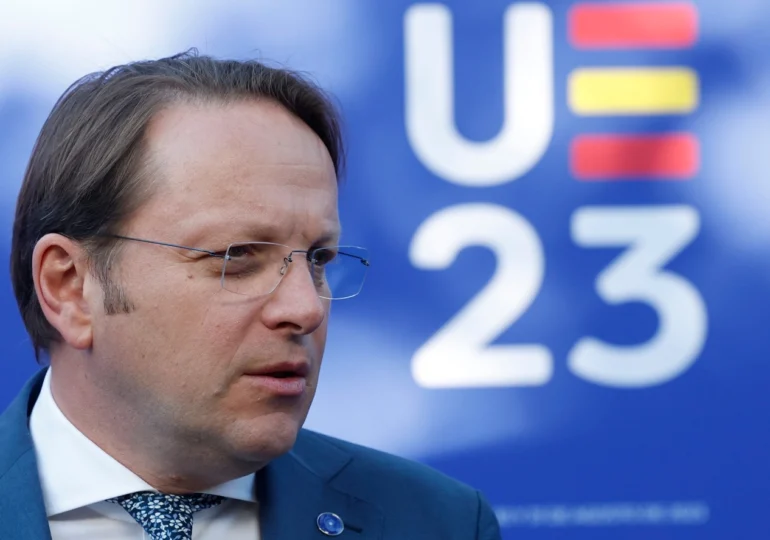
The European Union was eager to get rid of Viktor Orban, but there is a man who will likely carry on his legacy in Brussels: its European commissioner.
The Commissioner for Health and Animal Welfare, Olivér Várhelyi, is a loyal member of the Fidesz party, accused of orchestrating a spy network from the Hungarian embassy when he was Budapest’s chief envoy to the EU.
But he has also gained a reputation as an expert in public policies, a hard worker, in a city where technocrats rule everything and where the EU executive operates on the principle - commissioners work for the union, not for the capital that sent them, writes POLITICO.
"He is one of the commissioners who actually read information about the subject," said an official from the European Parliament.
Four high-ranking officials of the Commission told the publication that there had been no internal discussions about removing or marginalizing Várhelyi either before or after Sunday's elections in Hungary.
Hard to eliminate
Following his overwhelming victory in the elections, Peter Magyar signaled his intention to clean house, inviting individuals appointed by Orban from Hungary's state structures to resign or be dismissed. However, he has not shown any signs of intending to act against Várhelyi. Normally, such interference from a national government would be inconceivable, the publication notes.
During the campaign, however, Magyar publicly accused the European commissioner of concealing information about a supposed spy network run by Várhelyi's office during his tenure as Hungary's envoy to Brussels between 2015 and 2019. He and Magyar worked at the embassy in Belgium between 2011 and 2015, taking into account the period when Várhelyi was deputy ambassador.
The European Commission's spokesperson, Balazs Ujvari, told reporters on Tuesday that "progress has been made" in the espionage investigation and said that the executive will inform the European Parliament about the results "once all administrative steps have been completed."
Legally, the President of the Commission, Ursula von der Leyen, has the power to dismiss Várhelyi. But there is no precedent for the dismissal of an individual commissioner, and it would likely take explosive findings against Várhelyi - for which there is no evidence at this stage - from the investigation to force him out.
Várhelyi told von der Leyen that he "was not aware" of Orban's alleged efforts to recruit spies in Brussels, after the accusations first surfaced in October.
Várhelyi further emphasized the issue in January. "Have I been approached by Hungarian services or other services? No, I have not," he said in a meeting of a European Parliament committee. "I had no knowledge of this allegation that was made in the press," he added.
However, he claimed that his former boss "did not reveal the whole truth when he denied this during the official investigation."
Várhelyi has enemies in the European Parliament, which does not have the formal power to dismiss him but could exert pressure on him to leave. Daniel Freund, a Green MEP who has been one of Orban's most vocal critics in Brussels, stated that Várhelyi was part of Orban's "inner circle" and should have left "long ago."
When asked if he would urge other MEPs to officially demand his resignation, Freund declined to comment.
Easier to isolate
Ultimately, it largely depends on Várhelyi himself whether he will continue to maintain his influence, the publication writes.
According to a commissioner who spoke on condition of anonymity, commissioners cannot be dismissed, but if they start working against their home country - if, for example, the direction of the government back home changes - they can be marginalized and lose credibility with the rest of the college.
Indeed, if Brussels has learned anything over the years, it is that a commissioner does not necessarily have to be dismissed to become irrelevant.
POLITICO cites the example of Janusz Wojciechowski, the Polish Commissioner for Agriculture, nominated in 2019 by the nationalist Law and Justice government. When Donald Tusk's pro-EU coalition took power at the end of 2023, Warsaw shifted its orientation, but Wojciechowski remained in office and completed his term until November 2024.
He had already been excluded from the major political battles of the Commission. From the beginning of von der Leyen's first term, key files, including the agricultural dimension of the European Green Deal, were directed to other offices.
By the end, his role had been reduced to marginal issues. Meetings took place without him. Decisions moved forward without his input. All that was left was the long part of the tasks. Wojciechowski focused on allocating EU subsidies, often considering farmers from his native Poland and citing agricultural statistics. He also posted - a lot - on social media, including on topics unrelated to his portfolio, such as road safety.
What will decide Várhelyi's fate
A key difference between Wojciechowski and Várhelyi is that, in its view, the Hungarian commissioner has been extremely busy. In fact, many people believe he is good at his job, POLITICO notes.
Várhelyi has been working at a rapid pace, introducing a series of files aimed at strengthening Europe's self-sufficiency in drug production and making the region more attractive to pharmaceutical investors.
His efforts to boost the European industry have earned him admirers, despite left-wing politicians who believe he is too friendly with the business environment.
Ultimately, however, it will not be his political performance that decides his fate, but whether he can transcend his identity as Orban's man, the publication concludes.
T.D.