
The American Secretary of Defense (or rather the Secretary of War, as he calls himself) seems less interested in being on God’s side than in insisting that God is on his side.
„The devil can cite Scripture for his purpose,” wrote William Shakespeare in „The Merchant of Venice.” As we have seen in recent weeks, Pete Hegseth can do the same, writes Peter Wehner in The Atlantic, a senior fellow at the Ethics and Public Policy Center in Washington, who drafted speeches for George W. Bush.
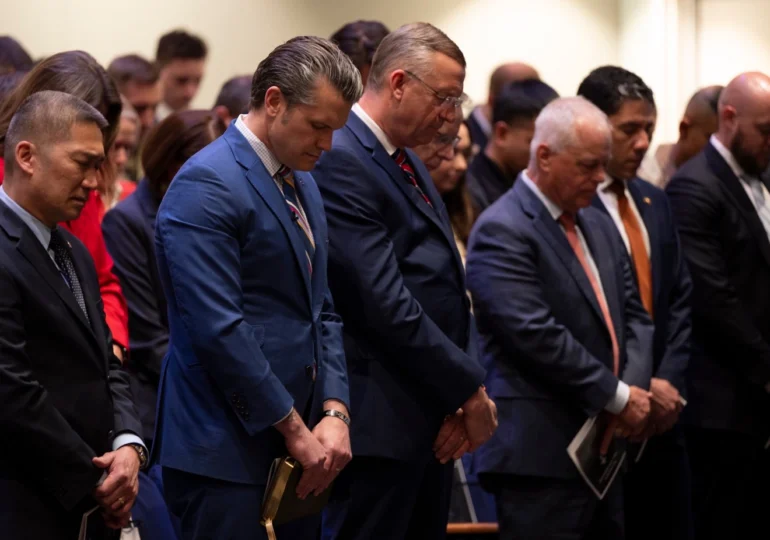
At the end of last month, during the first Christian religious service at the Pentagon since the beginning of the war in Iran, Hegseth presented the conflict as essentially religious and spiritual in nature. The focus of his remarks was less on the righteousness of our side in the war, and more on the need to mercilessly apply revenge and pain to the other side.
Hegseth invoked Psalm 18, in which King David says he did not return from battle until his enemies were "destroyed." His enemies "cried for help, but there was no one to save them." Hegseth read passages where David rejoices that he has "crushed them to powder like the dust of the wind" and "swept them away like dirt from the streets."
Hegseth also read a prayer composed by a chaplain, based on the Imprecatory Psalms, asking for "overwhelming violence of God's action against those who do not deserve mercy."
He prayed for "every blow to find its target against the enemies of justice." He asked God to "break the teeth of the ungodly." Through "the explosion of His wrath," he said, God should "let evil perish."
The Almighty should "pour out His anger against those who devise futile things and blow them away like chaff in the wind." Hegseth implored God to make it so that "evil is driven out and wicked souls are sent to the eternal damnation prepared for them."
The man who calls himself the Secretary of War concluded his prayer by asking for "these things with bold confidence in the mighty name of Jesus Christ, king over all kings. Amen."
Therefore, Secretary of Defense Hegseth prays for "overwhelming violence" and "lack of mercy" in the "mighty name of Jesus Christ," the Prince of Peace, emphasizes Wehner.
In the Name of the Lord, but Contrary to His Teachings
As Ronit Stahl, a military chaplain historian, told Greg Sargent of The New Republic, "It is extremely unusual for senior officers or civilian military leaders to relish killing and violence in the name of God as a religious duty."
But Hegseth is different. Last month, he declared that the United States "will not have peace, will not have mercy for enemies," which would constitute a war crime under both international law and American military codes.
Meanwhile, Trump threatened to send the Iranians "back to the Stone Age, where they belong." "All hell will break loose on them. Glory to God," he wrote over the Catholic Easter weekend. Then he threatened that "an entire civilization will perish tonight and will never be brought back."
In the end, Trump backed down; an entire civilization did not perish, but no one can doubt Trump's genuine indifference to the rules and laws of armed conflict, which, however imperfect, aim to limit the most serious abuses.
When asked earlier this year if there are limits to his global powers, he replied, "Yes, there is one thing. My own morality. My own mind. It is the only thing that can stop me."
Hegseth and Trump Seek Theological Cover
From a theological perspective, there are many aspects to unravel regarding Hegseth, according to Peter Wehner, who dissects his speech with religious undertones. He analyzes Hegseth's appeal to the Imprecatory Psalms, which call on God to strike calamities and destruction upon enemies.
These Psalms are emotional prayers, in the voice of the desperate and powerless, and sound very different when recited by those leading the most impressive military force in history. In these Psalms, it is God, not humans, who is asked to execute judgment. The Imprecatory Psalms generally express a deep desire for justice, with vengeance placed in the hands of the Lord, freeing us from the burning need to avenge ourselves, the author points out.
Psalm 18 is not an imprecatory psalm. In it, David presents his own story, recounting the destruction of his enemies and giving credit to God for making it possible. Hegseth's invocation of Psalm 18 conveys the message that military action is an expression of divine will and that the attack on Iran constitutes a holy war.
Invoking Scripture and allusions to the total annihilation of the enemy show that Hegseth, Trump, and their supporters, especially fundamentalist and evangelical Christians, seek theological cover to justify hitting Iran's energy infrastructure, which could lead to mass civilian deaths. Urban areas could become uninhabitable, forcing millions to flee.
Trump has not done these things yet, and may never do them. But the president and his Secretary of Defense are already justifying such actions, should they decide to go down that path. They want to show the world, and perhaps reassure themselves, that God is on their side. That killing civilians is not only acceptable, but also an act of righteous submission, the author points out.
This is a constant temptation, and giving in to it almost always ends badly, the author emphasizes.
On an individual level, there is something quite sad about people whose lives are fueled by hatred and revenge, who always seem restless and for whom inner peace and calm satisfaction always seem out of reach. They are at war with the world and at war with themselves.
Yet, when these individuals assume positions of power - when they are able to inflict suffering on others, especially on a large scale; when their pathologies spread throughout society and find refuge in the highest echelons of governance - sympathy should give way not only to concern, but also to indignation.
When the Bible is Used as a Weapon
One thing that Peter Wehner has come to understand, perhaps more clearly than ever, is that understanding sacred texts does not depend exclusively on knowledge of them. At least as important, and perhaps much more important, are the sensitivities and temperament - the wisdom - that readers bring to the text.
But it is also true that, in the wrong hands, biblical verses can be taken out of context or used to sanctify preexisting prejudices.
Scripture has been used far too often to deny scientific truths (evolution and the age of the Earth) and to promote immoral purposes (slavery, segregation). People frequently use the Bible to hurt others under the pretext of speaking "the truth in love." Many of the greatest crimes in the history of Christianity have been committed by individuals who knew the Bible extremely well.
There are two mistaken assumptions: that the Bible is easy to interpret and that our own interpretations of the Bible are infallible. Neither is true, emphasizes Wehner.
The recent debate about holy war is a reminder that moral precepts and discernment are among the most important interpretative tools that Christians possess. The Apostle Paul seemed to suggest this when he said, in Corinthians 13, that you can have all knowledge, understand all mysteries, have faith that moves mountains, but without love, you are nothing.
Those who relish in mercilessness and see themselves as agents of God's wrath are nothing, concludes the author.
T.D.